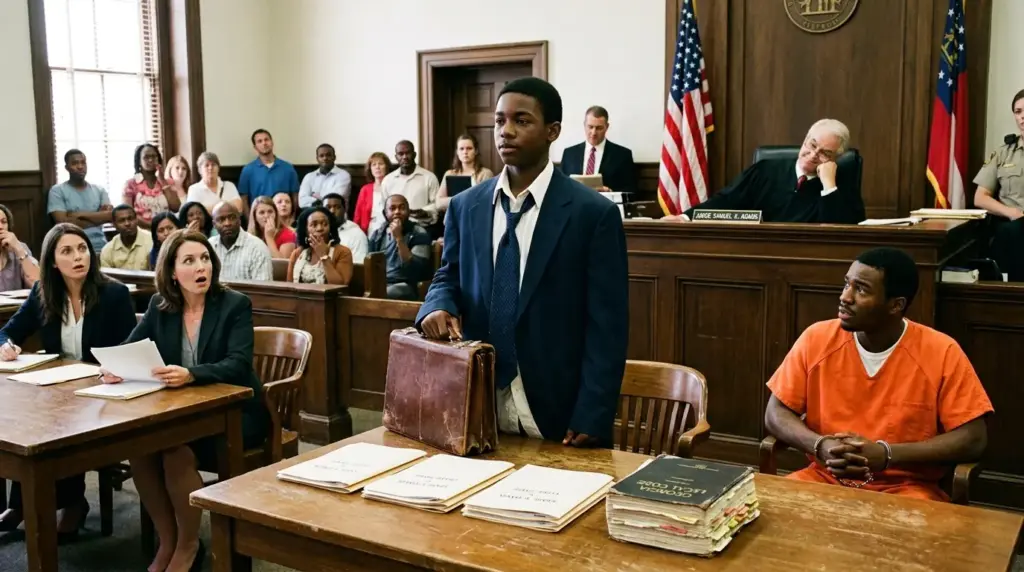
Their father had died six years earlier.
Their mother, Denise Carrington, worked long shifts as a home-care aide and had little money for legal fees.
The family’s savings were quickly consumed by court expenses and the cost of securing Isaiah’s initial legal advice.
When their attorney withdrew because of a scheduling and payment dispute, Isaiah found himself facing a preliminary hearing without reliable representation.
That was when Elijah stepped forward.
He had been studying law independently for two years, reading statutes, examining court decisions, and watching public legal proceedings to understand how evidence was presented.
He had never claimed to be a lawyer.
He had never attended law school.
But he had learned to read carefully, ask precise questions, and distinguish what a document actually proved from what someone wanted it to prove.
Most importantly, he had read every page of his brother’s case file.
Twice.
And he had discovered several details that troubled him.
The security footage had a gap.
The warehouse alarm log contained a timestamp that contradicted the prosecution’s timeline.
And the witness who claimed to have seen Isaiah leave had changed his account between the initial interview and the formal statement.
Elijah believed those inconsistencies mattered.
He also knew that belief alone would not be enough.
He needed the court to examine the evidence.
And before he could do that, he needed to get past the judge who had already decided he was a joke.
A Judge’s First Test
Judge Tolbert turned to the prosecutor.
“Ms. Lindholm, your position?”
Andrea Lindholm stood.
“Your Honor, the defendant’s proposed arrangement is unusual. The paperwork may document his request, but a private appointment does not necessarily authorize a nonlawyer to act as counsel in a criminal proceeding.”
Elijah nodded slightly.
He had expected that objection.
Lindholm continued.
“The prosecution has no interest in preventing the defendant from exercising any rights the law provides. However, we do object to any suggestion that a seventeen-year-old may simply appear as licensed defense counsel.”
“That’s a reasonable distinction,” Elijah said.
Judge Tolbert looked sharply at him.
“I didn’t ask you to comment, young man.”
“My apologies, Your Honor.”
Tolbert examined the documents.
Then he turned toward Isaiah.
“Mr. Carrington, do you understand that your brother is not a licensed attorney?”
“Yes, Your Honor.”
“Do you understand that representing yourself can carry serious consequences?”
“Yes, sir.”
“And you still wish to proceed this way?”
Isaiah glanced at Elijah.
He could see the worry in his brother’s face, hidden beneath the calm expression.
“I want my case examined fairly,” Isaiah said. “My brother has studied the evidence more carefully than anyone else in my family. But I understand the court has to decide what he can legally do.”
The judge watched him for a long moment.
Then he addressed Elijah.
“I will not treat this as a game. You will not be permitted to disregard court procedure, and you will not be allowed to mislead this court about your qualifications.”
“I agree, Your Honor.”
“If you are allowed to speak, it will be within the limits I establish.”
“Understood.”
Tolbert looked toward the clerk.
After a brief consultation, he explained that Elijah could not be recognized as licensed counsel merely because Isaiah had named him in a document. Any assistance he provided would have to comply with applicable law and court procedure. The court would not allow the teenager to assume professional status he did not possess.
Elijah accepted the ruling without argument.
Then he asked one question.
“Your Honor, may I submit a written memorandum identifying the evidentiary issues and the statutory questions relevant to the preliminary hearing?”
The judge paused.
“You may submit a memorandum. The court will determine what weight, if any, it deserves.”
“Thank you, Your Honor.”
Judge Tolbert tapped his pen against the desk.
“And one more thing.”
Elijah looked up.
“If your memorandum contains nothing but internet quotations and dramatic language, I will know.”
Elijah opened the second folder.
“It contains citations to the relevant statutes, the evidence disclosed by the prosecution, and a list of specific discrepancies between the reports and the physical records.”
The judge held out his hand.
“Let’s see it.”
Elijah passed the document to the bailiff.
Tolbert began reading.
At first, he appeared impatient.
Then he turned a page.
Then another.
His eyebrows drew together.
He flipped back to the beginning.
The courtroom waited.
Finally, he looked up.
“Where did you obtain the alarm log?”
“It was included in the discovery materials provided to my brother.”
“And you compared it with the incident report?”
“Yes, Your Honor.”
“How many times?”
“Four.”
Someone in the gallery shifted in their seat.
Judge Tolbert looked back down.
For the first time that morning, nobody was laughing.
The First Crack in the Prosecution’s Story
The preliminary hearing began with Andrea Lindholm presenting the prosecution’s account.
She described the warehouse attack, the missing money, the security footage, and the employee who had identified Isaiah.
Her presentation was organized and confident.
To anyone hearing the case for the first time, it sounded convincing.
Isaiah had been present.
His fingerprints were at the scene.
A witness had placed him near the exit.
And a large amount of cash was missing.
Lindholm finished by arguing that the evidence justified allowing the case to proceed.
Judge Tolbert nodded.
“Thank you, Ms. Lindholm.”
Then he looked at the defense table.
“Mr. Carrington, your memorandum raises several questions. Which issue do you believe the court should examine first?”
Elijah rose.
He kept his hands at his sides.
“The timeline, Your Honor.”
“Explain.”
“The prosecution states that my brother left the warehouse at 10:18 p.m. It also states that the alarm was triggered at 10:21 p.m. However, the original alarm log records a system interruption at 10:12 p.m. and a restoration at 10:29 p.m.”
Lindholm stood.
“The interruption was a routine technical issue.”
Elijah turned toward her.
“That may be the explanation. But the prosecution’s report does not establish that the system was functioning normally during the period in question.”





