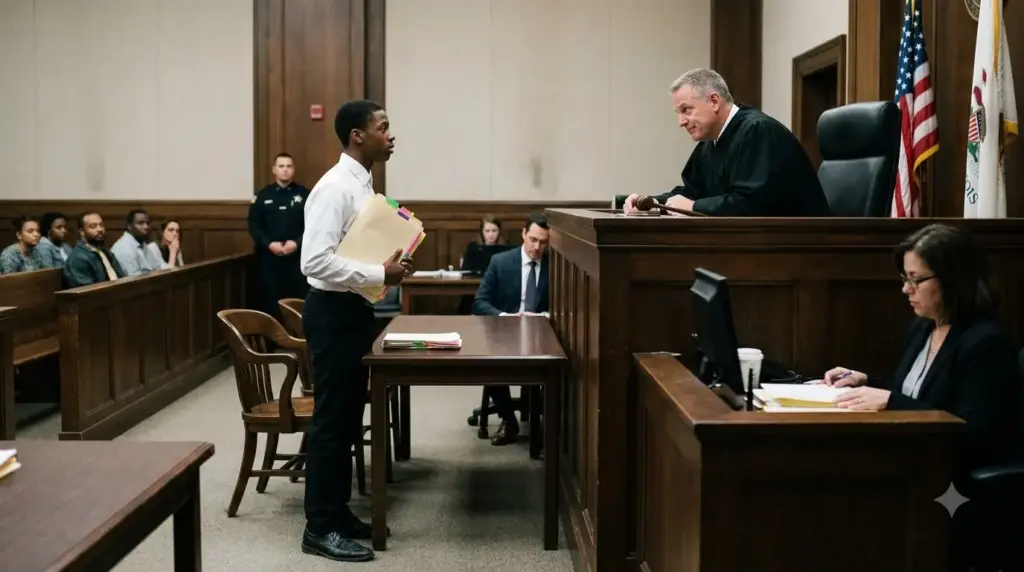
Internal Affairs began a full review of every case Caldwell had presided over in the previous decade.
Including the case of James Green.
Eight months later, at six o’clock on a cold February morning, Gloria, Darnell, and Isaiah stood outside the gates of Stateville Correctional Center.
Gloria held a small bouquet of flowers.
Her hands shook.
Not from the cold.
From anticipation.
Darnell had healed well.
The scars on his face had faded to thin lines.
He was working again, not at the warehouse, but as an EMT at Southside Community Hospital.
His record had been expunged.
His dream was alive again.
Isaiah stood slightly apart, unsure what to do with his hands.
In a few months, he would graduate high school.
His scholarship had been reinstated.
He had been accepted to the University of Chicago on a pre-law track.
But none of that mattered right now.
The gate buzzed.
Slowly, heavily, it swung open.
And James Green walked out.
He was forty-eight years old.
His hair had gone gray.
His face carried a decade of prison food, bad sleep, fluorescent lights, and stolen time.
He was thinner than Isaiah remembered, and he walked with a slight limp from a prison fight five years earlier.
But his eyes were the same.
Deep brown.
Warm.
Full of a love ten years of injustice had not extinguished.
Gloria ran to him first.
She threw herself into his arms and sobbed huge, racking sobs that came from the place where she had stored ten years of pain, fear, and hope.
“My boy,” she cried. “My baby boy. You’re home. You’re finally home.”
James held her tight, tears streaming down his face.
Darnell went next.
He wrapped his arms around his father, and for a long moment neither of them could speak.
Ten years of lost birthdays.
Lost holidays.
Lost everything.
“I’m proud of you, son,” James finally said. “You held this family together when I couldn’t.”
“I just did what you taught me, Dad.”
Then James looked at Isaiah.
The six-year-old who watched him get taken away was now taller, broader in the shoulders, with eyes carrying a weight no teenager should have had to carry.
“Isaiah.”
James’s voice cracked.
“You’ve grown so much.”
Isaiah could not speak.
His throat was too tight.
James walked toward him slowly.
Stopped in front of him.
Looked at him for a long time.
“You saved me,” James said. “You saved your brother. You took on a system that’s been destroying people like us for generations. And you beat it.”
He put both hands on Isaiah’s shoulders.
“Your mama used to say you were special. That God had plans for you. I didn’t understand what she meant back then.”
His voice broke.
“I understand now.”
Isaiah’s eyes burned.
“I’m sorry it took so long, Dad. I should have—”
James pulled him into a hug.
“Don’t you dare apologize. Don’t you ever apologize for being the bravest person I’ve ever known.”
Isaiah broke.
All the months of pressure, fear, loneliness, and carrying his family on his shoulders finally found release.
He cried in his father’s arms.
And for the first time in ten years, he felt safe.
They stood together outside the prison gates.
Four people.
One family.
Holding each other in the cold February morning.
Ten years of injustice finally made right.
Two years later, Isaiah was at the University of Chicago, studying political science on a pre-law track.
His professors said he had a gift.
Not just for understanding the law, but for seeing how it could be used as either a weapon or a shield.
Diana Russell started a nonprofit called Second Chance Legal Defense, offering free representation to people fighting wrongful convictions.
Isaiah worked there every summer and most weekends during the school year.
Darnell became a full paramedic at Southside Community Hospital, the same hospital where he had nearly died.
He was good at it.
The best, some said.
James returned to work as a mechanic.
He opened a small shop in the old neighborhood.
Nothing fancy.
Just honest work for honest pay.
Every night, he sat at the kitchen table while Isaiah studied, reading law books beside him.
“Just trying to understand what my son does,” he would say with a smile.
Gloria still went to church every Sunday.
Still prayed every night.
But now, when she spoke about her grandsons, her voice no longer carried the old fear.
It carried pride.
At a small community center on the South Side, twenty families sat in folding chairs.
Mothers who had lost sons to the system.
Fathers fighting to prove their innocence.
Siblings trying to save brothers and sisters.
Isaiah, now eighteen, stood at the front of the room.
“I know you’re scared,” he said. “I was scared too. Every day for almost a year, I woke up wondering if that would be the day they got to me.”
He looked at their tired, hopeful, desperate faces.
“They want us to believe the system can’t be changed. They want people without money, without power, without connections to believe we were born to lose.”
He shook his head.
“But I’m standing here to tell you that is a lie. We can fight. We can win. Not because we’re stronger than them. We’re not. But because we have something they can’t take away.”
He paused.
“The truth. And the courage to speak it.”
In the years that followed, Isaiah’s organization helped overturn twenty-three wrongful convictions.
Twenty-three people walked free.
Twenty-three families reunited.
Twenty-three stories rewritten.
He did not become famous.
There was no movie deal.
No best-selling memoir.
Just the work.
Day after day.
Case after case.
Because Isaiah understood something most people never learn.
Change does not usually happen in one dramatic courtroom moment.
It happens in the grind.
In thousands of hours reading documents, interviewing witnesses, filing motions, chasing records, fighting bureaucracy, and showing up even when no one is watching.
One person can make a difference.
Not by being a hero.





