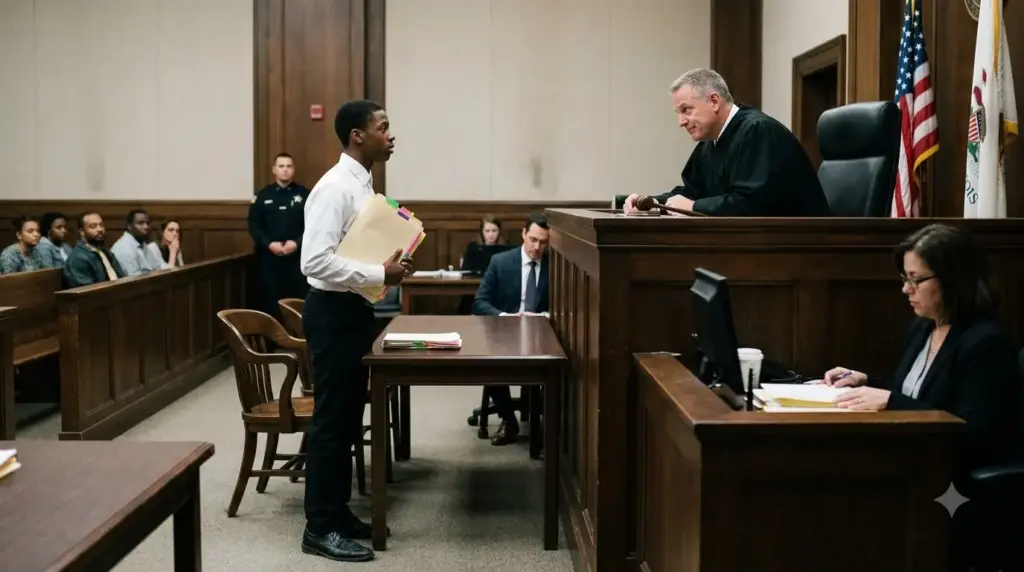
“You are not on the witness list.”
“Under Rule 6115, any witness with material information may be called to testify. I have material information.”
Terrence walked forward, past the prosecutor’s table, until he stood in front of Isaiah.
“I owe you an apology,” he said quietly. “And I owe you the truth.”
Then he faced the court.
“Eight months ago, I was present when Sergeant Derek Morrison falsely accused Darnell Green of assault. I witnessed the incident. There was no contact. Morrison fell on his own. I saw it with my own eyes.”
He swallowed.
“Two weeks ago, Sergeant Morrison ordered me to spy on Isaiah Green. To befriend him. To give him fabricated evidence. To report his family’s movements so they could be… discouraged.”
His voice cracked.
“I am the reason Darnell Green is in the hospital. I told them his schedule. His route home. What time he finished work. I didn’t think they would actually—”
He could not finish.
“I have done terrible things. I betrayed a sixteen-year-old kid who was only trying to save his brother. I did it because I was scared. Because I was weak. Because I cared more about my career than doing what was right.”
He held up the USB drive.
“But when I saw Darnell Green in that hospital bed, beaten half to death because of information I gave them, I couldn’t live with it anymore. I made a copy of the original recording. The real one. Unedited. Morrison talking about quotas, CoreCivic, protection from above.”
He handed the drive to the clerk.
“I am ready to face the consequences of what I did. But first, let the truth be heard.”
The courtroom erupted.
Caldwell banged his gavel.
Then the doors opened again.
A woman walked in.
She was in her fifties, elegant, wearing a designer suit that cost more than most people made in a month.
She carried a leather briefcase in one perfectly manicured hand.
Melissa Caldwell.
The judge’s wife.
Every head turned.
The noise died instantly.
“What are you doing here?” Caldwell asked, his voice barely audible.
Melissa walked forward.
Her heels clicked against the marble floor.
She did not look at her husband.
She looked at the seal of justice above the bench.
“My name is Melissa Caldwell,” she said, voice clear, “and I am here to testify against my husband.”
The silence was absolute.
“For twenty-five years, I have known what Richard does. I have watched him convict innocent people to fill CoreCivic facilities. I have counted the money that came in and pretended not to notice where it came from. I have looked the other way while he destroyed families. Hundreds of families.”
She opened her briefcase.
“I have financial records. Bank statements. Emails between Richard and CoreCivic executives. Twenty-five years of evidence I was too much of a coward to use.”
She handed a thick stack of folders to the clerk.
Then she turned to Isaiah.
“I watched this trial from my living room. I saw the news coverage. Today, I saw something that changed everything.”
Her voice softened.
“I saw a sixteen-year-old Black boy from the South Side walk into this courtroom alone. No money. No power. No connections. Just the truth and the courage to speak it. And I watched my husband mock him, humiliate him, and tell him to go home because he didn’t have the breeding to stand in his presence.”
Her eyes filled.
“If a child can be that brave, if a child can stand against everything my husband represents, then I have no more excuses. No more reasons to stay silent.”
She turned to Caldwell.
“Richard, you will ask me why. Why now? Why like this?”
She pointed at Isaiah.
“Because of him. Because he showed me what courage looks like. And because I refuse to be a coward for one more day.”
Caldwell shot to his feet.
“Melissa, you’ll destroy our family. Everything we built.”
“No, Richard,” she said, voice like ice. “You destroyed our family twenty-five years ago. I’m just finally telling the truth about it.”
The doors opened one last time.
Two men in suits entered, badges visible on their belts.
“Judge Richard Caldwell,” one said. “Internal Affairs. You are being placed on administrative leave pending investigation into corruption, bribery, and criminal conspiracy. Please come with us.”
Caldwell looked around the room.
At the reporters writing furiously.
At the crowd staring in disbelief.
At his wife.
At Terrence.
Finally, at Isaiah.
Isaiah met his gaze.
“Twenty-five years,” Isaiah said quietly. “That’s a long time to destroy innocent lives, Your Honor.”
Caldwell had no response.
They led him away.
The substitute judge reviewed the evidence for less than ten minutes.
“Based on the testimony and evidence presented, the conviction of Darnell Green is hereby vacated. The defendant is cleared of all charges.”
In the gallery, Gloria Green collapsed into tears, clutching her Bible to her chest.
Darnell, who had insisted on being wheeled into the courtroom despite his injuries, reached out for his brother.
Isaiah went to him and hugged him gently, careful of the broken ribs and fractured skull.
“You did it,” Darnell whispered. “You actually did it.”
Isaiah held his brother tight.
“We did it,” he said. “All of us.”
Three months later, Richard Caldwell was indicted on forty-six counts of corruption, bribery, and criminal conspiracy.
He was stripped of his judgeship.
His law license.
His freedom.
Bail was set at two million dollars.
He could not pay it.
Derek Morrison was fired from the Chicago Police Department and charged with evidence tampering, perjury, assault, and conspiracy to commit assault.
Twenty-three other cases he worked were reopened for review.
Terrence Williams was suspended from the force and faced departmental charges, but he cooperated fully with investigators and testified against Morrison.
At his hearing, he said, “I can’t undo what I did. But maybe I can help fix it.”
CoreCivic’s contract with the state of Illinois was suspended.
A federal investigation opened into their practices nationwide.





