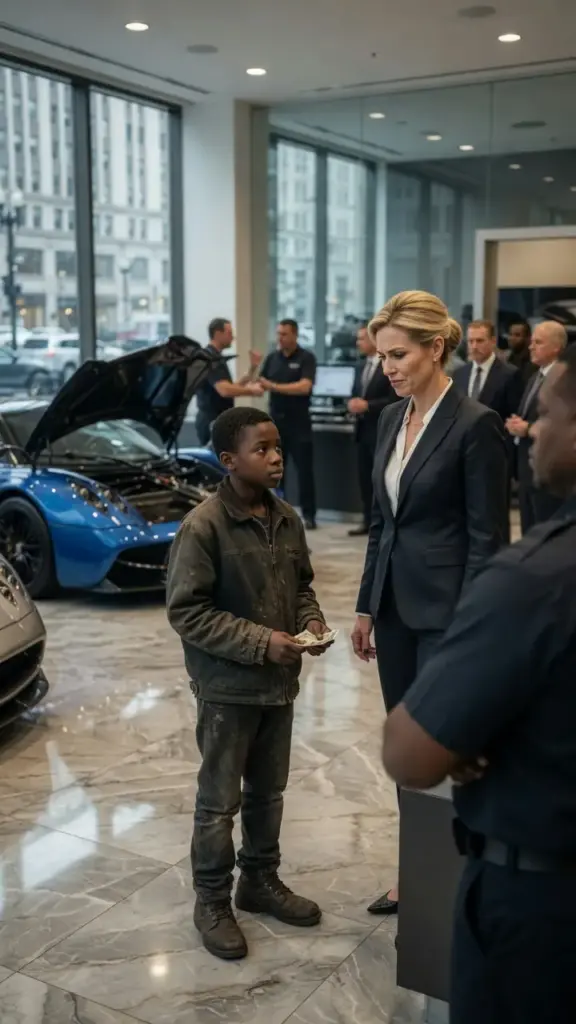
The look of someone who had just found something they had been searching for without knowing it. Dale lowered his phone. He had filmed the whole thing. And behind everyone, standing alone by her desk, Victoria Whitmore stared through the glass at the young man she had called trash. The young man she had tried to arrest.
The young man who had just done in 4 minutes what two factory engineering teams and $200,000 could not do in 3 weeks. Her face was blank. But her hands were shaking. Victoria didn’t clap. She didn’t congratulate.
She pushed through the service bay door and walked straight toward the Pagani like a prosecutor approaching the stand. Anyone can start an engine, she said. That doesn’t mean it’s fixed. I want a full road test. Every system, every mode.
If one single warning light comes on, I’m calling the police. She was grasping for anything now, any crack, any excuse to prove that the boy she had called trash was exactly what she said he was. Eleanor looked at Fletcher. Can you drive it? Yes, ma’am.
Victoria laughed, a sharp, ugly sound. He probably doesn’t even have a license. Fletcher pulled his wallet from his back pocket, took out his Illinois driver’s license, held it up without a word. Valid, clean, no points. Victoria’s mouth tightened.
She had nothing left to throw. The test track, she said to Chad, behind the building, full circuit. I want every system engaged. Whitmore Motors had a private test loop behind the dealership, a quarter-mile strip of smooth asphalt that Victoria used for client demonstrations. Today, it would be Fletcher Caine’s proving ground.
Chad drove the Pagani out of the service bay and positioned it at the start of the loop. Fletcher walked out behind him. The afternoon sun hit the ice-blue body and turned it into liquid light. The carbon fiber panels gleamed. The car looked like it was breathing.
Fletcher opened the driver’s door and sat down. The cockpit wrapped around him. Alcantara, carbon fiber, machined aluminum. Everything was hand-stitched. Everything was precise.
The steering wheel alone cost more than a year of his grandfather’s rent. He adjusted the mirrors, buckled in, placed his hands at 10 and 2. The crowd gathered at the edge of the track. Victoria stood at the front, arms crossed, lips pressed into a thin line. Eleanor stood beside her, calm as marble.
Dale held up his phone, still filming. Chad had the diagnostic tablet connected via wireless link, monitoring every parameter in real time. Fletcher pressed the start button. The V12 thundered to life. Clean, deep, no stutter.
The sound rolled across the parking lot like distant thunder. He selected sport mode. The hybrid system engaged. The e-motor hummed alongside the V12. Two power sources working in perfect harmony for the first time in over 3 weeks.
Fletcher released the brake. The Pagani surged forward. The acceleration was savage. 0 to 60 in 3 seconds flat. Fletcher felt the G-force push him into the seat.
The twin turbos spooled with a high-pitched scream. The hybrid motor added instant torque off the line. The car didn’t hesitate. It launched. He took the first corner at speed.
The suspension loaded perfectly. The tires bit into the asphalt. The steering was direct, sharp, alive. He could feel every grain of the pavement through the wheel. Halfway down the back straight, he switched to full electric mode.
The V12 went silent. The e-motor took over. Smooth, silent, seamless. No lag, no fault code, no warning light. Just clean, effortless power.
He switched back to hybrid. The V12 rejoined without a hiccup. The transition was so smooth it felt like the car was one single organism rather than two systems bolted together. Fletcher completed the circuit. He pulled the Pagani back to the start line, brought it to a gentle stop, and killed the engine.
The silence was enormous. Chad stared at the diagnostic tablet. His eyes were wide. His mouth hung open. Every parameter is green, he said, loud enough for everyone to hear.
Every single one. Zero fault codes, battery thermal nominal. Hybrid sync nominal. ECU communication nominal. Transmission response nominal.
He looked up from the screen. This car is running better than the day it left the factory. Todd let out a breath he didn’t know he had been holding. Better than factory spec? How is that possible? The firmware patch, Chad said quietly.
The community patch he loaded. It optimized the idle calibration and the hybrid transition mapping. Pagani’s own software didn’t have it. The crowd broke into applause, real applause, not polite, not cautious, the kind of clapping that starts in the gut and works its way out before you can stop it. The receptionist was clapping.
The salesman was clapping. Even the woman with the pearl necklace, the same woman who had shaken her head at Fletcher an hour ago, was clapping. Fletcher stepped out of the Pagani. He closed the door gently, the way you close something that deserves respect. He looked down at his hands, the same hands that Victoria Whitmore had wanted removed from her showroom.
Oil under the nails, a small cut on the left thumb from the sensor connector, grease in the creases of his palms. Those hands had just brought a $2.4 million machine back from the dead. He looked across the parking lot at Victoria. She was standing perfectly still. Her arms had dropped to her sides.
Her face was blank, not angry, not humiliated, just empty. The face of a woman watching the foundation of her authority crack in broad daylight. She didn’t say a word. She didn’t have to. Eleanor Ashford walked across the parking lot toward Fletcher.
She didn’t rush. She didn’t need to. Every person in that crowd already knew what was about to happen. She stopped in front of him, looked him in the eye, and extended her hand. Fletcher shook it.





