Hank started teaching him at 8 years old. Not with textbooks, with sound. He would start an engine and ask Fletcher to close his eyes. What do you hear? It’s running.
That’s what everybody hears. Listen again. Fletcher would press his ear closer. And slowly, over months, over years, he began to hear what his grandfather heard. The slight rattle of a loose valve, the whisper of a belt that was 3 weeks from snapping, the hollow tick of a fuel injector firing a fraction of a second late.
Every engine talks, Hank told him. Most people just never learned to listen. That became the rule Fletcher lived by. Not a motto he put on a T-shirt, a discipline, a practice. Every Saturday morning, Hank would pull a different engine into the garage.
Lawn mowers, motorcycles, boat motors, old Chevys from the junkyard, and Fletcher would diagnose the problem with his eyes closed. By the time he was 12, he could identify a misfire by ear faster than Hank could pull up a diagnostic code on the scanner. By 14, Fletcher was rebuilding transmissions. By 16, he had taught himself the basics of ECU programming by reading open-source forums and downloading factory service manuals that cost $400, but showed up free on engineering torrents. He couldn’t afford school, but the internet didn’t check his bank account.
What set Fletcher apart wasn’t just talent, it was obsession. While other kids on his block played basketball under the streetlights, Fletcher sat at the kitchen table with Hank’s old laptop studying wiring diagrams for hybrid powertrains he would never be able to afford. Pagani, Koenigsegg, Bugatti, McLaren. He memorized their systems the way some kids memorized basketball stats. Not because anyone asked him to, but because the complexity thrilled him.
Every circuit was a puzzle. Every fault code was a mystery. And Fletcher Caine did not leave mysteries unsolved. Hank watched all of this with quiet pride. He never pushed, never bragged.
He just left the garage door open and the tools where Fletcher could reach them. The last project they started together was a 1969 Camaro SS. Hank found the shell at a salvage auction. Rusted through, no engine, no interior, just a frame and a dream. They spent two years on it.
Hank handled the body, Fletcher handled the powertrain. They worked side by side every weekend. Radio playing Motown, grease on their hands, cold Pepsi on the workbench. Then Hank got the diagnosis. Pancreatic cancer.
Stage four. Six weeks from the doctor’s office to the funeral home. Fletcher was 17. The Camaro sat unfinished in the garage. The tools stayed on the pegboard.
The radio stayed off. For six months Fletcher didn’t touch an engine. He went to school, came home, sat in the empty garage and stared at the Camaro’s open hood like it was a grave. Then one night, somewhere around 3:00 in the morning, he heard it. A sound coming from the engine bay.
Not a real sound. A memory. His grandfather’s voice. What are you here for? Fletcher picked up a wrench.
And he got back to work. He had been working on the Camaro ever since. Two years of slow progress, buying parts when he could afford them, improvising when he couldn’t. The turbo actuator was the last piece he needed to bring the engine to life. The one part he couldn’t fabricate in a home garage.
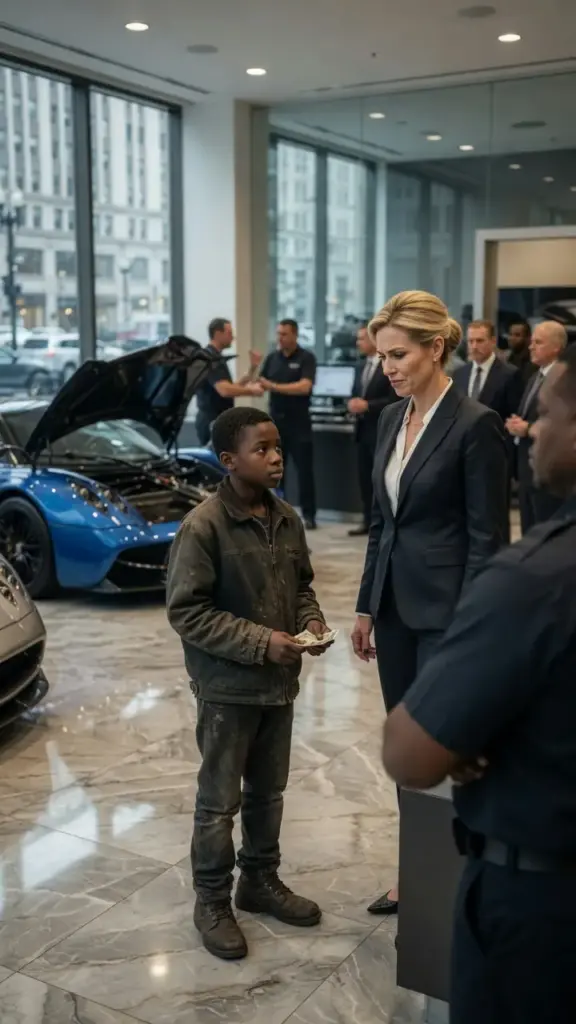
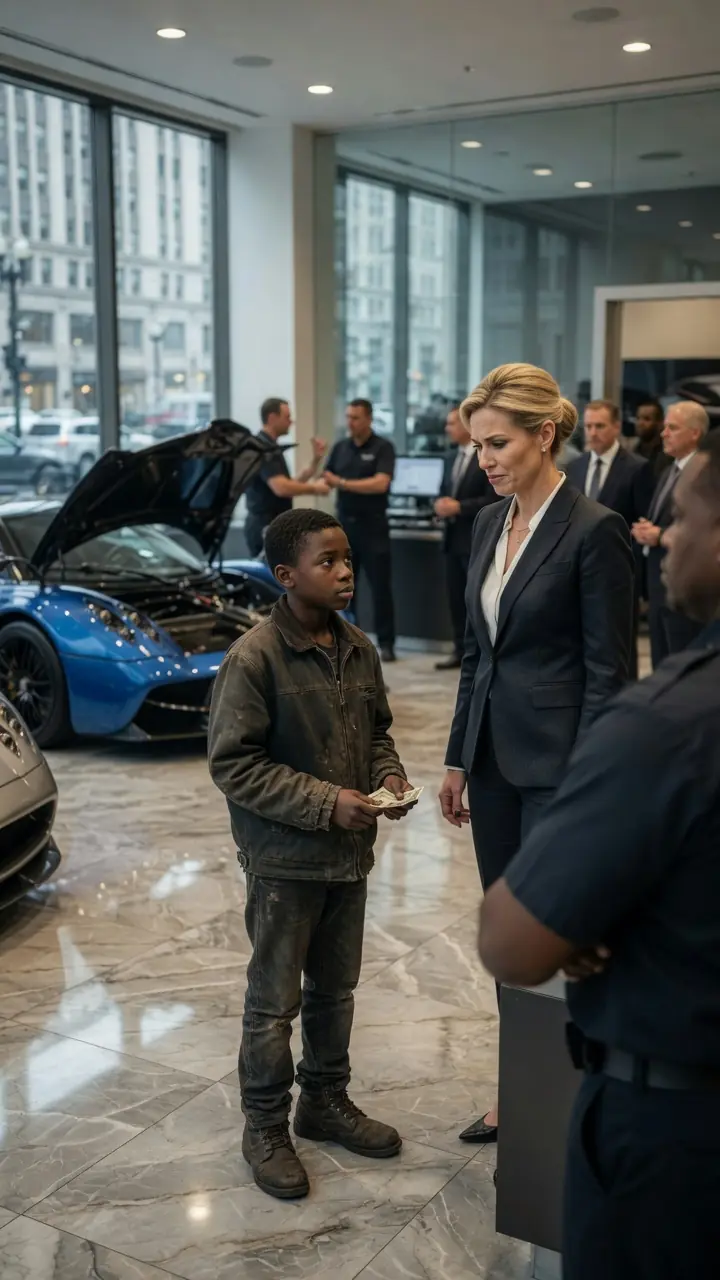
That’s why he walked into Whitmore Motors on a Tuesday afternoon with $20 and grease under his fingernails. Not to prove anything. Not to impress anyone. Just to finish what his grandfather started. He never expected to find a $2 million car with a problem he had already solved a hundred times in his head.
Victoria opened her mouth to respond, but the front doors swung open first. Eleanor Ashford walked in like she owned the building. Silver hair swept back. A charcoal cashmere coat over a white silk blouse. No jewelry except a single watch.
A Patek Philippe that cost more than the McLaren in the corner. She was 71 years old and moved like a woman who had never once waited for permission to enter a room. Two things happened at the same time. Victoria’s face shifted from fury to fear. And every employee in the showroom stood up straighter.
Eleanor Ashford was not just a client. She was the client. Four Paganis, two Bugattis, a Koenigsegg Jesko. Her late husband, Richard Ashford, had built one of the largest private equity firms in the Midwest. When he died, Eleanor didn’t sell.
She expanded. The Ashford Trust now managed north of $2 billion. And Eleanor’s personal car collection, 46 vehicles insured for over 90 million, was one of the most respected in the world. She walked past the reception desk without stopping, past the lounge, past the champagne, straight to the service bay window. She looked at the Pagani, then at Chad, then at Todd, then at Victoria.
Is my car running? Victoria smoothed her blazer. Mrs. Ashford, we’re making excellent progress. Is it running? Yes or no?
Not yet, but our team. Your team has had 3 weeks. Eleanor’s voice was quiet, but it carried like a blade. I gave you two factory engineers. I gave you a deadline.
And I walk in here to find the same car on the same lift with the same hood open. She paused. What exactly am I paying you for, Victoria? Victoria’s hands trembled behind her back. She clasped them together to hide it.
The powertrain issue is more complex than we initially. I heard something interesting when I walked in. Eleanor turned and looked directly at Fletcher. This young man said he knows what’s wrong with my car. The showroom held its breath.
Victoria almost laughed. Mrs. Ashford, with all due respect, this is a trespasser. He walked in off the street. He has no credentials, no training, no business being anywhere near your vehicle. Eleanor studied Fletcher for a long moment.





