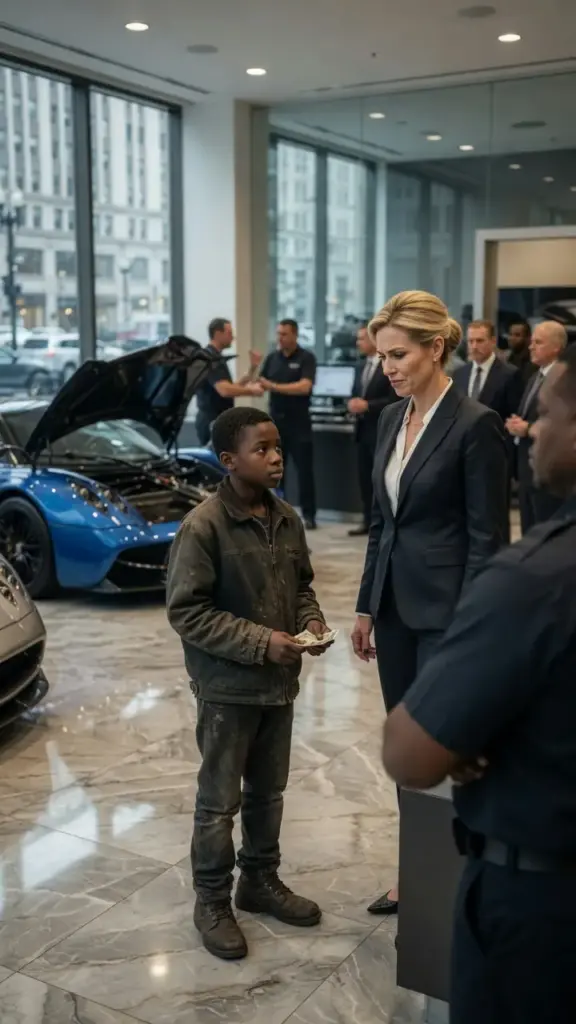
Every screen was flashing red. Chad Brennan, the head technician, slammed his tablet on the workbench hard enough to crack the screen protector. Three weeks, he said. Three goddamn weeks. Todd Mercer, the junior technician, pulled off his gloves and threw them on the floor.
The Modena guys gave up, Chad. They literally flew two engineers across the Atlantic, and they couldn’t find it. What are we supposed to do? I don’t know. But Eleanor Ashford is coming back in 24 hours, and if this car isn’t running, Victoria is going to burn this place down and us with it.
Chad ran his hands through his hair. He looked wrecked. Dark circles under his eyes. Three weeks of 18-hour days staring at fault codes that made no sense. The ECU throws six different errors every time we boot it, he said.
The hybrid relay won’t sync. The Modena engineers said the whole powertrain needs to come out and go back to Italy. $200,000 minimum. And that’s if we’re lucky. Todd leaned against the fender.
And the owner? Eleanor Ashford, as in Ashford Trust, as in the woman who has four Paganis, two Bugattis, and a direct line to the CEO of every manufacturer in Europe. Chad lowered his voice. She gave Victoria a deadline. 48 hours. Fix it or she pulls every car she has with us and files a lawsuit for negligent service.
How much are we talking? Her collection with us is worth north of 12 million. If she walks, Whitmore Motors doesn’t just lose a client. We lose the reputation. No serious collector will touch us again.
Fletcher had stopped walking. Dale still had his arm, but Fletcher’s feet were rooted to the marble floor. He heard the whine, faint, high-pitched, barely audible under the hum of the overhead lights, coming from the Pagani’s relay cluster. He knew that sound. He had heard it a hundred times in YouTube teardowns, in engineering forums, in the hundreds of hours he spent studying hybrid powertrain schematics on his grandfather’s kitchen table while the rest of the neighborhood slept.
That whine wasn’t a powertrain failure. It was a firmware conflict. The ECU and the e-motor relay were speaking two different protocol languages, and the system was caught in an endless loop of miscommunication. Fletcher looked at Dale, then at Victoria, then at the Pagani. That relay cluster is your problem, he said.
His voice carried across the showroom, clear, calm, certain. Every head turned. Chad looked up. Todd looked up. Victoria spun around.
What did you just say? Her voice was ice and iron. Your ECU firmware was updated to the wrong version during a routine service. It’s sending conflicting signals to the hybrid relay. That’s why your diagnostics throw six different fault codes.
The system doesn’t know which protocol to follow. It’s not a hardware failure. It’s a software mismatch. Chad stared. He looked at Todd.
Todd looked at the diagnostic screen. Neither of them spoke. How would you even know that? Chad finally asked. Because I’ve studied every technical service bulletin Pagani ever published on the Huayra BC powertrain.
That whine your relay is making right now? It’s a textbook symptom of a firmware version conflict. Page 43 of the 2019 service reference manual, section nine, paragraph two. The showroom was silent. Not quiet, silent. The kind of silence that fills a room when something impossible just happened.
Victoria stepped forward. Her face was white. Her hands were shaking. Not with fear, but with fury. Because somewhere in the back of her mind, behind the pride and the contempt, she knew he might be right.
You expect me to believe, she said slowly, that some street kid who can’t afford a $20 car part knows more about this engine than two factory-trained engineering teams from Italy? Fletcher met her eyes. I don’t expect you to believe anything, ma’am. I’m telling you what’s wrong with that car. You can let me show you, or you can spend $200,000 shipping it back to Modena and wait 6 months for them to find exactly what I just told you for free.
Victoria’s jaw clenched. She looked at Chad. Chad looked at the floor. His silence said everything. The car that no one could fix for under $200,000.
The client coming back in 24 hours. $12 million in collector accounts hanging by a thread. And a 19-year-old kid from South Side Chicago with oil under his fingernails and no diploma on his wall who just diagnosed the problem by listening. Victoria Whitmore had two choices. Let him try or let her empire crack.
She hated both options. But she hated losing Eleanor Ashford more. Fletcher Caine learned to listen to engines before he learned to read. His grandfather, Hank Caine, was one of the first black mechanics to work on a NASCAR pit crew in the 1970s. Not as a driver.
Not as an engineer with a framed degree. As a wrench man. The guy who crawled under cars at 2:00 in the morning while the rest of the team slept, chasing a sound only he could hear. Hank never got his name in the papers, never got a trophy, never got a thank you from the team owners who took credit for the wins his hands made possible. What he got was a reputation.
Quiet, stubborn, and right. Every crew chief in the Southeast knew the same thing. If Hank Caine said the engine was wrong, the engine was wrong. If Hank Caine said it would hold, it would hold. When the racing world moved on and the younger mechanics with computer degrees pushed the old hands out, Hank came home to South Side Chicago.
He opened a one-bay garage behind his house on Halsted Street. No sign out front. No website. Just a roll-up door, a concrete floor, and 30 years of tools hanging on pegboard walls. That garage became Fletcher’s world.





