PART 2
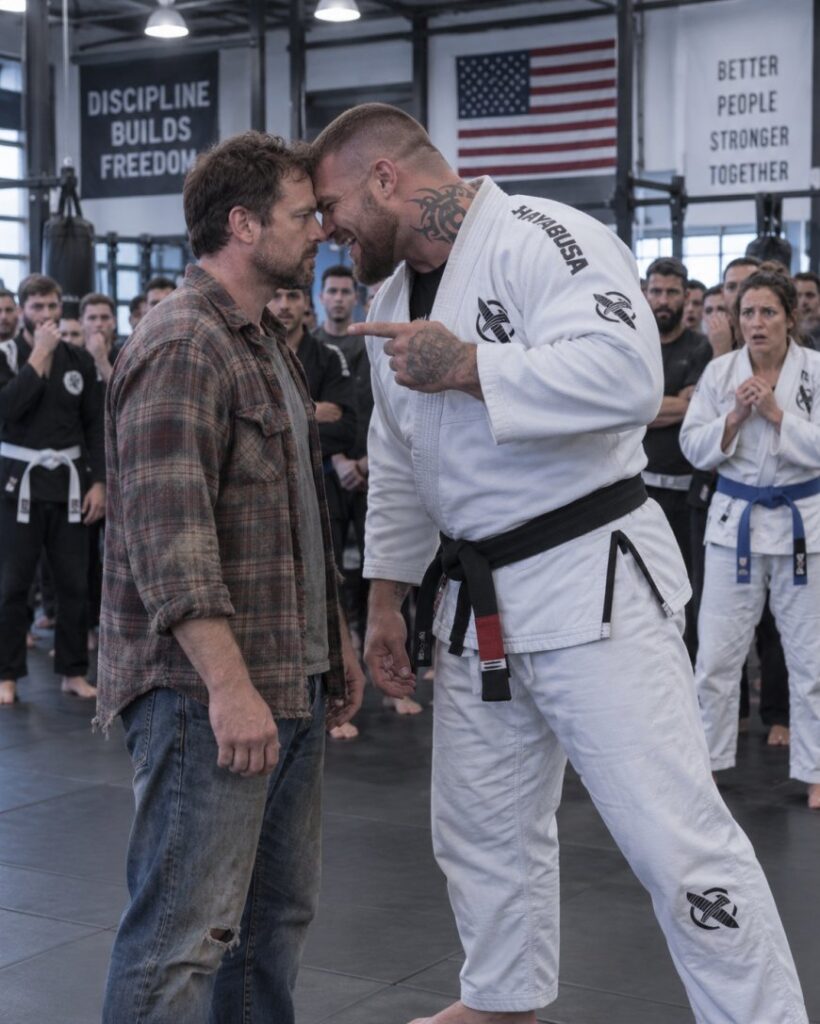
Bradley circled me like a shark that had already tasted blood. His feet made soft squeaking sounds against the vinyl as he bounced, feinted, and reset. He was waiting for me to make a mistake — to overcommit, to flinch, to give him the opening he needed to put on a show for the crowd.
I gave him nothing.
The gym had gone quiet in a way that felt unnatural. Sixty people, most of them breathing hard from their own training, and yet the only sounds were the hum of the overhead lights and the wet rhythm of Bradley’s breathing. Chloe stood at the edge of the mat with her hand still on her mouth. Professor Dave had his stopwatch raised but hadn’t started it. He was watching me the way a man watches a storm roll in over flat land — with the quiet certainty that something irreversible was about to happen.
Bradley shot in again.
This time he didn’t go for the double leg. He went for a body lock, arms wrapping around my waist, driving his shoulder into my sternum. It was a smart adjustment. He’d realized my frames were too strong for a direct takedown, so he was trying to smother me, to use his weight to fold me backward and drag me into deep water.
I let him come.
His arms closed around my midsection. His head pressed against my chest. He was strong — genuinely strong, the kind of strength that comes from years of lifting and grappling and believing you’re the toughest man in every room. I felt his grip tighten, felt him begin to drive forward, using his legs to push me off balance.
I didn’t fight the body lock. I didn’t try to pummel my way out. Instead, I dropped my hips and widened my base, sinking my weight straight down into the mat. Bradley’s forward pressure met a wall of gravity. His feet started to slide. He grunted, muscles straining, trying to lift me off my base.
I let him exhaust himself for three seconds. Four. His breath came hot and fast against my chest. His arms trembled with effort. The crowd began to murmur — this wasn’t the quick, brutal humiliation they’d expected. This was something slower. Something more deliberate.
Then I moved.
I reached down with my right hand and grabbed the waistband of his gi pants. My left hand found his collar. I didn’t yank. I didn’t jerk. I simply rooted my feet, rotated my hips, and used his own forward momentum to guide him past me. It was a textbook tai otoshi — a body drop — but executed with the kind of lazy, unhurried precision that made it look effortless.
Bradley’s feet left the mat. His body rotated through the air. He landed flat on his back with a slap that echoed off the concrete walls.
The crowd gasped. Someone dropped a water bottle. The sound of it clattering across the floor was deafening in the silence.
Bradley scrambled to his feet, face crimson, eyes wild. He didn’t reset. He didn’t circle. He charged.
That was his second mistake.
He came at me with pure rage, arms flailing, reaching for my collar with both hands. He wanted to grab me, shake me, prove to everyone that the first exchange had been luck. His technique had completely abandoned him. What remained was just a big, angry man trying to overwhelm a smaller opponent through sheer aggression.
I stepped inside his reach and let his own momentum carry him past me. As he stumbled, I placed my hand on the back of his neck — not a grip, just a guide — and helped him along his way. He went down face-first, catching himself on his hands and knees. The slap of his palms against the vinyl was followed by a low, collective groan from the crowd.
He was on all fours now, chest heaving, sweat dripping onto the mat. He looked up at me, and for the first time, I saw something other than arrogance in his eyes. Confusion. Fear. The dawning realization that he had made a terrible miscalculation.
“Stand up, Bradley,” I said quietly.
He didn’t move.
“Stand up.”
He pushed himself to his feet. His legs were unsteady. His hands were shaking. He wiped sweat from his eyes with the back of his forearm and tried to reset his stance, but his feet wouldn’t cooperate. He was exhausted. He had spent years relying on his size and strength, and neither had mattered.
I could have ended it then. I could have taken him down again, mounted him, and made him tap in front of everyone. But that wasn’t the lesson he needed to learn. He needed to understand something deeper — something that couldn’t be taught through a single defeat.
“Again,” I said.
He looked at me like I’d just spoken a foreign language.
“What?”
“Again. Try again.”
He stood there, chest heaving, trying to process what was happening. In his world, fights ended when someone got hurt or humiliated. You won, or you lost. There was no middle ground. No teaching moment. No quiet space where ego dissolved and something real could emerge.
But that was the lesson. That was always the lesson.
“I don’t —” he started.
“You wanted to teach me something,” I said, my voice calm and even. “So teach me. Show me what a brown belt does when he’s tired. When he’s frustrated. When nothing is working. Show me the technique that got you to this rank.”
The crowd was watching. Chloe was watching. Dave was watching. And Bradley, for the first time in his adult life, had no idea what to do.
He reset his stance. He circled. But the arrogance was gone. His eyes were no longer predatory. They were desperate. He was searching for a technique, a trick, anything that would let him salvage this moment.





