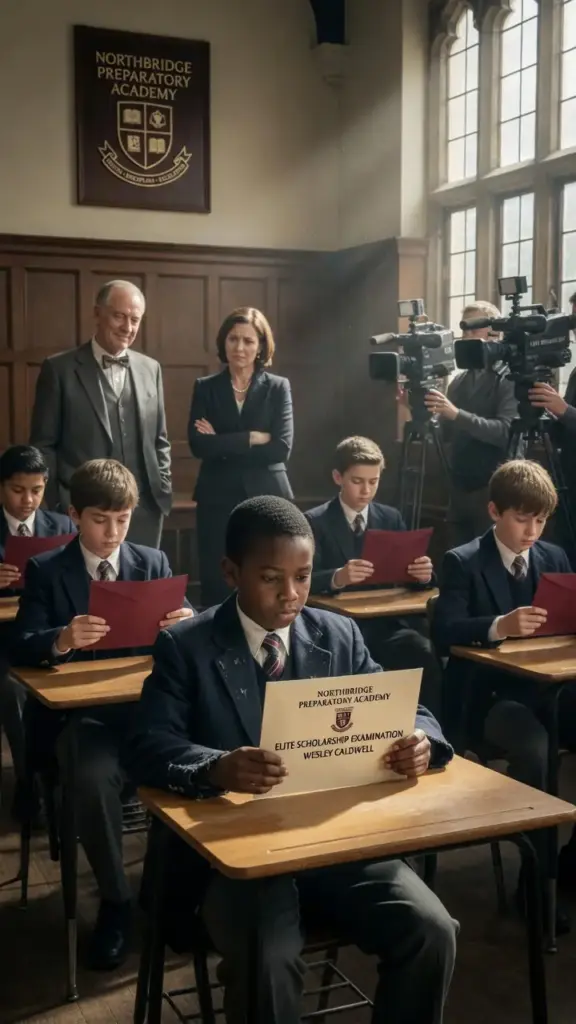
He turned around and faced the audience.
He spoke quietly. His voice was small, but the hall had gone so silent that everyone heard him.
“Before I solve this, I’d like to say one thing for the record. This problem isn’t random. This is the central application of a paper titled ‘Tensor Decomposition in Hilbert Space Operators’ published in 1998. The paper has been cited twelve hundred times. The first author,” he turned. The hall turned with him. Three hundred faces pivoted toward the lectern. “Is the gentleman standing right there?”
A sound went through the audience that was not a gasp and not a laugh. It was something in between.
The Globe reporter stopped writing because his hand was shaking. A woman in the second row covered her mouth. The MIT observer who had been filming earlier was now standing.
Then Wesley turned back to the board. He uncapped the marker.
The competence reveal was simple, and the audience could follow it even without understanding the math.
He started building the proof from the foundation up, step by step, talking quietly to himself as he wrote, the way kids do when they’re working hard.
He wrote out the operator. He wrote out the assumptions. He stopped at step four. He turned to the audience again.
“Most people would assume the operator is bounded. Mr. Whittaker’s paper assumes that. But there’s a more general case where it isn’t. I’ll do both.”
A murmur. Two of the MIT observers exchanged a look.
He solved the standard case. Five minutes. The board filled.
He moved to the second half of the board. He solved the generalized case. Six minutes. The second half filled.
Both cases on the board now, side by side, in a child’s careful handwriting.
He capped the marker. The wall clock read 9:55. Twelve minutes.
The hall was silent.
Wesley walked back to the podium. He did not sit.
Without being asked, he picked up his original exam packet from the panel table and carried it to the lectern. He placed it on the surface in front of Whittaker.
“And now, sir, my exam, as agreed.”
The audience leaned forward.
The first golden beat, the subtle flaw.
Wesley flipped to page two of his exam.
“Problem two had a typo. I caught it at minute six and reported it to Mr. Whittaker. He told me to answer what was on the page. I solved both versions. Either version is acceptable.”
He flipped to page five.
The second golden beat, the public reversal.
“Problem five required a lemma that is not stated in the exam packet. The only way to solve it cleanly is to know the lemma. I cited my source.”
He held up the page so the camera could see. The camera zoomed. The screen behind the stage showed, in a child’s careful handwriting in the margin, the words, “Per Whittaker and Lang, 1998.”
The audience saw it. The MIT observers saw it. The Boston Globe reporter saw it. Vivian Caldwell, in the third row, saw it.
Wesley did not look at Whittaker as he said the next part. He looked gently at the audience.
“I read your paper when I was eight years old, sir. I found a copy in the public library on Dudley Street. I didn’t understand most of it, but I understood the elementary lemma in chapter two. I kept the photocopy in my desk drawer at home. I read it again two nights ago. I thought, ‘If anyone in this room would recognize a real proof, it would be you.’”
He stepped back from the lectern.
The third golden beat. The reluctant admission.
Dr. Ashford stood up slowly from the panel table. She did not speak to Whittaker. She spoke to the room.
“Mr. Whittaker, as lead examiner, will you confirm for the official record into this microphone that Master Caldwell’s solutions to all five written problems are correct?”
The hall held its breath.
Whittaker’s jaw worked. He looked out at the audience. He looked at the donors he had been laughing with in the hallway twenty minutes ago. He looked at the press camera in the third row, lens up, recording.
“They are correct.”
“Louder, please. The microphone.”
Whittaker leaned forward. His mouth was tight.
“They are correct. All five.”
The audience did not cheer. They exhaled. It was a strange collective sound. Three hundred people releasing the breath they had been holding for an hour.
Vivian Caldwell in the third row pressed both hands to her face and bent forward in her seat.
The status flip was complete.
The man with all the authority in the room had just confirmed into a live microphone that the Black ten-year-old boy he had publicly humiliated had solved a college calculus exam and a doctoral-level tensor proof in fifteen minutes total using the man’s own published research.
But the story wasn’t over because while Whittaker was speaking those words into the microphone, Mrs. Hollings, the foundation chair, was opening an email on her phone that had been sitting unread in her inbox since 7:48 that morning.
What was in that email?
As Headmaster Bradford stepped to the podium to begin closing remarks, Mrs. Hollings stood up from the panel table and asked for the floor.
She walked to the lectern with a folder. The hall went quiet again.
“Before we conclude, the foundation received an anonymous email at 7:48 this morning before the exam began. We did not act on it because we had no grounds. We do now.”
She held up a single sheet of paper.
“This is a transcript from the Northbridge security audio system. The system has been recording the teachers’ prep room continuously for two years. It was installed after a petty theft incident. Most of the faculty have forgotten it exists.”
She put on her glasses.
“The recording is from the night before last. 11:34 p.m. The voices are Mr. Whittaker and Vice Principal Sandra. I will read two lines.”





