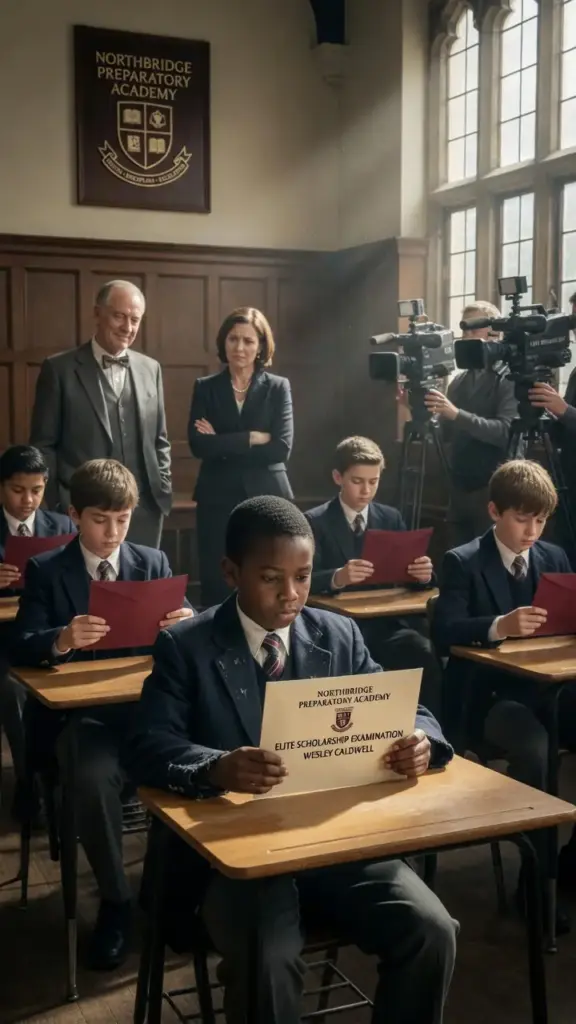
Wesley sat very still. He looked at the pages in his hands. He looked at the pages on Charlotte Brooks’s desk to his left. Charlotte was eleven. She was on problem one, a polynomial. Theodore Hayes, ten, on his right, was on problem one, the same polynomial. The other two children had the same exam, too.
Five maroon envelopes, four matching exams, one cream-colored envelope with something else entirely.
Wesley’s pages had five problems. Limits, derivatives, integration by parts, a continuity proof, a convergence question. The header at the top of the first page had been carefully blacked out with a marker. But the formatting was unmistakable.
He had seen this exact font, this exact spacing in a binder of old MIT exams that had been left in a corner of the public library on Dudley Street. He had read it when he was nine. He had solved three of those problems on scratch paper while waiting for his mother to finish her late shift.
He understood three things in three seconds.
First, this was a college calculus exam.
Second, if he simply raised his hand right now and said, “Sir, my exam is wrong,” he would lose. Whittaker would shrug and say, “It looks correct to me, sweetheart. Maybe the problems are just over your head.” The panel outside would hear that the boy had asked to switch his exam mid-test. The headline tomorrow would write itself. “Ten-year-old finalist demands easier test, withdraws.” He would be the kid who couldn’t take the heat. The scholarship would go to someone else. Whittaker would walk away clean.
Third, the live stream had not started yet. The world outside the exam room could not see what had just happened. But it would in four minutes when the cameras went live. Every page he wrote would be projected onto a giant screen in front of three hundred people, including the Boston Globe, including the MIT observers, including his mother in the third row.
He had two choices. Walk out or pick up the pencil.
He picked up the pencil.
He smiled. A small private smile almost to himself.
Whittaker, watching from across the room, mistook that smile for nervousness. He turned to Sandra and whispered something and laughed under his breath.
But the smile wasn’t fear. It was recognition.
Wesley had seen this exam before, sort of. He knew what was inside. And he had just realized something Whittaker did not know.
Two nights ago, sitting at his kitchen table at ten, Wesley had reread an old photocopied paper he had carried around since he was eight. A paper he had found in the same library, abandoned in a return bin.
The paper was titled “Tensor Decomposition in Hilbert Space Operators” by H. Whittaker and R. Lang, 1998. He had read it dozens of times. He didn’t understand all of it, but he understood the elementary lemma in chapter two completely. He had memorized it the way other kids memorize song lyrics.
He didn’t know yet that the fifth problem on his exam, the convergence question, required exactly that lemma to solve cleanly.
Whittaker had built the trap from his own materials. He was about to walk into it.
The clock on the wall said 9:03. The big screen in the public hall flickered on. The camera above his desk lit up. A red dot appeared. The live stream had started.
Three hundred people in the next room leaned forward in their chairs. Vivian, in the third row, gripped the strap of her tote bag so tightly her knuckles went white.
Wesley did not write anything for the first ninety seconds. He read. And then he read again.
What does it look like to the watching world when a quiet child stares at a blank page and refuses to move?
In the public hall, the audience had no idea what kind of exam was on Wesley’s screen. They could only see the page itself, projected fifteen feet wide above the stage. Most of them couldn’t read calculus on sight. They could see math symbols, integral signs, the curl of a derivative. They saw a child not writing anything.
Some of them began to whisper.
“He’s frozen. The poor thing is frozen.”
A woman in the fifth row, one of Charlotte Brooks’s aunts, turned to her sister and said, loud enough to carry, “I told you. Affirmative action picks. They get them in the door and then they crack.”
Vivian heard it. She did not turn around. She did not breathe.
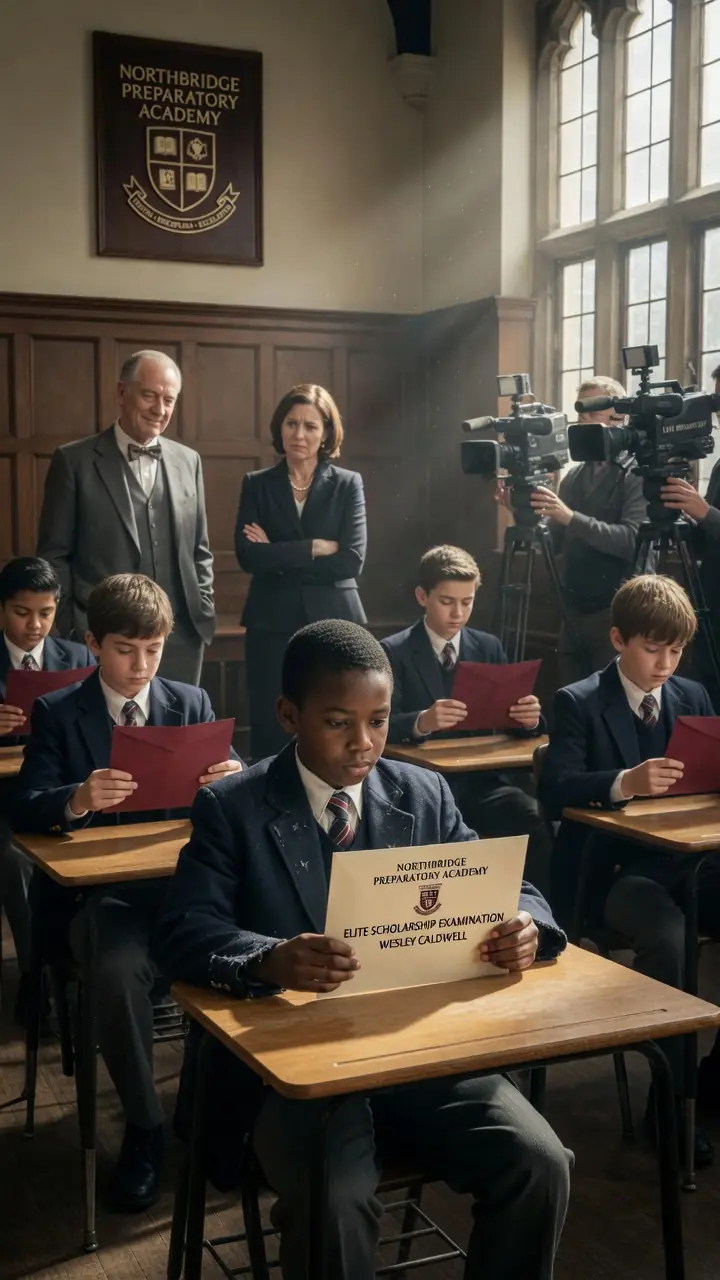
But Wesley wasn’t frozen. He was reading the whole exam first, all five problems, before writing a single mark. Most kids, even smart kids, start writing immediately.
Wesley read. That was the first thing. He’d been doing it since he was seven.
Within sixty seconds, he saw something nobody else had seen. Not the proctor, not the panel, not Whittaker himself.
Problem two had a typo.
The problem read, “Let f of x be continuous on the closed interval from zero to one, and let the derivative of f at every point equal one over x.” But one over x is undefined at x equals zero. You cannot have a function whose derivative equals one over x on a closed interval that includes zero. The two conditions contradict each other.
It was the kind of mistake a senior calculus student might catch. A panicked freshman would not. A panicked ten-year-old definitely would not.
Wesley caught it. And he made a decision.
He decided the order. Problem three first, because it was the cleanest. Then problem one, then problem four, then problem two, which he would solve in both possible interpretations to prove the typo. Then problem five, the convergence proof, which he would save for last.
He picked up the pencil and began.
Round, careful handwriting. Numbers neat, symbols precise. The kind of handwriting a child uses when he has been told his entire short life that his work has to be twice as clean to be considered half as good.





