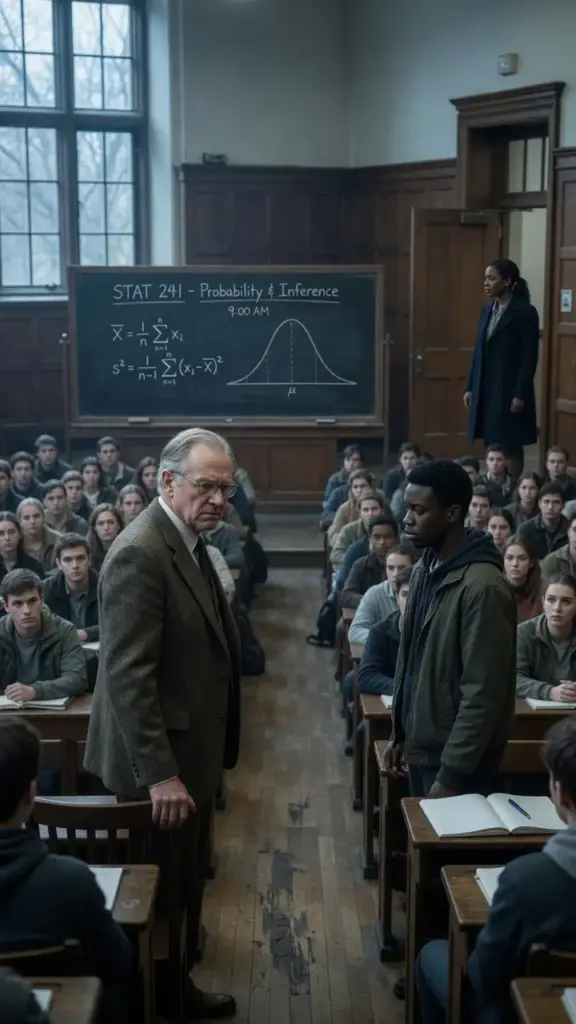
When he finished, the room was quiet. Not the uncomfortable silence he was used to, a different kind. The kind that follows something real.
Two students in the back row started clapping. Then a third. Then half the room. Hadley didn’t clap.
She waited until the applause died. Then she pulled out her grading sheet and wrote for 30 seconds. She didn’t look at Owen, didn’t acknowledge the response from the class, just wrote.
“Thank you, Mr. Yates. Next.” Owen returned to his seat. His hands were shaking. Not from nerves, but from the adrenaline of having done everything right and knowing it still might not matter.
The grades were posted online that evening. Owen refreshed the page at 9:47 p.m. His presentation score loaded in the column next to his name. D. Not D plus. Not D minus. Just D.
The kind of grade that says, “I could have given you an F, but I wanted you to know I was being generous.” Below the score was a comment from Hadley.
“Presentation lacked academic rigor. Topic selection was emotionally driven rather than analytically sound. Recommend focusing on core statistical methods rather than social commentary.”
“Perhaps trade school offers programs better suited to this approach.” Owen stared at the screen for a long time. He closed the laptop, sat on the edge of his bed, pulled out his phone, and almost, almost called his mother.
His thumb hovered over her name for 10 seconds. Then he put the phone face down on the mattress. He picked up his backpack, walked out of the dorm, and crossed the dark campus to a bench near the library.
The one under the old oak tree where nobody went after 9:00 because the lights didn’t reach that far. He sat there in the dark for 2 hours.
For the first time since arriving at Whitmore, Owen Yates thought about leaving. Not transferring, leaving. Packing his two suitcases and his box of books, driving back to Ridgefield Courts, and telling his mother it just didn’t work out.
She’d understand. She’d hold him. She’d say it wasn’t his fault, and they’d both pretend the dream hadn’t died on a cold tile floor in room 4B.
Dr. Crawford found out about the grade the next morning. She’d requested access to the department’s grading portal as part of her quality review. When she pulled Owen’s file, she saw the D.
Then she read the presentation file attached to his submission. She read it twice. Then she opened her own notebook and flipped to her notes from Thursday’s session.
She’d been in the room, back corner, behind the pillar. She had watched Owen deliver that presentation. She had watched the class respond.
She wrote one line in the margin of her file. This is A-level work. It received a D.
This is no longer a pattern. This is persecution. She picked up her phone and called the university president’s office. “I’m ready,” she said. “Schedule the assembly.”
Owen almost didn’t go to class on Friday. He lay in bed staring at the ceiling while his alarm buzzed three times. His backpack sat by the door already packed from the night before, a habit his mother had drilled into him since middle school.
“Be ready before the world gives you a reason not to be,” she always said. He turned off the alarm, stared at the ceiling some more.
Then he thought about Gloria, about the way her knees cracked when she stood up after a 12-hour shift, about how she never once called in sick because sick days meant short checks, and short checks meant late rent.
He got up, put on his shoes, picked up the backpack, walked to class. Hadley was already mid-lecture when he slipped in through the back door.
She didn’t look at him, didn’t acknowledge his existence at all. Owen took a seat in the last row and opened his notebook.
After class, Crawford was waiting in the hallway. Same plain coat, same portfolio. She was leaning against the wall like she just happened to be there, but Owen had noticed her before.
The consultant who showed up everywhere, who sat in the back of Hadley’s lectures with a face that gave away nothing. “Owen, how’s the week been?”
He stopped, looked at her. The answer sat right behind his teeth. The D, the bench, the two hours in the dark, the suitcase he’d pulled out and then shoved back.
“Rough,” he said. First honest word he’d spoken to anyone on this campus in weeks. Crawford nodded.
She didn’t push, didn’t ask what happened, just said, “Can I show you something?” She walked him to a quiet corner of the student commons, pulled out her phone and showed him a photograph, not from the investigation.
A photograph of a girl, maybe 16, standing in front of a school with a backpack that was taped together at the strap. “That’s me,” Crawford said.
“16 years old, Camden, New Jersey. My guidance counselor told my mother I wasn’t college material. Said I should focus on something more. His word was realistic.”
Owen looked at the photo, then at her. “I went to college anyway, then law school. Then I spent 12 years suing institutions that told kids like us what we couldn’t be.”
She put the phone away. “I’m not telling you this so you feel better. I’m telling you because the people who try to break you are always the ones most afraid of what you’ll become.”
“And that fear, that’s the only honest thing they’ve ever shown you.” Owen didn’t say anything for a long time.
Then, “She gave me a D on my midterm presentation.” “I know. It was good work.”
“I know that, too.” He searched her face. “How?”
“Because I was in the room, Owen. Third row from the back. I watched every second of it.”
Something shifted in his eyes. Not hope, not yet, but the absence of the thing that had been sitting on his chest since Thursday night.





