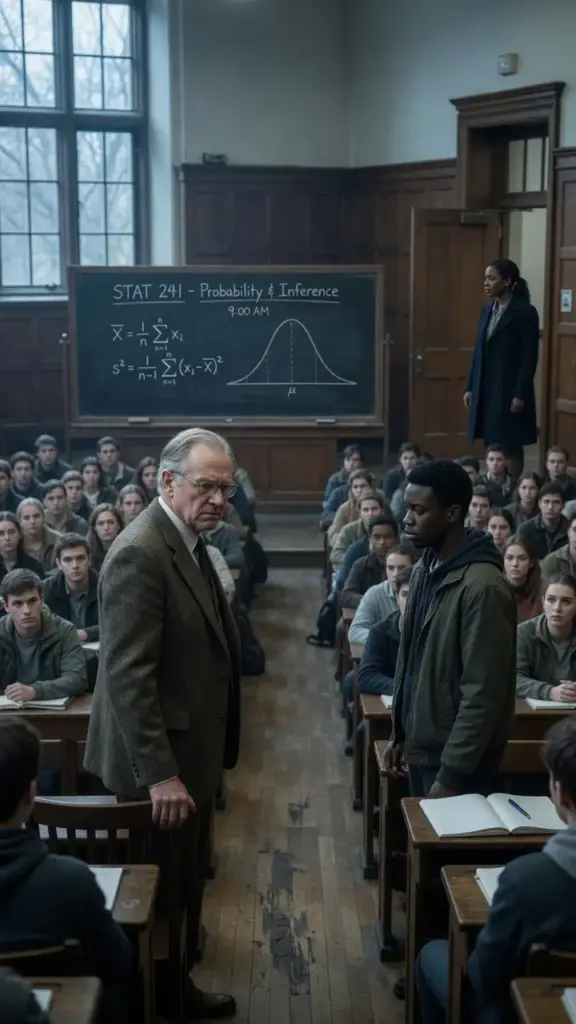
She heard “charity.” She heard “scrubbing toilets.” She heard “you’ll amount to nothing.”
And she stood there. A black woman in a plain coat, invisible to everyone inside that room, and listened to another black woman’s son be told he was born worthless.
She didn’t introduce herself, didn’t storm in, didn’t slam her portfolio on the podium and announce who she was. She just opened her phone, typed six words, and walked away.
Elaine Crawford had cleaned up buildings on fire before. This one she was going to dismantle brick by brick. The next morning Dr. Crawford requested permission to sit in on Mrs. Hadley’s advanced statistics lecture.
She used her consultant cover, evaluating teaching methodology across departments, standard quality assurance review, nothing to worry about. Hadley didn’t just agree, she welcomed it.
“Finally,” she told the department secretary loud enough for three offices to hear. “Someone from the outside who can see how a real classroom should be run. I’ve been asking for recognition for years.”
She even wore a new blazer. Crawford arrived 10 minutes early and took a seat in the back row, far left corner, behind a concrete pillar where she could see the entire room without being the center of it.
She placed her portfolio on the foldout desk, opened a fresh page, and wrote the date at the top. The students filed in. Owen Yates walked through the door at exactly 8:58.
He didn’t sit in the front row this time. He chose the third row, middle seat. A small retreat that nobody noticed except the woman in the back corner who understood exactly what it meant.
Hadley started the lecture at 9:01. For the first 20 minutes she was good, better than good, she was sharp. Her explanation of regression analysis was clear, well-structured, and genuinely engaging.
She moved across the front of the room with the confidence of someone who had owned that space for two decades. Crawford wrote in her notebook. Strong content delivery, knows her material.
Then she called on Owen. “Mr. Yates, since you seem to think your GPA entitles you to opinions, explain multicollinearity to the class.”
Owen stood. “Multicollinearity occurs when two or more independent variables in a regression model are highly correlated, which makes it difficult to isolate the individual effect of each variable on the dependent”
“Sit down.” Owen paused. “I said sit down. You’re reading a textbook definition like a parrot. Anyone can memorize. I asked you to explain.”
“I was explaining.” “You were reciting. There’s a difference. But I wouldn’t expect you to know that.”
She turned to the class. “Can someone who actually understands the concept help us out?” A white student in the second row raised his hand and gave almost the exact same answer.
Hadley nodded. “Good. Clear. Concise. See, Mr. Yates? That’s what understanding sounds like.” Owen sat down. His jaw tightened. His pen didn’t move for a full 30 seconds.
Crawford’s hand gripped her own pen so hard the cap cracked. The lecture continued. Hadley assigned a group case study. Four students per team analyzing a data set on income inequality.
She read the groups aloud from a printed list. Every name was called except one. “Mrs. Hadley,” Owen said, “I don’t have a group.”
Hadley looked at her list, then at him, then back at the list as if she were checking for a misprint she already knew wasn’t there. “It seems we have an odd number this semester. You’ll work alone, Mr. Yates.”
“Submit the same deliverables as the groups. Same deadline.” “That’s four people’s work.”
“Then I suggest you start early.” She smiled. “Unless you’d like to withdraw from the course, that’s always an option.”
The room went quiet. Not the shocked silence from the day before. This was the practiced silence of people who had learned that looking away was safer than looking up.
Owen pulled out his laptop and opened a blank document. He didn’t argue, didn’t raise his hand again, didn’t look at anyone. Crawford closed her notebook.
After class, she waited in the hallway. She watched students stream out, some laughing, some checking phones, all of them moving on with their day like nothing had happened.
Then Owen came out, last one through the door, backpack over one shoulder, eyes straight ahead. She stepped into his path, not blocking, just present.
“Excuse me, I’m part of the education consulting team visiting campus this week.” She extended her hand. “Elaine.” Owen shook it. Firm grip, tired eyes. “Owen.”
“How’s the semester going for you?” He looked at her for a long moment, measuring, deciding. Then he said what he’d trained himself to say. “I’m used to it.”
Three words, delivered flat, like a door closing. Crawford watched him walk away down the corridor. His footsteps echoed against the tile, steady, even, unhurried.
The walk of someone who had been carrying weight so long, he’d forgotten what it felt like to stand straight. She opened her phone and added a second entry below the first.
Day two, same class, public humiliation, isolated from peers, grading bias. Student response? Resignation. Then she typed one more line. He said I’m used to it. That’s the worst part.
On day three, Elaine Crawford stopped observing and started hunting. She’d seen enough in two lectures to know this wasn’t a personality conflict or a tough love teaching style that rubbed one student the wrong way.
This was a pattern, systematic, practiced, the kind of behavior that doesn’t develop overnight. It calcifies over years, protected by silence and institutional cowardice.
She needed evidence, not the kind that lives in feelings and anecdotes, the kind that survives a 10-year review board, a faculty union grievance, and if it came to it, a courtroom.
She started with the students. On Wednesday afternoon, she booked a small conference room in the student services building and posted a notice on the department bulletin board.
Education quality review, confidential student feedback sessions. All participants anonymous. No faculty present.





