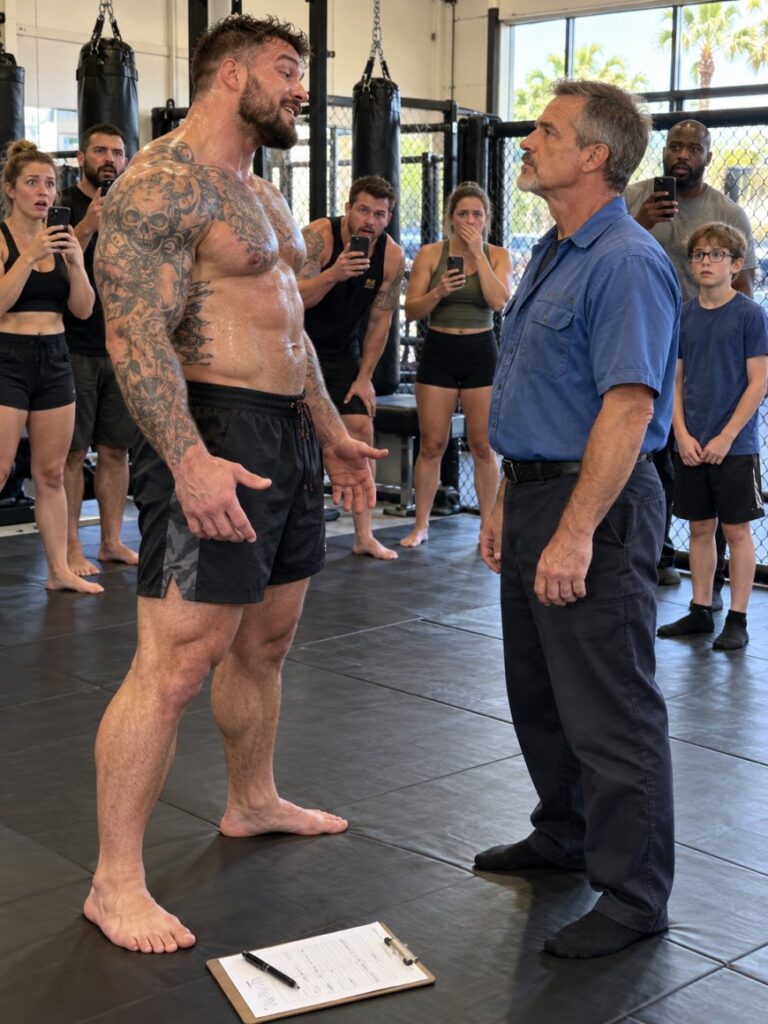
The school called me the next afternoon.
The assistant principal’s voice was different now. Softer. More careful.
She had seen the video. She had spoken with the district. The three eighth graders who had been targeting Milo were being suspended. There would be an investigation into the earlier reports.
I listened without saying much.
When she finished, I asked one question.
“What are you going to do for the next child who comes to you before there’s a video?”
There was a long pause.
“We’re reviewing our protocols,” she said.
“Good,” I said. “Review them out loud. With parents. Not just in meetings.”
I hung up before she could answer.
A few months later, I found a small martial arts program operating out of a converted warehouse about twenty minutes from our house. It was run by a woman named Sandra Cole. Former military medic. Years of serious grappling training. No cameras. No banners. No highlight reels.
Her classes were small. On the wall above the entrance, she had posted a single typed sentence.
Control is the skill. Everything else is just practice.
Milo came off the mat after his first session there with a different expression than he had ever worn leaving Bryce’s gym. He looked less armored. He looked like he was somewhere that was actually his.
I began volunteering with Sandra’s program on weekend mornings. A no-cost self-defense awareness class for children who had histories with bullying.
The first thing I taught every time was not how to strike. It was not how to escape a hold.
It was how to hold eye contact without aggression. Steady and clear. The kind of gaze that communicates a person understands their own worth and doesn’t need anyone to remind them of it.
Then I taught them how to use their voice before anything else. How to find trustworthy adults and use them before situations escalated.
The boys who had been targeting Milo made another attempt several weeks later. They followed him toward the side entrance, where they had always found him alone and uncertain.
Milo didn’t run.
He turned to face them. Stood straight. Spoke in a voice loud enough for the other students in the hallway to hear. He named what was happening. He identified the individuals involved. He made it clear he was not alone in witnessing it.
The older boys had spent months building a version of Milo in their minds.
The version standing in front of them didn’t match.
They made no contact. They left.
Milo told me about it that evening at dinner. Straightforward. No performance. He just said what happened and then asked me to pass the potatoes.
I listened. I asked a few questions. Then I told him that what he had done took more composure than most adults managed under pressure.
He nodded and reached for his glass.
The conversation moved on to other things.
I sat across from my son and thought about the promise I had made in a hospital room four years ago. I had been afraid that the parts of me capable of surviving certain kinds of darkness were incompatible with the father I wanted to be.
What I understood now was that capability and character were never the same thing.
What a person can do and what a person chooses to do live in entirely separate registers.
The one that mattered—the one Milo would carry into the rest of his life—was the one I had been quietly choosing every single day.
Milo didn’t need to become a fighter.
He had needed to believe he was worth defending.
And that belief had been in my power to give all along.
The strongest people in any room are rarely the ones making the most noise. They’re the ones who already know what they’re capable of and choose, every day, to lead with something better than force.
I had spent years hiding from that truth.
Now I watched my son walk to the fridge without holding his arm stiff. I watched him set his backpack down without flinching. I watched him pick up a soldering iron and lose himself in the careful work of rebuilding something broken.
He was still kind.
He was still gentle.
And he stood differently now.
Not because he had learned how to hurt someone.
Because he had learned that he didn’t have to.
The soldering iron hissed against the joint, sending up a thin curl of smoke that smelled like hot metal and pine rosin. Milo’s tongue pressed into his cheek the way mine did when I concentrated, and I felt the old reflex to correct his grip before I remembered he wasn’t asking for help.
He set the iron down and held the circuit board up to the desk lamp. A tiny green light blinked on.
“There,” he said. “It’s alive again.”
“Nice work.”
He didn’t gloat. He just turned it over in his hands, checking the solder points the way Sandra had taught him to check a training partner’s balance—lightly, without needing to prove anything.
“Dad?”
“Yeah.”
“At the class tomorrow—the new kid. The one who won’t talk.”
I nodded. Sandra had mentioned him.
Nine years old. Quiet in a way that wasn’t shy.
“Can I show him the eye thing? The one you teach first?”
The request landed somewhere deep and quiet in my chest.
Not because it was remarkable. Because it was ordinary.
Because my son had absorbed the lesson without turning it into a weapon or a performance.
“Only if he wants to learn it,” I said.
“You offer. You don’t push.”
“I know.”
He said it without irritation. Just a fact.
I watched him unplug the iron and wind the cord with the same deliberate care he used on the mat.
The kitchen clock ticked. Outside, a neighbor’s dog barked once and went quiet.
“Hey,” I said.
He looked up.
“I’m proud of you.”
He tilted his head, considering that. Then he smiled—small, crooked, real.





