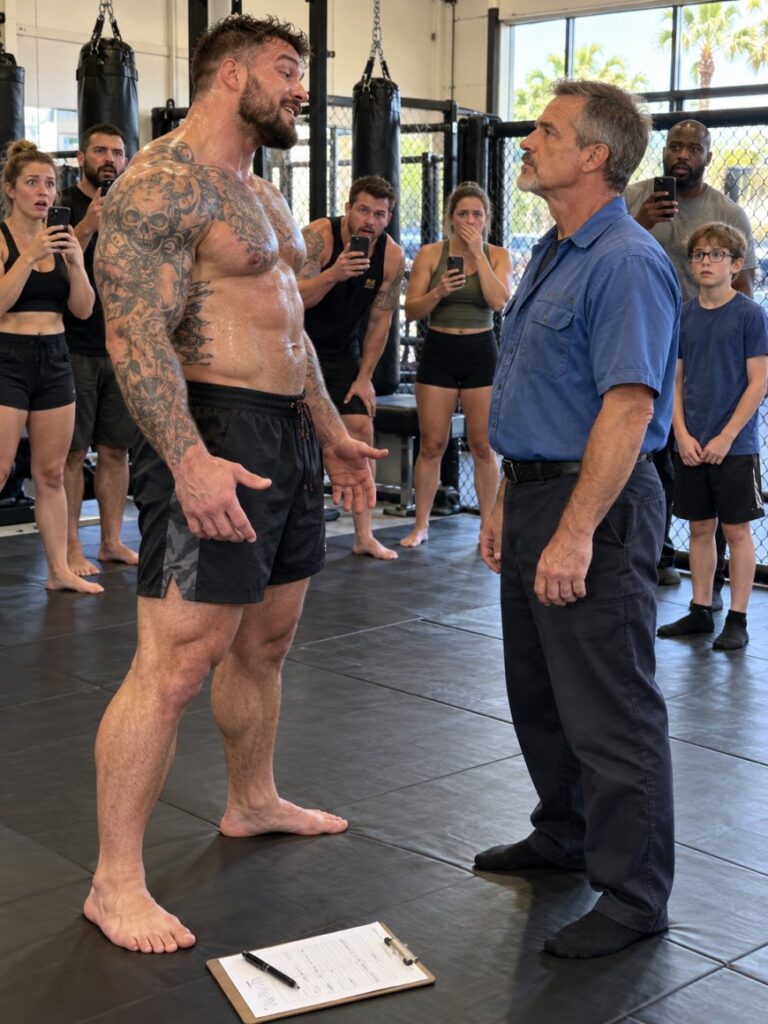
“Roll him onto his side,” I said to the nearest assistant. “Stay with him. Someone call an ambulance.”
Both of them moved immediately. Neither questioned me.
A teenage boy near the edge of the circle spoke up. He had been training there for over a year. I had seen him in the background of Bryce’s videos, always quiet, always watching.
“Why didn’t you keep going?” he asked.
There was no hostility in it. Just confusion. The kind that comes when a basic assumption has been removed.
I looked at him.
“Because the danger was finished,” I said.
He frowned, turning it over.
I didn’t explain more. He would either understand it or he wouldn’t. But I saw something shift in his face. He had never once heard Bryce say that restraint was the point.
He had only ever heard Bryce say that winning was the point.
I stood and walked to Milo.
He was still gripping the folding chair. His knuckles were white. His eyes were wet, but he wasn’t crying.
He looked at me like he was seeing two people at once.
“Dad?”
“I’m here.”
“You could have ended it sooner.”
It wasn’t an accusation. It was a question.
“Yes,” I said.
“Why didn’t you?”
I thought about how to answer in a way that was true without being performed.
“Because knowing you can hurt someone and choosing not to are the same skill operating in opposite directions,” I said. “The second direction is harder.”
He blinked.
“The person with the most strength in any conflict isn’t the first one to use it,” I said. “It’s the last one who needs to. The space between those two moments is where character either holds or it doesn’t.”
Milo didn’t respond right away. He looked at my face. The scars on my forearms. The calm expression. The complete absence of satisfaction.
Then he nodded slowly. Not like he was agreeing to be polite. Like he was filing it away.
“You scared me,” he said quietly.
“I scared myself,” I said.
He stepped forward and hugged me. It was quick and fierce. The way a twelve-year-old hugs when he doesn’t want anyone to see his face.
I held him.
Then I walked to the front counter.
The liability waiver was still there. My signature on the bottom. Bryce’s neat little form. The same document he had used before.
I picked it up, folded it once, and tore it in half along the crease.
I set the two pieces back on the counter.
Then I turned to the parents along the wall.
The ones who had watched Milo get thrown to the mat. The ones who had heard Bryce say into the cameras that a father had raised a son with no backbone. The ones who had stayed in their seats and said nothing.
“The next time a child in this room is treated the way my son was treated tonight,” I said, “the answer isn’t to wait for someone else to decide the moment is serious enough to act.”
My voice was steady. That made it land harder than anger would have.
A woman near the back lowered her phone. A man near the door looked at his shoes.
No one argued.
I picked up Milo’s gym bag and slung it over my shoulder. Then we walked toward the exit.
I didn’t look back.
The ambulance arrived eleven minutes later. Bryce was conscious and communicative by then, sitting up with an ice pack against his jaw. He was examined and cleared of serious injury. No fracture. No concussion.
The physical recovery was the least complicated part of what the night cost him.
The footage started circulating before midnight.
Multiple angles. Multiple accounts. Clips edited to different lengths across different platforms. The section that generated the most response wasn’t the final hook.
It was the earlier footage.
Bryce executing a full-force shoulder throw on a twelve-year-old boy. Bryce delivering his camera-facing commentary while the child lay curled on the mat. Bryce nudging Milo’s foot with his shoe and telling him not to embarrass his father.
That footage was not ambiguous.
It didn’t need interpretation.
Parents with children enrolled at Keller Combat Academy began contacting each other within twenty-four hours. What emerged was a pattern. Incidents their children had described and minimized. Moments the parents had witnessed and rationalized. An atmosphere inside the gym that several of them had registered as wrong and then set aside because Bryce’s credentials were real and his marketing was polished.
The video made acting on it simple.
Withdrawals came in over the following week in numbers that gutted the enrollment. Assistant instructors gave interviews corroborating the pattern. Three regional competition organizations suspended Bryce’s participation. His sponsorship agreements were terminated in quick succession.
The videos he had produced so carefully became a comprehensive archive of behavior that no longer required commentary to be understood.
Keller Combat Academy closed its doors before the end of the following month.
I declined every interview request.
I didn’t consider what had happened a story worth telling. I had stopped a situation that needed stopping. That was the full extent of my accounting.
At home, Milo was quieter than usual for a few days.
Not withdrawn. Thoughtful.
On the third night after the fight, he came into the kitchen while I was making coffee before my shift. He sat at the table and watched me for a while.
“You were never just on a ship,” he said.
I poured the water slowly.
“No,” I said.
“Were you scared? When you were over there?”
I thought about how much truth a twelve-year-old can carry.
“Yes,” I said. “A lot.”
“Did you ever want to hurt someone like you wanted to hurt Bryce?”
I set the coffee down.
“Yes,” I said. “That’s why I stopped.”
He nodded. He didn’t ask for details. He didn’t need them. He just needed to know that his father was not a man without darkness. He was a man who had chosen what to do with it.





