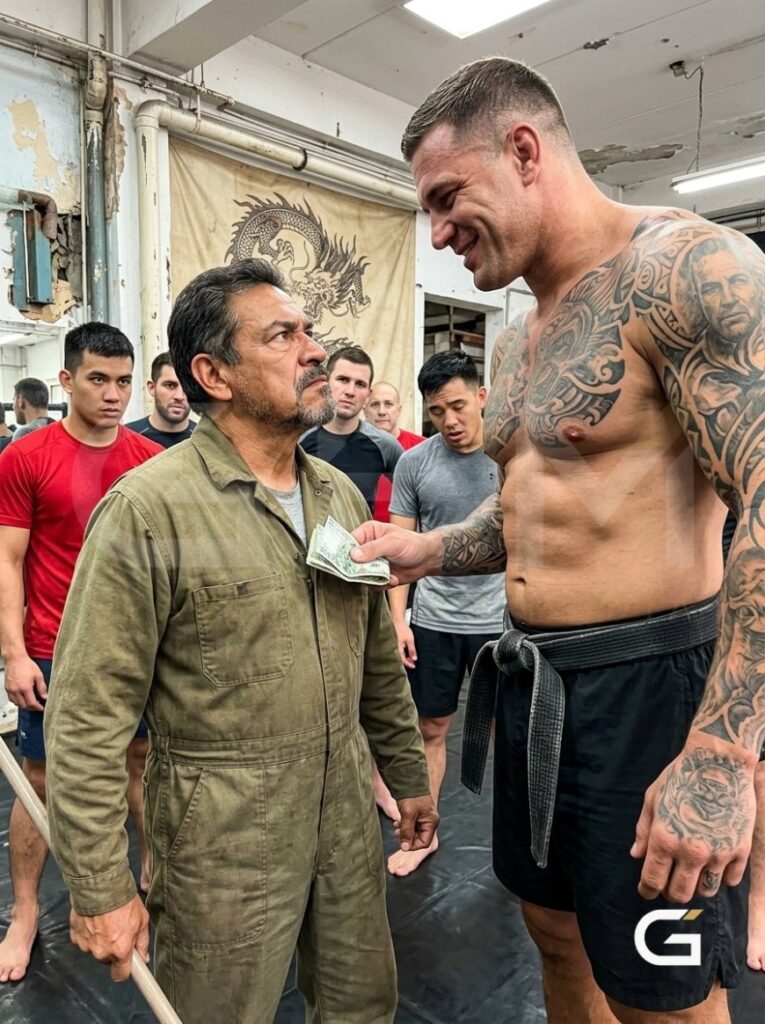
He opened the closet door and stepped inside, disappearing into the darkness.
“Edward?” I called.
“Yes?”
“Thank you.”
There was a long pause.
“Goodnight, Kevin.”
The closet door clicked shut.
—
I showed up at six a.m. the next morning, half expecting the whole thing to have been a dream.
But Edward was already there, standing in the center of the mat, barefoot, arms crossed. He was wearing the same faded gray t-shirt under his jumpsuit, which he had unzipped and tied around his waist like before.
“You’re on time,” he said.
“I try.”
“Trying isn’t good enough. Either you’re on time or you’re not.”
He walked toward me and stopped about six feet away.
“First lesson,” he said. “Forget everything you think you know about fighting. Forget the techniques. Forget the combinations. Forget everything you’ve been taught.”
I frowned.
“What am I supposed to do, then?”
“Stand there. Breathe. Feel your feet on the mat.”
I did as he said, standing awkwardly in the center of the floor, shifting my weight from foot to foot.
“Stop fidgeting,” Edward said. “Plant yourself. Feel the earth beneath you. The mat doesn’t move. Neither should you.”
I tried to stand still.
“Now close your eyes.”
I closed them.
“Tell me what you feel.”
I felt stupid, standing there with my eyes closed in an empty gym at six in the morning. But I tried to focus.
“I feel… the mat under my feet. It’s a little cold.”
“Good. What else?”
“I feel the air. There’s a draft coming from somewhere.”
“Good. What else?”
“I feel… heavy. My legs feel heavy.”
“Why?”
“Because I’m standing still?”
“Because you’re not relaxed. You’re holding tension in your muscles. When you’re tense, you’re slow. You’re predictable. You’re easy to read.”
I heard his footsteps approaching.
“Relax your shoulders. Let your arms hang natural. Unclench your jaw.”
I tried to do as he said.
“Better,” he said. “Now open your eyes.”
I opened them. Edward was standing directly in front of me, barely an arm’s length away.
“Hit me.”
I blinked.
“What?”
“You heard me. Throw a punch. Right hand. Whatever you’ve got.”
I hesitated.
“I don’t want to—”
“That’s your first mistake. Stop thinking about what you want. Stop thinking about consequences. Just act.”
I threw a half-hearted right hand. Edward didn’t even move. He just tilted his head and let my fist sail past his ear.
“Again. Harder.”
I threw another punch, putting more force behind it. He slipped it with a tiny head movement.
“Again.”
I threw a combination—jab, cross. He deflected both with his palms.
“Again.”
I kept throwing. He kept slipping, ducking, deflecting, always staying just out of reach, always calm, always in control.
“Stop,” he said.
I stopped, panting.
“Your problem is that you’re throwing your punches from your shoulders. Your power is coming from your arms, not your body. That’s why Trent was able to walk through you.”
He moved to my side, positioning himself so I could see his profile.
“Watch.”
He threw a slow, exaggerated punch, twisting his hips and driving his rear foot into the ground.
“Your power comes from here,” he said, touching his hip. “And here.” He touched his foot. “And here.” He touched his shoulder. “Your arm is just the messenger. It delivers the power, but it doesn’t create it.”
He threw another slow punch, this time faster, and I felt the air displace in front of his fist.
“Understand?”
“I think so.”
“Good. Now let’s try again.”
—
We trained for an hour. By the time Edward had to clock in for his shift, I was drenched in sweat and my shoulders were on fire.
“Same time tomorrow?” I asked.
Edward looked at me for a long moment.
“You lasted the full hour,” he said. “Most people quit in the first fifteen minutes.”
“Is that a yes?”
He nodded.
“Same time tomorrow.”
—
I trained with Edward every morning for the next three months.
He never called himself my coach. He never gave me a title or made promises about the future. But every day, from six a.m. to seven a.m., he taught me. Not just techniques, but principles. Footwork. Timing. Distance. Breath control. The art of staying calm under pressure.
He was patient. He was precise. He was demanding.
He never praised me. But he never gave up on me, either.
And slowly, over those three months, I got better.
Not dramatically. Not overnight. But I started to feel the changes. My punches hit harder. My defense got tighter. My mind got clearer.
He even taught me the counter to Trent’s leg kick—the one that had felled me in the beginning.
“Catch it,” he said, demonstrating. “Step in, not back. Always move forward. Offense is defense.”
I practiced that one move hundreds of times. From the right, from the left, moving forward, pivoting, catching the kick and countering with a hook to the liver.
Edward watched me, expressionless.
“Again.”
I did it again. And again. And again. Until my hip was sore and my wrists were aching.
“Again.”
I did it again.
“Good,” Edward said.
It was the first time he’d ever said that word to me.
—
Six months later, Trent Lawson came back to the gym.
He’d been gone for a while—rumor was he’d been training somewhere else, licking his wounds, trying to rebuild his shattered ego.
When he walked through the doors, the gym went quiet.
He looked different. Leaner. Humbled.
He walked over to me while I was wrapping my hands.
“Kevin,” he said.
“Trent.”
There was an awkward pause.
“I owe you an apology,” he said. “For what happened before. For the way I treated you.”
I looked at him. The arrogant kid who had humiliated me was still there, but buried under layers of shame and regret.
“You don’t owe me anything,” I said.
“I do. I was out of line. I was cruel.”
“You were.”
He winced.





