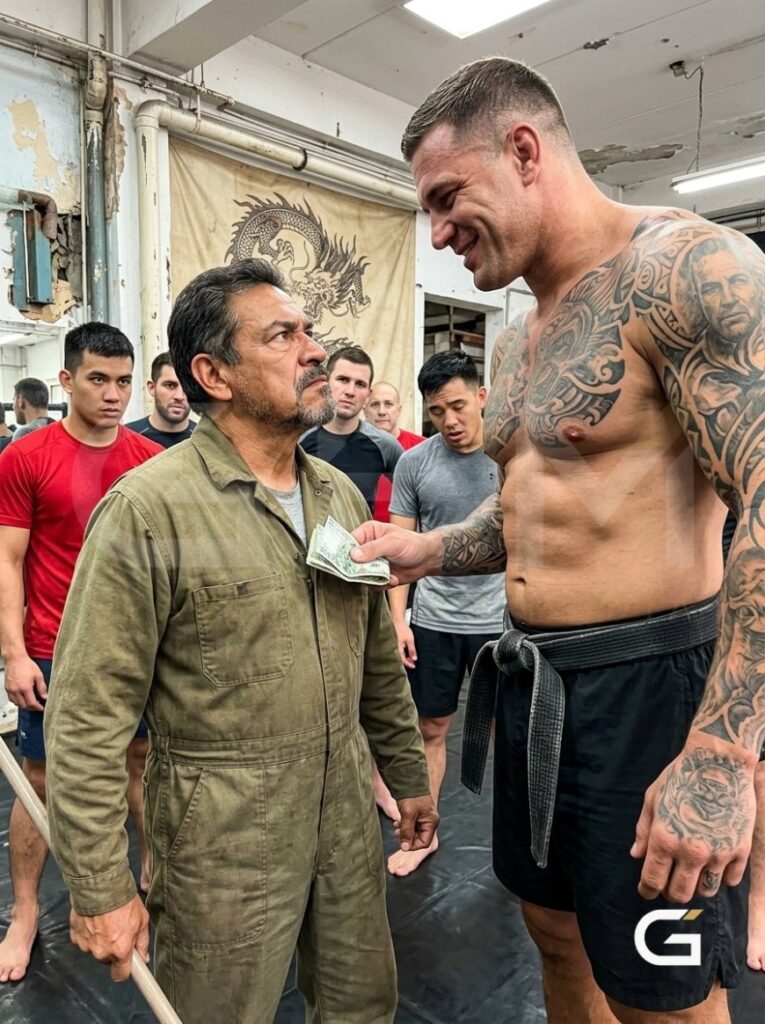
“Detroit Iron,” Kevin said. “Middleweight. Fought bare knuckle in the nineties. Retired undefeated.”
The color drained from Davis’s face.
“That’s impossible,” he whispered. “Arty Hayes was a legend. He disappeared twenty years ago. Nobody knows where he went.”
“Until now,” somebody muttered.
Davis looked at the locker room door where Edward had disappeared.
“Well, I’ll be damned.”
—
I found Edward in the hallway behind the locker rooms, sitting on an overturned bucket, eating a sandwich wrapped in wax paper.
He looked up when he heard my footsteps. His eyes didn’t have that flat, unblinking quality anymore. They were just… tired. Tired the way anyone would be tired after a twelve-hour shift.
“Kevin,” he said.
“You know my name?”
“I know everybody’s name.”
I didn’t know what to say. My nose was still sore, my thigh still ached, and I had just watched a fifty-eight-year-old man dismantle the best fighter in our gym without breaking a sweat.
“I wanted to thank you,” I said.
“For what?”
“For… I don’t know. For standing up to him.”
Edward took a bite of his sandwich. Chewed slowly.
“I didn’t stand up for you,” he said. “I stood up because he was disrespecting the mats. There’s a difference.”
“I don’t understand.”
He swallowed, wiped his mouth with the back of his hand.
“These mats aren’t just rubber and foam. They’re a place where people come to learn. To grow. To become better versions of themselves. When somebody treats that like a joke—when they use it to humiliate instead of teach—they’re poisoning the well. I couldn’t let that stand.”
I stood there, absorbing his words.
“The things you said to him,” I said. “About talent not being enough. About discipline and humility.”
“What about them?”
“Do you really believe that?”
Edward took another bite of his sandwich. Chewed. Swallowed.
“I know it,” he said. “I learned it the hard way. Twenty-two years of fighting. Hundreds of rounds. Dozens of men who came into the sport with more natural ability than me and washed out within five years. You know why?”
I shook my head.
“Because they never fell in love with the process. They only loved the winning. And when the winning stopped—when they lost a fight, or got hurt, or hit a wall—they had nothing left to fall back on.”
He folded up his wax paper and tucked it into his jumpsuit pocket.
“But the fighters who lasted? The ones who made it to the top and stayed there? They were the ones who woke up every day and put in the work, not because they wanted a trophy, but because they loved the art. They respected the craft. They respected their opponents.”
He stood up, picking up his mop.
“That’s what separates the greats from the pretenders. Not talent. Never talent.”
—
I walked with him as he finished his rounds. The gym was empty now—everyone had cleared out after the fight, whispering and speculating and trying to make sense of what they’d seen.
The fluorescent lights hummed. The mop swished across the floor. Edward moved slowly, deliberately, dragging his left heel the way he always did.
“You could have any job you want,” I said. “With your skills, you could—”
“I don’t want any job,” Edward interrupted. “I want this job.”
“Why?”
He paused his mopping and looked at me.
“Because it’s quiet,” he said. “Because nobody expects anything from me. Because I spent two decades in the spotlight, trading pieces of my soul for applause, and I never want to do that again.”
He resumed mopping.
“The world is full of people who want to be thought of as tough. As dangerous. As special. They spend their whole lives chasing that feeling, that validation. And what do they get? Broken bones. Brain damage. Empty bank accounts. Estranged families. Regrets.”
The mop swished across the floor.
“I got out while I still had a choice. I walked away from the garden. I found peace. And I’m not going to throw that away just because some twenty-two-year-old with a trust fund and a chip on his shoulder thinks it would be fun to beat up an old man.”
I thought about that for a long time.
“I almost quit tonight,” I admitted. “After Trent put me on the mat. I was lying there, bleeding, and I thought—why am I doing this? Why am I paying two hundred dollars a month to get humiliated by some rich kid who doesn’t respect anybody?”
Edward stopped mopping.
“Did you quit?”
“No.”
“Why not?”
I thought about it.
“Because I love this,” I said slowly. “I don’t know why. I’m not particularly good at it. I’m not fast or strong or especially talented. But something about it… something keeps pulling me back.”
Edward nodded slowly.
“That’s the thing,” he said. “The thing that matters. You have the only quality that can’t be taught. You have heart.”
—
He finished his mopping and walked back to the supply closet, where he stored his bucket and mop. I followed him like a lost puppy, not wanting the night to end.
“Will you teach me?” I asked.
Edward froze with his hand on the closet door.
“Teach you what?”
“Anything. Everything. The things you know.”
He turned to look at me, and for a moment, I saw something in his eyes—not the flat, unblinking stare of the fighter, but something softer. Something almost like hope.
“I don’t teach,” he said.
“Please.”
“Why would you want me to teach you? I’m just a janitor.”
“Because you’re not just a janitor. And we both know it.”
Edward studied my face for a long moment. I don’t know what he was looking for, or what he found. But eventually, he nodded.
“Tomorrow morning,” he said. “Six a.m. Before my shift starts. Be here early, and we’ll see if you still feel the same way.”
“I’ll be here.”
“Don’t be late.”
“I won’t.”





