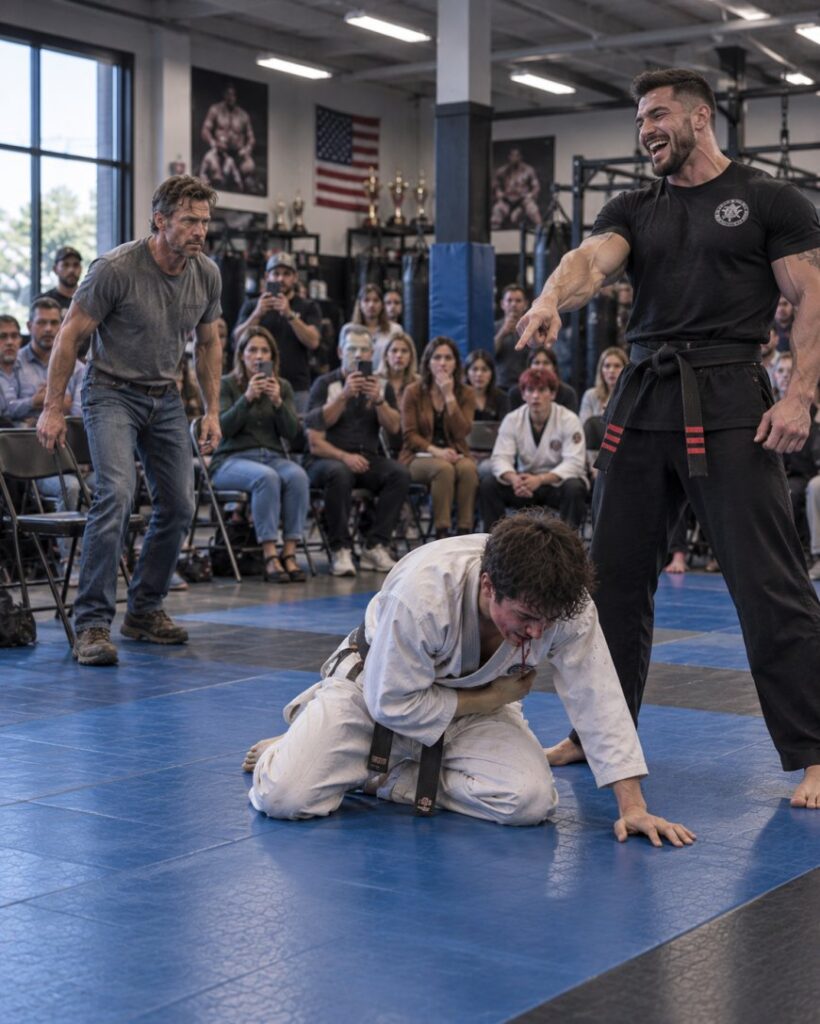
I had said stop twice before this point — quietly and without apparent urgency. Blake had registered the word both times and continued, because stopping was no longer something he was prepared to do. Not with the phones running, not with his students on the wall, not with whatever was happening to the story he had constructed about himself since the afternoon started.
The older gentleman at the end of the parent row leaned over to the woman seated next to him — a parent who had been watching with the expression of someone no longer certain what she was seeing. He said it quietly, not to the room, not as an announcement, just a statement between two people in adjacent chairs: that the man on the mat was a SEAL.
He said it the way someone states a fact they have confirmed to their own satisfaction, and feel no need to embellish.
The word traveled the way words travel in a quiet room — sideways and without announcement, through the small gaps between people already paying close attention to the same thing. Two seats down, another parent caught it. One of the older students near the wall heard it. Blake, who had never fully stopped performing for the room even while fighting, heard it too.
The effect was not immediate and not dramatic. Blake didn’t freeze. What he did was throw his next combination with slightly less precision, take half a second longer to reset, and start fighting in a way that was no longer about demonstrating anything. He was fighting now because the alternative was accepting what the word meant, and he wasn’t ready to do that.
He came at me with everything he had left, which was considerable. Blake Harron was a genuinely talented fighter, and under any other circumstances, the combinations he produced in those next forty-five seconds would have been admirable.
But the shift had happened. He was no longer moving with the fluid confidence of someone who expected to win. He was moving with the urgent, uneconomical energy of someone trying very hard not to lose — which is a different thing entirely, and which tends to solve the problem only in movies.
I changed modes.
I had been content until now to stay in the negative space, to let Blake exhaust his patterns, to let the room observe the difference between performance and function. That phase was finished.
I stepped into the next combination rather than away from it, neutralized the lead hand, changed the geometry of Blake’s base with one deliberate adjustment of my own foot position, and took us both to the mat. The sequence ended with me on top, Blake’s guard passed, and roughly one hundred ninety pounds of focused, unhurried control pressing Blake Harron into the mat of his own gym.
Blake tried to use his hips to create leverage. I adjusted. Blake tried to reach an arm free. I moved to counter the reach before it completed. Blake tried to bridge and roll and found that the angle was wrong and had been deliberately made wrong. Whatever Blake attempted in the next several seconds had already been anticipated — not by calculation, but by the kind of deep pattern recognition that comes from having spent a significant portion of one’s professional life in situations where getting the position wrong had consequences that extended well beyond the mat.
Blake started to panic. Not visibly, not completely, but in the specific involuntary way the body panics when it realizes its usual tools are not working and it cannot identify what would. His breathing changed. His attempts to escape became less technical and more frantic. I felt all of it and responded to none of it with additional force, which in certain ways was more disorienting than if I had.
I spoke, and my voice was level in the way that voices are level when the person speaking has nothing to prove. I asked Blake if he knew why he’d been able to do what he’d done to Evan that afternoon.
Blake said nothing.
I told him anyway. Because Evan was afraid of him. I said it not as an accusation but as a mechanical fact. A young fighter held in an unfamiliar environment, facing an adult in a position of authority who had made fear the central teaching instrument, was never going to perform. Blake had built his entire class around ensuring that fear was always present and always pointed at himself. And he had told himself it was discipline. Told himself it was preparation for the real world.
What it actually was, I said in the same flat, unhurried tone, was the satisfaction of watching people smaller than you confirm that you were powerful. And I said that Blake had been mistaking that feeling for respect for a long time.
Blake’s body went through one more attempt to escape, and then stopped — not from lack of will, but from the arrival of the understanding that he was not going to escape, and that whoever this man was, he had not yet decided what he intended to do about that.
I shifted to a shoulder lock, slow and precise. Blake felt the joint load, felt the precise point at which another two centimeters of movement would produce damage that couldn’t be undone in a weekend. And that was the moment when all of this afternoon’s architecture — the credentials, the titles, the belt, the phones, the performance — collapsed into something much simpler and more honest.
Blake tapped the mat once with his free hand, then a second time, then a third.
I held the position for exactly one additional beat.





