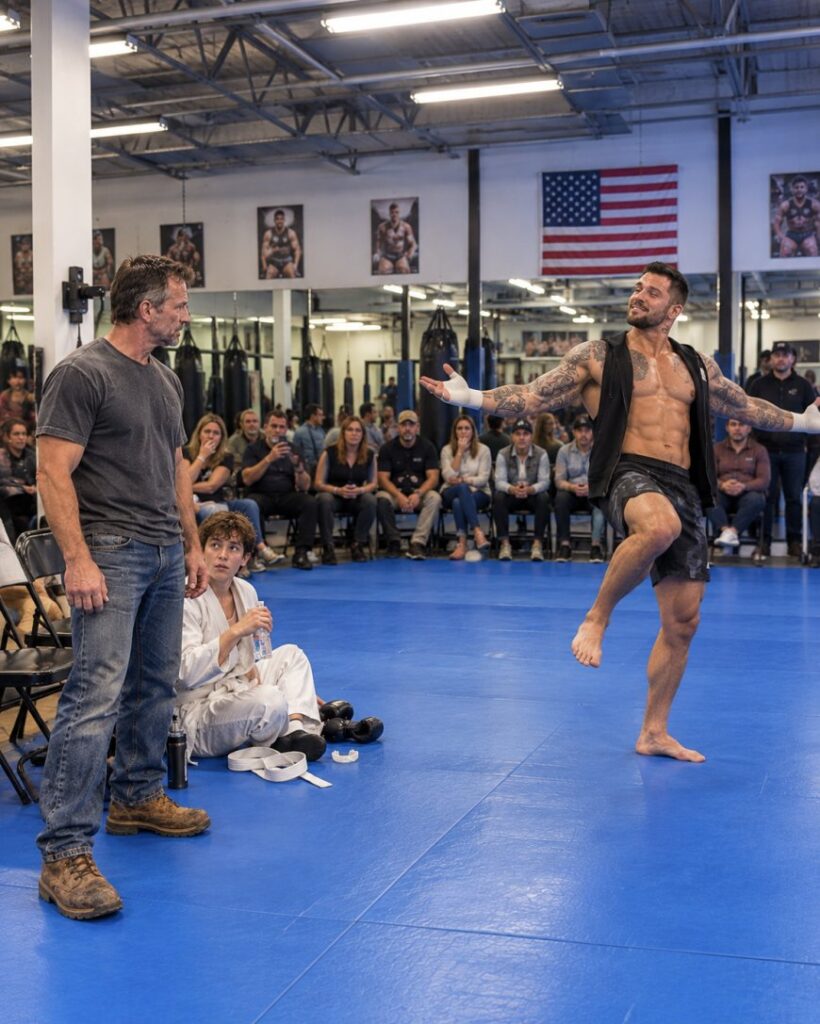
He had brought monsters to kill a sheep — only to realize the sheep was a wolf wearing a wool coat.
I began to walk toward him. My footsteps were slow, deliberate. The steel toes of my boots scraped softly against the concrete.
“No,” Trent whimpered, pressing his spine so hard into the tire it looked like he was trying to phase through it. He raised his hands, palms facing out. “No, please. Please, man, stop.”
I stopped two feet away. I looked at Trent. I looked past the muscles, past the tattoos, past the carefully constructed facade of a local tough guy.
I saw exactly what Trent was. A scared, pathetic child playing dress-up in a world that didn’t care about him.
“You brought men to hurt me,” I said. My voice wasn’t angry. It was a quiet, factual hum. “You brought a chain. You wanted to put me in a wheelchair because your ego couldn’t handle the truth.”
“I was mad. I wasn’t thinking.” Trent babbled, tears mixing with the sweat on his bruised cheeks. He slid down the rubber tire until his knees hit the greasy floor. He was begging.
I reached down. Trent flinched, curling into a tight defensive ball, waiting for the killing blow.
But I just reached into the front pocket of Trent’s hoodie and pulled out his cell phone.
I looked at the screen. I locked eyes with the trembling black belt.
Then I squeezed my hand.
The glass shattered, cutting into my palm, the plastic casing snapping under the immense, unyielding pressure of a man who spent his life turning rusted steel bolts.
I dropped the mangled electronics onto the floor and crushed it into dust beneath my heel.
“You’re going to pack up your gym,” I said, my voice dropping to a terrifying whisper. “You’re going to sell the mats. You’re going to break your lease. By Monday, that storefront is going to be empty. You will never teach another child. You will never put a belt around your waist in this town again.”
Trent stared at the floor, nodding frantically, sobbing. “Okay. Okay. I swear I’m done. I’m out.”
“If I drive past that strip mall next week and see your sign—” I leaned in closer, the smell of grease and copper filling Trent’s senses. “I will not hit you. I will not break your ribs. I will simply remove you. Do you understand the difference?”
Trent looked up into my eyes. He saw the void. He saw the absolute, unquestionable truth in the statement.
He nodded once.
“Get your trash out of my shop,” I said.
I turned my back on the three broken men. I didn’t look over my shoulder to see if they were getting up.
I walked to the heavy industrial sink in the corner of the garage. I turned the metal knob, letting the scalding hot water run over my bruised, cut hands. I pumped a thick glob of pumice soap into my palms and began to scrub.
I scrubbed the grease. I scrubbed the blood. I watched the dark gray water spiral down the metal drain.
I closed my eyes. I breathed in for four seconds. I held it for four seconds.
I pushed the heavy iron door in my mind shut, listening for the internal click of the vault locking back into place.
It was harder to close this time. It always was.
I dried my hands on a paper towel. I checked my watch. It was 5:30 p.m.
I needed to get home. I had promised Leo we would order pizza tonight.
Sometimes the most dangerous man in the room is the one trying the hardest to avoid a fight.
I’m not a hero. I’m not a vigilante. I’m just a father who spent twelve years learning how to kill and the last ten years trying to forget.
Trent broke my son’s nose because his ego couldn’t handle a sixteen-year-old who was trying his best. He humiliated Leo in front of his peers because he needed to feel powerful. He brought thugs to my workplace because he couldn’t face the truth: that out in the real world, without his trophies and his padded mats and his worshipful students, he was nothing.
I gave him a chance to make it right. I asked for a simple apology. I asked him to change the way he ran his school.
He laughed in my face.
So I taught him the lesson he charged those parents for. I showed him what real violence looks like. I showed him that the quiet man with the limp and the thinning hair was not a sheep — he was a wolf who had chosen to live among sheep.
And when he tried to retaliate, when he brought his monsters to my workplace, I dismantled them piece by piece.
I didn’t enjoy it. I never do. The monster in me is not a pet. It’s not something I can call up and put away at will. Every time I let it out, it takes something from me. It leaves a residue that I have to scrub away in VA clinics and fluorescent-lit therapy rooms.
But some things are worth the cost.
My son’s dignity is worth the cost.
His safety is worth the cost.
His belief that his father can protect him is worth the cost.
That night, Leo and I sat on the couch, a large pepperoni pizza between us, watching some mindless action movie he picked out. His face was still swollen. The tape across his nose made him look like a cartoon boxer. But he was smiling.
“Dad,” he said, around a mouthful of pizza. “What you did… at the dojo. And yesterday. I don’t… I don’t really understand it. But thank you.”
I took a long pull from my beer. I looked at my son — my awkward, trying-too-hard, all-elbows-and-knees son — and felt something loosen in my chest.





