Trent gripped the edges of the porcelain sink. His hands were shaking. Anger — hot and venomous — began to boil in his gut, temporarily overriding the pain.
He remembered the feeling of my hand on his throat. He remembered the complete, humiliating helplessness. He remembered the sound of his own rib snapping. And worse — he remembered the sound he had made afterward. A pathetic, whimpering squeal.
And his two students had seen it. They had seen their god bleed.
Trent opened the medicine cabinet, grabbed a bottle of leftover painkillers from a torn meniscus surgery two years ago, and dry-swallowed two white pills. He leaned over the sink, staring at the bloody, mangled ruin of his face.
“He got lucky,” Trent told himself. The lie felt good. It felt necessary. “I wasn’t ready. He cheap-shotted me. He’s an old man.”
The rationalizations piled up — bricks in a wall of denial. Trent was a narcissist, and a narcissist’s brain cannot process absolute defeat. It must rewrite the narrative.
But beneath the lies, a cold spike of dread remained. My ultimatum echoed in his ringing ears.
“You will stand in front of that class. You will apologize.”
If he didn’t, the man with the dead eyes would come back. Trent knew that much was true. He had felt the killer in me.
But apologizing? Bowing to a teenager in front of the suburban housewives who thought he was a hero? In front of the kids who worshiped him? It would destroy his business. It would destroy his myth.
Trent turned on the faucet, splashing cold water on his unbroken cheek. He hissed in pain.
He had to survive today. He had to play the game.
But as he looked in the mirror, his eyes narrowing to dark slits, a new, darker thought took root.
He would give the old man his apology today. And then he would destroy him tomorrow.
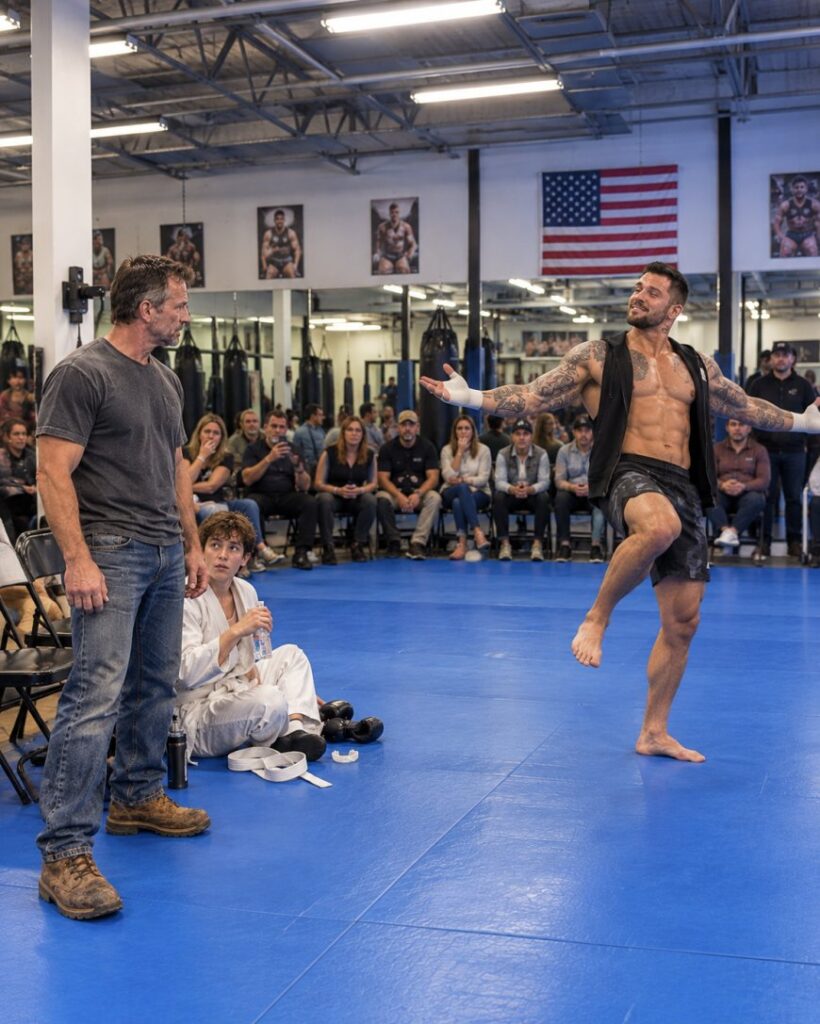
The dojo felt different.
The smell of cheap floor wax was exactly the same. The neon sign hummed at the exact same pitch. But the air inside the room was heavy, stagnant.
It was 4:15 p.m. The intermediate teen class was stretching on the mats. The row of folding chairs along the mirrored wall was packed with parents holding coffees and scrolling on their phones.
The bell above the glass door chimed.
The room went entirely silent.
I walked in. I wore my heavy work boots, faded denim, and a plain black t-shirt. I walked with that slight limp, my expression perfectly neutral.
Right behind me was Leo. The boy was wearing his white GI, carrying his duffel bag. His face was a horrific canvas of purple and yellow, the tape across his broken nose drawing every eye in the room.
Several parents gasped. Whispers erupted instantly, hands covering mouths.
I ignored them. I walked over to the edge of the mat and stopped. I looked at Trent.
Trent was standing in the center of the blue vinyl. He looked terrible. He was wearing his black GI, but it hung loosely on his frame. He had a thick white splint taped across his ruined nose. He was standing stiffly, his left arm held unnaturally close to his ribs. The bruising around his eyes couldn’t be hidden.
When Trent saw me, a visible shudder ran through his body. He tried to suppress it, puffing his chest out instinctively, but the movement pulled at his broken ribs, and he winced sharply, dropping his posture back to a hunched, defensive slump.
“Leo,” I said quietly, not taking my eyes off Trent. “Get on the mat.”
Leo swallowed hard. His hands were shaking. He took his shoes off, his bare feet slapping softly against the floor. He walked onto the mat, stopping ten feet away from Trent.
The other teenagers had stopped stretching. They were staring — at their instructor, then at Leo, then at the quiet man standing by the door.
Trent looked around the room. He saw the mothers staring at his bruised face. He saw the doubt creeping into the eyes of his students. His jaw tightened.
He had rehearsed this in his head all day. He had planned a speech about mutual respect, about how martial arts is a journey of mistakes. He wanted to spin this. He needed to save face.
Trent cleared his throat. It sounded wet and painful.
“Listen up,” Trent said, addressing the room. His voice lacked its usual booming authority. It sounded thin. Weak. “ Martial arts is about learning. It’s about pushing limits. Sometimes… sometimes those limits get pushed too far in the heat of training. Last night, Leo and I had a hard spar…”
He paused. He looked over at me.
I hadn’t moved. I hadn’t blinked. I was just watching.
But the look in my eyes wasn’t the look of a parent. It was the look of a sniper waiting for a target to step into the crosshairs. It was a promise of catastrophic violence.
The speech died in Trent’s throat. The lie evaporated.
The phantom feeling of his windpipe being crushed rushed back into his memory, suffocating him. The room felt incredibly small, the walls closing in.
He realized with terrifying clarity that if he tried to spin this — if he tried to maintain his ego — the man standing by the door would walk onto the mat and finish the job in front of fifty people.
Trent dropped his gaze to the floor. The silence stretched thick and agonizing.
“I lost control,” Trent said, his voice cracked.
A collective murmur rolled through the parents in the folding chairs.
Trent forced himself to look at Leo. The teenager was trembling, looking at Trent not with respect, but with pure, unadulterated fear.
“I let my ego get the better of me.” Trent forced the words out. They tasted like poison, burning his tongue. Every syllable felt like a piece of his identity being chipped away with a chisel. “I struck you when you were defenseless. It wasn’t a lesson. It was a mistake. A coward’s mistake. I broke your nose and I humiliated you.”





