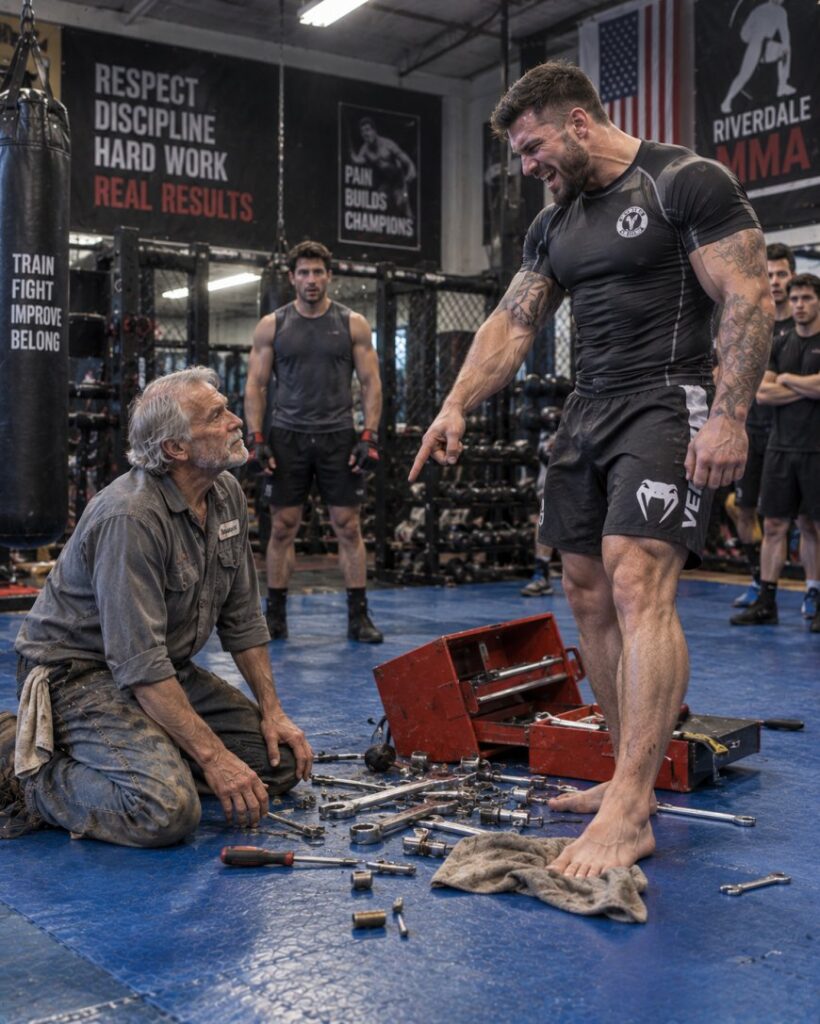
“Pain teaches you your limits,” Hank said. “But it doesn’t teach you how to live. That’s something you have to figure out on your own. I could have broken his thumb in ten different ways. I could have put him in the hospital. But that wouldn’t have taught him anything except fear. And fear is a terrible teacher.”
He picked up his mop and started pushing it across the mats. “Come on. Let’s finish up. I’m tired.”
Sam picked up his mop and followed.
Two weeks later, Sam showed up at the gym on a Wednesday night—not his usual training day—and found Hank sitting on the bench near the lockers, staring at his phone. The old man’s face was pale.
“Hank?” Sam said. “What’s wrong?”
Hank didn’t look up. He just handed Sam the phone.
On the screen was a news article. The headline read: FORMER CORRECTIONS OFFICER CHARGED IN 2009 INMATE DEATH.
Sam felt his stomach drop. He scanned the article, his eyes moving quickly. It was about an incident at Ely State Prison—a fight between inmates that had escalated. A corrections officer had intervened. An inmate had died. The officer had been cleared of wrongdoing at the time, but new evidence had surfaced. The case was being reopened.
“Is this you?” Sam asked.
Hank nodded slowly. “I was the officer.”
Sam read the article again. The details were sparse—the kind of preliminary reporting that leaves more questions than answers. The inmate had been a violent offender, serving life for murder. He had attacked another inmate with a homemade weapon. Hank had intervened. The inmate had died from his injuries.
“They said it was self-defense,” Hank said quietly. “They said I did what I had to do. But now they’re saying maybe I used excessive force. Maybe I didn’t have to hit him that hard. Maybe I could have restrained him instead of…”
He trailed off, staring at the floor.
Sam sat down next to him. “What happened?”
Hank was quiet for a long time. Then he said, “The inmate’s name was Marcus. He was twenty-nine years old. He had a daughter. He had a mother who visited him every month. He was a bad man—he’d killed two people—but he wasn’t a monster. No one is.”
He looked at Sam. “When he came at me with that shank, I didn’t think. I just reacted. I put him down. And he didn’t get up. The coroner said it was a freak thing—the way he hit his head when he fell. But I’ve been replaying that moment for fifteen years. Every night. Wondering if I could have done something different.”
Sam didn’t know what to say. He just sat there, listening.
“I thought I was done with all of this,” Hank said. “I thought I could just mop floors and disappear. But it doesn’t work that way. The past doesn’t let you go. It just waits for the right moment to pull you back.”
He stood up, wincing as his knees popped. “I have to go. I have a meeting with a lawyer tomorrow.”
Sam stood up too. “Do you have a lawyer?”
“I have a public defender. He seems decent. Young. Idealistic.” Hank shrugged. “We’ll see.”
He picked up his keys and walked toward the exit. Sam followed him.
“Hank,” he said. “You’re not alone.”
Hank stopped at the door. He didn’t turn around.
“I know,” he said quietly. “But that doesn’t change anything.”
He pushed the door open and stepped out into the night. Sam watched him go, his heart heavy.
The next few weeks were hard. Hank’s case was all over the news—not just local, but national. The story had everything: a former corrections officer, a dead inmate, a reopened investigation, a city divided. Some people called Hank a hero. Others called him a murderer. The truth, as always, was somewhere in between.
Sam visited Hank at his apartment—a small, cluttered one-bedroom on the edge of town. Hank didn’t have much: a recliner, a television, a bookshelf crammed with paperback thrillers and old magazines. On the wall was a photograph of a woman with kind eyes and a warm smile. Hank’s wife.
“She was beautiful,” Sam said.
Hank nodded. “She was.”
They sat in silence for a while, watching the news. The reporters were outside the courthouse, waiting for the hearing to begin. Hank’s public defender had told him to stay home, to avoid the cameras.
“They’re going to twist everything,” Hank said. “They’re going to make me look like a monster.”
“You’re not a monster,” Sam said.
Hank looked at him. “You don’t know that.”
“I know what I saw. I know what you did for me. For Brad. You could have hurt him, but you didn’t. You chose to let him go.”
Hank was quiet for a moment. Then he said, “That was different.”
“How?”
Hank didn’t answer. He just stared at the television, his jaw tight.
The hearing was held three days later. Sam took the day off work and sat in the back of the courtroom, watching. Hank sat at the defendant’s table, wearing a plain gray suit that hung loose on his thin frame. His public defender—a young woman named Aisha who couldn’t have been older than thirty—spoke passionately about Hank’s decades of service, his clean record, his exemplary conduct.
The prosecutor spoke about Marcus. About his daughter, who was now sixteen. About his mother, who had been waiting fifteen years for justice. About the coroner’s report, which suggested that the fatal blow might have been preventable.
Sam watched Hank’s face. The old man didn’t flinch. He didn’t show any emotion at all. He just sat there, his scarred hands folded on the table, his eyes fixed on the judge.
The judge was an older woman with silver hair and sharp eyes. She listened to both sides, asked a few questions, and then announced that she would take the matter under advisement. The hearing was adjourned.





