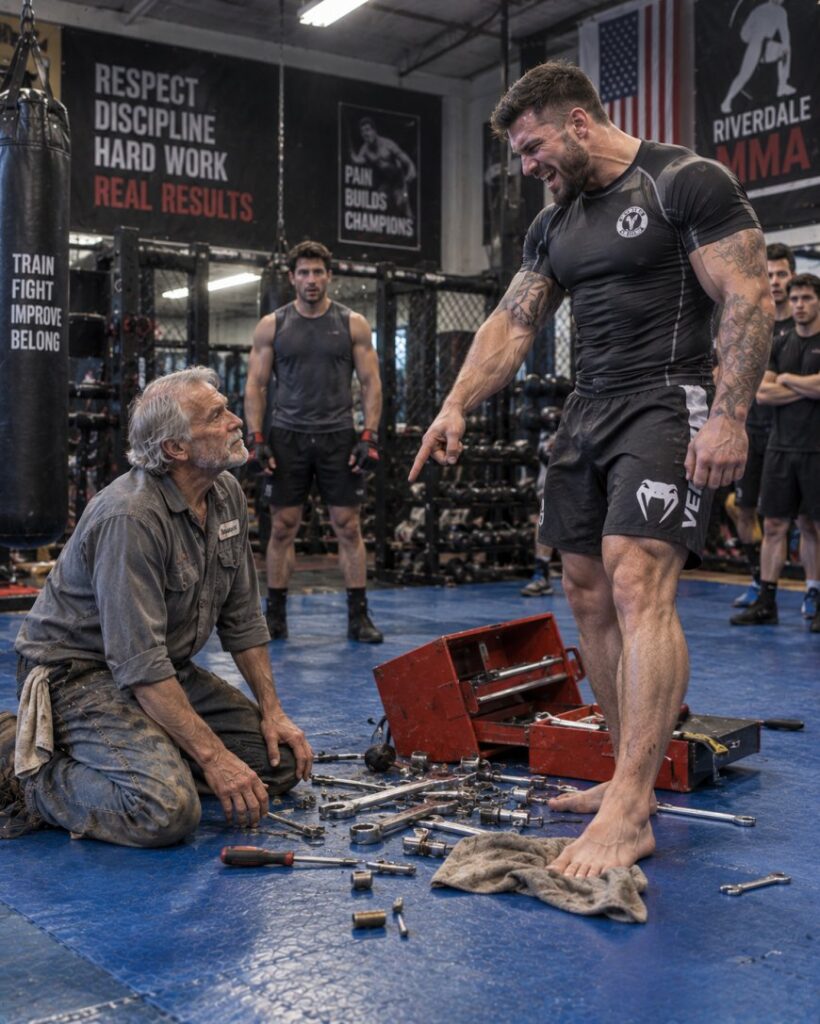
Hank was quiet for a long time. The only sound was the hum of the fluorescent lights and the distant rattle of the industrial fan in the back corner. Then, slowly, he set the mop against the wall and lowered himself onto a nearby bench. He groaned as he sat, his knees popping audibly. He pulled the small plastic bottle of mentholated muscle rub from his pocket and began working it into his swollen knuckles.
“I wasn’t calm,” Hank said quietly. “I was terrified.”
Sam blinked. “You didn’t look terrified.”
“That’s because fear and panic are two different things.” Hank rubbed the ointment into his left hand, his movements slow and methodical. “Panic is when you lose control. Fear is when you know exactly what’s happening and you choose what to do next. I’ve been afraid so many times that it doesn’t slow me down anymore. It just… informs me.”
Sam sat down on the bench across from him, careful to keep his distance. “Informs you how?”
“Tells me what the other guy is about to do. Tells me where his weight is. Tells me which joint is exposed.” Hank flexed his fingers, wincing slightly. “When you’ve been in enough fights, you stop seeing people as people. You see them as geometry. Levers and angles and points of failure. That kid, Brad—he looked at me and saw an old man. I looked at him and saw a puzzle I’d already solved a hundred times.”
Sam absorbed that. “How many fights have you been in?”
Hank chuckled—a dry, hollow sound. “Real fights? I stopped counting after the first year at Ely.”
“Ely?”
“Nevada State Prison. Maximum security. I worked there for twenty-five years.” Hank paused, studying Sam’s face. “You know what a corrections officer does?”
“Keeps order,” Sam said.
“Keeps order,” Hank repeated, a bitter edge in his voice. “That’s a polite way of saying I spent every shift surrounded by men who had nothing left to lose. Men who would kill you for a pack of cigarettes. Men who would wait weeks for the right moment, the right angle, the right second when you turned your back.” He held up his left hand. “You see this pinky? Lost it in a fight with an inmate who got hold of a homemade knife. Nearly took my thumb, too. The scar you saw—that’s from another one. A guy who thought I was too friendly with the wrong gang. Slipped a shank between my fingers when I wasn’t looking.”
Sam felt a cold knot form in his stomach. “How did you survive?”
Hank shrugged. “I learned to see it coming. I learned to read the shift in a man’s shoulders before he moved. I learned that violence isn’t a skill—it’s a language. And once you speak it, you can’t unlearn it.”
He finished rubbing his hand and screwed the cap back on the bottle. “That’s why I told you no. You don’t want to learn this language, accountant. It doesn’t make you stronger. It just makes you tired.”
Sam was quiet for a moment. Then he said, “But you didn’t hurt him. You could have. You could have broken his thumb, or his wrist, or his elbow. But you didn’t.”
“No,” Hank agreed. “I didn’t.”
“Why?”
Hank looked at him, and for the first time, Sam saw something other than exhaustion in his eyes. He saw something that might have been regret.
“Because I’ve broken enough men,” Hank said quietly. “I’ve done enough damage. I’ve spent my whole life learning how to take people apart, and I’m tired. I’m tired of seeing the look in their eyes when they realize they can’t stop you. I’m tired of the sound a bone makes when it snaps. I’m tired of the nightmares.” He paused. “That kid in there—he’s a bully. But he’s not a monster. Not yet. Maybe he’ll learn. Maybe he won’t. But that’s not my job. My job is to mop the floors and go home.”
Sam nodded slowly. He understood, or at least he thought he did. Hank had spent decades steeped in violence, and now he was trying to wash it off, one bucket of soapy water at a time.
“I’m sorry,” Sam said.
Hank raised an eyebrow. “For what?”
“For pushing. For following you to your truck. For showing up here every night like some kind of stalker.”
Hank snorted. “You’re not a stalker. You’re just curious. I get it. Most people look at me and see a broken-down old man. You looked at me and saw a question. That’s not something I can hold against you.”
He stood up, groaning as his knees popped again. He picked up the mop and started pushing it across the mats. Sam watched for a moment, then stood up and walked to the supply closet. He found another mop—an older one, with a wooden handle worn smooth by decades of use—and carried it back to the mats.
Hank stopped and looked at him. “What are you doing?”
“My calves are tight,” Sam said. “I need the friction to stretch them out.”
Hank stared at him for a long moment. Then, slowly, the corner of his mouth twitched—not quite a smile, but close enough.
“Suit yourself,” Hank said. “But if you leave puddles, I’m making you clean them up.”
“I know,” Sam said.
They worked in silence, side by side, pushing the mops across the blue canvas. The rhythmic sound of wet cotton on rubber filled the empty gym, punctuated only by the occasional splash of the bucket and the distant hum of the traffic outside. Sam paid attention to his technique—the way he engaged his core, the way he drove from his hips instead of his arms. He thought about leverage. He thought about balance. He thought about how a man who spent his life forcing things would eventually break himself against his own resistance.





