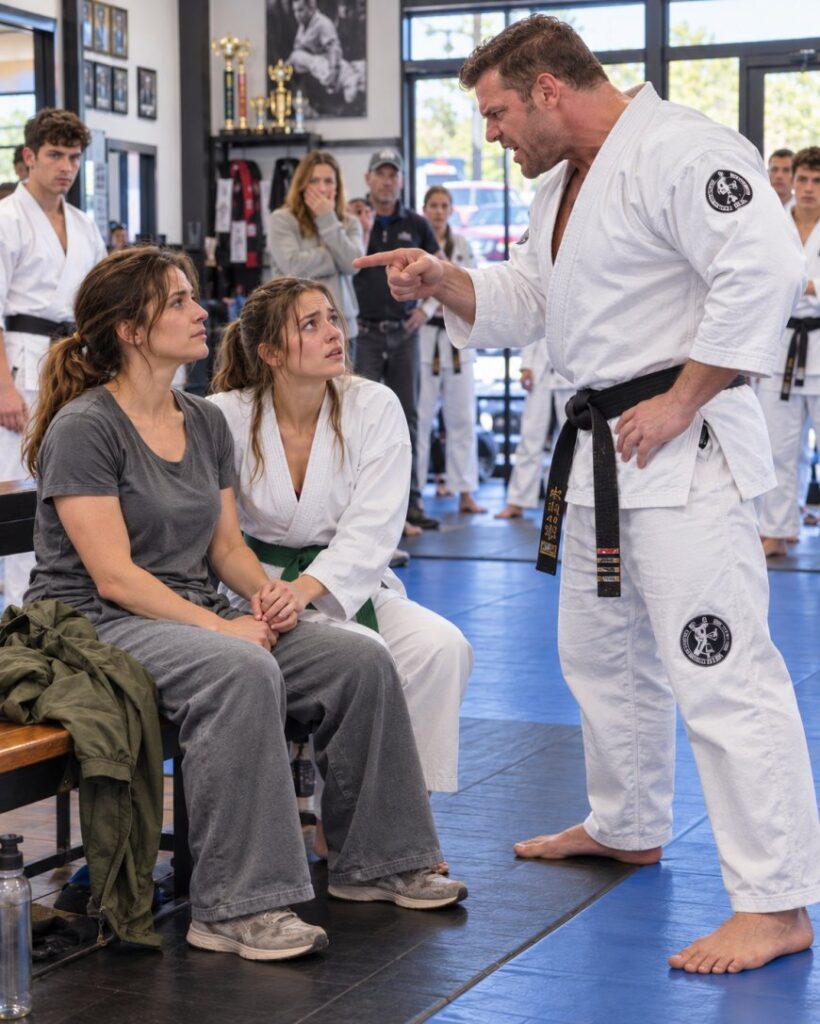
A photographer took the picture. Years later, it became my favorite. Not because Sarah wore a black belt. Because neither of us looked afraid.
She left for college the following fall. Sports psychology. That surprised me.
“I thought you’d do graphic design.”
She looked horrified. “I’ve seen your deadlines.”
Fair.
She wanted to study why young athletes stayed in abusive coaching environments. Why humiliation sometimes gets mislabeled as discipline. Why talented people confuse suffering with progress.
At twenty-four, she came home with news. She had been accepted into a graduate program.
Then she placed something on my kitchen table. An old DVD. My name was written across it.
LILY CARTER — WORLD GRAND PRIX FINAL.
My stomach dropped. “Where did you get this?”
“Grandma’s storage boxes.”
My mother had died four years earlier.
Sarah sat opposite me. “I watched it.”
I couldn’t speak.
“Mom, Uncle Tommy is in it.”
I stared. “What?”
“Before the fight.”
She opened her laptop. My hands went cold.
“No.”
“Just watch thirty seconds.”
“I can’t.”
“Okay.”
She immediately closed the screen.
That made me look at her. No pressure. No disappointment. No accusation of weakness.
She had learned. Maybe I had too.
“Open it.”
Sarah hesitated. “Sure?”
“Yes.”
The video began. Thirteen-year-old footage. Backstage. A younger me bouncing lightly beneath arena lights.
Then Tommy leaned into frame. Twenty-two. Alive. Grinning.
I stopped breathing.
He looked directly into the camera. “Lily’s pretending she can’t hear me because she’s doing her scary Silent Storm thing.”
My hand covered my mouth. Sarah reached across the table but didn’t touch me until I took her hand.
Tommy continued. “If she wins tonight, she’s going to say it was training.”
He grinned. “If she loses, she’s going to blame my driving.”
I laughed through a sob.
Then he became unexpectedly serious. “My sister thinks fighting is what she’s best at.”
He shook his head. “She’s wrong.”
My chest collapsed inward.
“The best thing Lily does is make scared people feel like they’re not stupid for being scared.”
He glanced off-camera. Someone called him. He looked back.
“So if she ever quits fighting, fine. Just don’t let her quit that.”
The video ended.
I couldn’t move. Thirteen years. I had believed Tommy died on the way to celebrate the fighter I had been. But his last surviving words about me had nothing to do with winning. Nothing about toughness. Nothing about belts.
He had seen something I had forgotten.
Sarah came around the table. I stood. Then folded into my daughter’s arms.
I cried against her shoulder until my knees hurt.
“I thought I killed him.”
She held me tighter.
“No.”
“I know.” For the first time, I meant it. “He chose to drive.”
My voice shook. “The weather changed.”
“Yes.”
“I loved him.”
“I know.”
“And none of those things caused the other.”
Sarah pressed her cheek against my hair. “No.”
That was the day my brother finally stopped dying every time I remembered him. He became Tommy again. Annoying. Funny. Too loud. Terrible driver even before the accident. A brother who stole my protein bars and told strangers I could beat them up. A young man who loved me.
Not a punishment I had been carrying for thirteen years.
At forty-nine, I stepped onto a mat to teach for the first time. Not fighting. Not exactly.
Robert had created a monthly workshop for parents, coaches, and teenage athletes. He called it Strength With Consent. I hated the title. Sarah loved it.
We taught boundaries. How to recognize coercive coaching. How to distinguish discomfort from injury. How to build confidence without manufacturing fear.
I demonstrated almost nothing. That surprised people. They expected Silent Storm.
I gave them Lily Carter. A mother. A former fighter. A woman who had once believed the only safe way to handle her strength was to bury it.
At the end of the first session, Jenkins approached me. He was twenty-six now. A physical therapist. He had returned to martial arts but never competed.
“Remember me?”
“Your grandmother kicks better than you.”
His eyes widened. Then I smiled.
He laughed. “Okay. I deserved that.”
“No, you didn’t.”
The smile disappeared. I touched his arm. “That’s the point.”
He nodded. Then told me he specialized in adolescent sports injuries partly because of what happened.
“I kept thinking about how many kids hide pain because they’re scared their coach will think they’re weak.”
He looked across the gym. “So now I listen.”
Tommy’s words returned. Make scared people feel like they’re not stupid for being scared.
I swallowed. “That’s good work.”
Jenkins smiled. “So is this.”
Robert retired at seventy-two. At his final academy gathering, he removed the old black belt he had worn for decades. He placed it in a display case.
Under it was a plaque.
TECHNIQUE GIVES YOU OPTIONS. CHARACTER TELLS YOU WHICH ONES NOT TO USE.
Sarah cried. I pretended I had allergies.
Robert hugged me. “You know, I spent years telling people I discovered Silent Storm sitting in my waiting area.”
“You did not discover me.”
“Let an old man improve the story.”
“No.”
He laughed. Then grew serious. “You saved this place.”
I shook my head. “No.”
He started to argue.
“The students did.” I looked toward Jenkins. Toward parents. Toward Sarah. “They spoke.”
Robert nodded slowly. “And you made room.”
Maybe. That was enough.
Jake never returned to the academy. Years later, I heard he had become a site supervisor. One of his former coworkers told Robert that Jake had a reputation for stopping work when someone reported an unsafe condition.
I didn’t know whether the story was true. I hoped it was. Not for me. For whoever worked beside him.
Redemption, if it exists, isn’t applause for becoming decent. It’s doing the decent thing when nobody who remembers your worst moment is there to see it.
Sarah eventually became Dr. Sarah Carter. The first time I saw the name printed on her office door, I took a picture.





