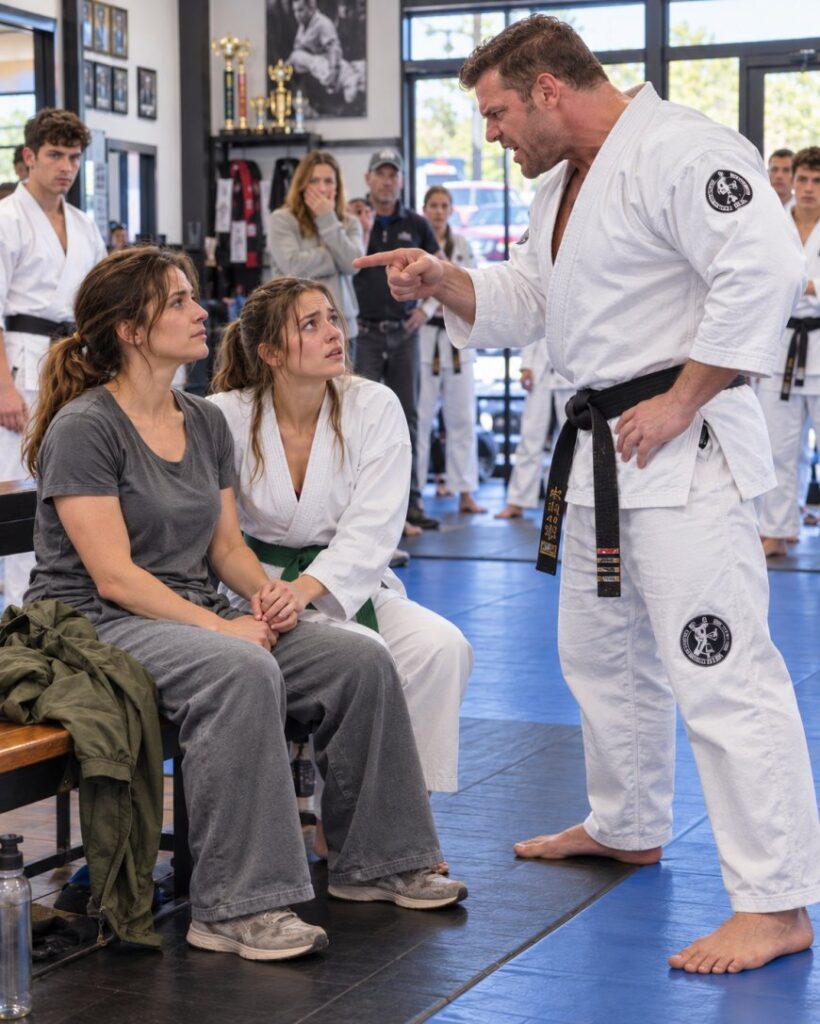
The same footage he hoped would make him look dominant became the cleanest evidence of what he had become.
Robert terminated him permanently. The academy’s governing association opened a disciplinary review. Jake’s instructor credentials were suspended during the investigation and later revoked by the organization that had certified him. Several families pursued claims related to documented injuries. His brother was dismissed for suppressing complaints. Sponsors connected to the academy ended their relationships with Jake personally.
And because he had built his reputation online, his downfall happened in the same place he had sought admiration.
But I refused every interview. So did Sarah.
A local reporter called me three times. An MMA podcast offered money. Someone found old footage of Silent Storm and combined it with the dojo video. Millions of views.
I hated it.
For forty-eight hours, I considered posting everything. My career record. Jake’s behavior. A statement that would finish him publicly.
I even wrote it.
Then Sarah walked into my bedroom. “You going to post that?”
“Maybe.”
She sat beside me. “Will it help the kids?”
That stopped me. Not: Will it hurt Jake? Will people think you’re awesome? Will it go viral? Will you win?
Will it help the kids?
I deleted the draft.
Instead, I gave my statement privately to the investigation. Robert did the same. The parents did the same.
Consequences did not require spectacle. That was something Jake had never understood.
Three months later, the academy reopened under a different structure. Robert asked me to come by. I refused twice. On the third call, he said: “Not to teach.”
“What then?”
“To listen.”
So I went.
The mats were the same blue. The fluorescent lights still buzzed. But the wall where Jake’s oversized photograph had hung was empty.
Robert had arranged chairs in a circle. Parents. Students. Two new instructors. Jenkins sat beside his mother. Sarah beside me.
Robert stood in the center. “I taught Jake when he was seventeen.”
His hands were clasped tightly. “I mistook intensity for commitment.”
Nobody moved.
“I rewarded him for being the last person to quit. The hardest person in the room. The one who could absorb pain and keep going.”
He swallowed. “Then when he became an instructor, I assumed those traits would make him strong enough to lead.”
Robert looked at Jenkins. “I was wrong.”
Jenkins’s mother wiped her eyes.
Robert continued. “I taught him that toughness deserved authority without teaching him that authority requires restraint.”
That sentence hit me. Because I had spent thirteen years doing something similar to myself. I had treated my own strength as dangerous because grief had fused strength with loss.
Jake had treated strength as permission. Both were distortions.
Robert looked at the students. “The academy will no longer promote anyone based solely on technical ability.”
New standards followed. Student welfare. Clear stop rules. Independent complaint channels. No instructor handling complaints against themselves. No humiliation as discipline. No filming minors without explicit consent. Parents allowed to observe. Students allowed to say they were hurt without being called weak.
Jenkins returned after his ankle healed. So did Sarah.
I almost didn’t let her.
The first night back, I sat in my old chair. Same sweatpants. Same purse.
But when Sarah stepped onto the mat, she looked over at me. I smiled. She smiled back. Then trained.
Six months later, I saw Jake again. He was standing outside a grocery store.
For one second, neither of us moved. He looked smaller. Not physically. Without the uniform, belt, students, and room arranged around his authority, he was simply a man in jeans holding a paper bag.
He approached slowly. “I owe you an apology.”
I waited.
“I shouldn’t have challenged you.”
I said nothing.
“I shouldn’t have underestimated you.”
There it was. Still wrong.
I looked at him. “That’s not what you did.”
His eyebrows tightened.
“You think this is about losing to me?”
He looked away.
“You picked me because you thought I couldn’t stop you.”
Silence.
“You did the same thing to those kids.”
His jaw worked. “I never meant to hurt anyone.”
“Then why didn’t you stop when they said you were hurting them?”
He had no answer.
I stepped around him.
“Lily.”
I stopped.
His voice was different. Smaller. “What am I supposed to do now?”
I turned. For a moment I saw not the bully on the mat, but a man discovering that consequences do not automatically contain instructions for redemption.
“I don’t know.”
He looked almost angry again.
I continued. “But if you ever figure it out, start by learning that an apology isn’t a way to get your old life back.”
His face changed.
“It’s what you give someone even if they never give you anything in return.”
Then I left.
Two years passed before I heard his name again. Robert mentioned it quietly. Jake was working construction. Attending counseling. No martial arts instruction. He had written letters to several former students. Not asking forgiveness. Not defending himself.
Jenkins received one. He never replied. That was his right.
Sarah received nothing because Jake had not been her direct instructor long enough to target her the way he had others.
I received no letter either. Good. Not every story needs the villain to return transformed. Sometimes accountability means accepting that the people you hurt are allowed to continue without witnessing your improvement.
Sarah changed too.
At eighteen, she earned her black belt. The ceremony was small. Robert tied it around her waist. Then stepped back.
She looked toward me. “Mom?”
I knew that tone. “No.”
Everyone laughed.
“Come on.”
“No.”
She held out her hand. “Just stand with me.”
That I could do.
I stepped onto the mat. My feet touched blue canvas. For an instant, I couldn’t breathe. Tommy. Arena lights. Rain. Hospital.
Then Sarah’s fingers closed around mine. “You’re here,” she whispered.
I looked at her. She wasn’t talking about the ceremony.
I squeezed her hand. “So are you.”





