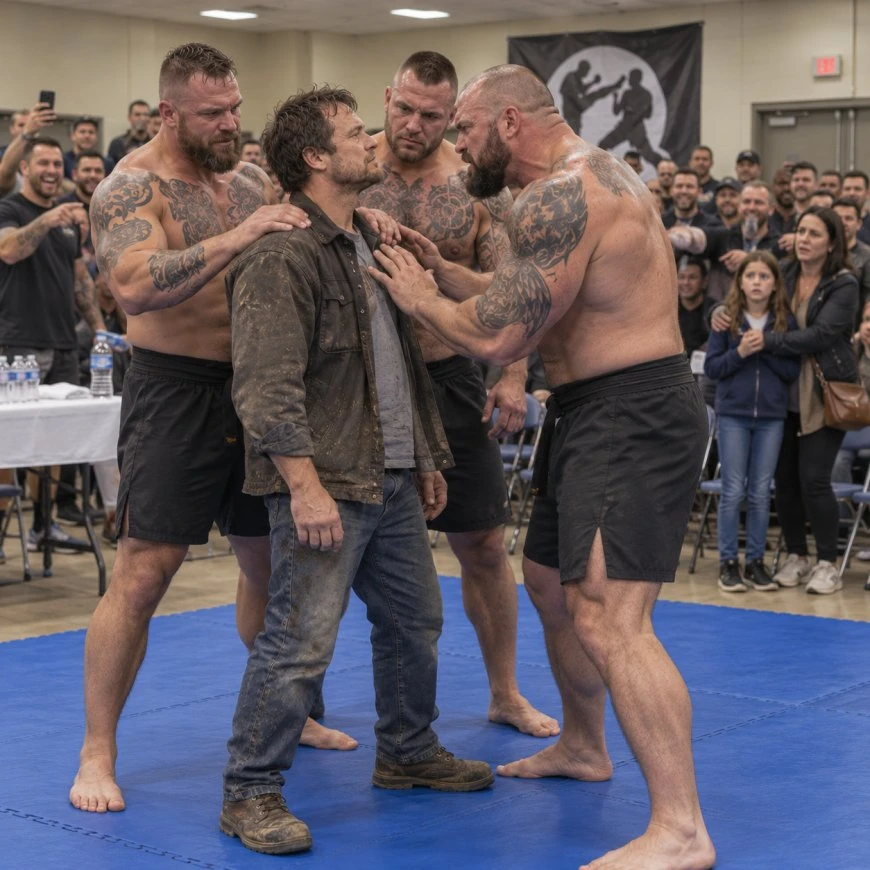
I didn’t turn the engine off. I just sat behind the steering wheel, gripping it until my knuckles turned white.
What I had spent six years trying to prevent was now sitting like a stone in my chest.
It wasn’t exactly guilt. It wasn’t exactly failure.
It was the sickening realization that my past had finally caught up to the one person I wanted to protect from it.
I had carefully taught Mara that the ability to hurt someone was never the same as the right to do it.
But because of a fight I didn’t start and didn’t want, she was sitting in a principal’s office, using violence to defend my name.
I pulled my phone out and called Celeste from the parking lot.
“I want to stop the case,” I told her, my voice rough.
“Desmond, we have the evidence,” Celeste argued immediately.
“I don’t care,” I said. “I want to stop. I’ll accept whatever settlement Grant puts in front of me.”
I told her I couldn’t let Mara become collateral damage in a public war over my pride.
Celeste was quiet on the other end of the line.
“I’ll hold off on filing our next motion until Friday,” she finally said.
Her tone made it clear she thought I was making a massive mistake, but she was choosing her moment to push back.
I walked into the school, picked Mara up, and drove us home in complete silence.
I made dinner. We ate at the kitchen table without discussing the fight, the principal, or the lawsuit.
After she helped me clear the plates, Mara went upstairs to her room.
I started washing the dishes, staring blankly at the dark window above the sink.
Ten minutes later, I heard footsteps on the stairs.
Mara walked into the kitchen and stopped. She leaned against the doorframe, crossing her arms.
She looked at me with an intensity that made her look years older than eleven.
“You’re thinking about quitting, aren’t you?” she asked.
I turned off the faucet. “How do you know that?”
“I can see it on your face,” she said simply.
I grabbed a towel and dried my hands, avoiding her eyes. “It’s complicated, Mara. I’m trying to protect you.”
“You always told me that walking away from a fight was a strong decision,” she said, her voice steady.
I looked up at her.
“I believed you when you said that,” she continued. “But walking away from a fight is not the same thing as walking away from a lie.”
She held my gaze, refusing to let me look away.
“Those are two different things, Dad.”
She didn’t wait for me to respond. She turned around and walked back upstairs.
I heard her bedroom door close softly.
I sat alone in the dark kitchen for two hours, letting her words dismantle every excuse I had built.
She was right. If I settled, I was agreeing to Grant’s lie. I was telling my daughter that the truth wasn’t worth defending.
At eight o’clock the next morning, I called Celeste.
“We’re going to trial,” I told her. “Use the full protocol. Don’t hold anything back.”
I spent that entire evening sitting at Mara’s desk in her bedroom.
I laid out my complete military file. I explained the commendations, the specific wording of the combat reports, and exactly what the court was going to hear.
I wanted her to hear the harshest details from me, before a hostile lawyer shouted them in a courtroom.
She listened, nodding slowly, confirming what she had already figured out on her own.
The trial was set for six weeks after Celeste submitted our final filings.
Those six weeks dragged on with an agonizing slowness.
We maintained a superficial appearance of normal life. I went to work at the rehab center. Mara went to middle school.
Major Calvin Rohr called me twice during that period.
Once was to formally confirm he would testify on my behalf. The second time was just to talk about baseball, offering a quiet, steadying presence.
On the morning of the first day of trial, Sandra Okafor pulled into my driveway.
Sandra was a physical therapist at the rehab center who had become a close friend over the last two years.
She offered to drive Mara to the courthouse so I could arrive early with Celeste and bypass the local press.
I walked into the county courtroom wearing a borrowed navy suit.
I sat down at the defense table next to Celeste. I kept my back straight and my hands resting flat on the mahogany table.
I didn’t turn around to look at the gallery, but I knew exactly where Mara was sitting.
She was in the second row, wearing a crisp white shirt and a blue jacket, sitting next to Sandra.
Grant Maddox’s legal team opened the trial with massive, performative confidence.
Richard Hollis stood before the jury box, projecting the image of a deeply concerned citizen.
He didn’t start with the events at the convention center. He started with my military record.
Hollis spent fifteen agonizing minutes establishing my exact combat training.
He used military terminology to describe my capabilities, painting me as a highly efficient machine designed for violence.
Then, he dimmed the lights and played Grant’s viral nineteen-second clip on the courtroom monitors.
He played it twice at full speed.
Then he played it a third time, freezing the frame every half-second.
He labeled every micro-movement I made with aggressive, technical combat terms.
By the time Hollis sat down, he had painted a terrifying picture.
He told the twelve jurors they weren’t watching a father defending himself. They were watching a disguised predator unleashing military-grade violence on an unsuspecting civilian.
The jury looked incredibly uncomfortable. Several of them wouldn’t even look in my direction.
Celeste Warren let the tension hang in the room for a long moment before she finally stood up.
“Your Honor,” Celeste said smoothly. “The defense would like to enter the full, unedited transcript of the event into evidence.”





