PART 2

I recognized the man instantly.
It was Major Calvin Rohr.
I hadn’t seen him since I was lying in a military hospital bed in Germany, over a decade ago.
He was the commanding officer who had filed my medical discharge papers. He had stood by my bed after a car fire and a piece of twisted metal ended my career.
He stood silently in the middle of the crowd now.
He was looking directly at the jagged scars exposed across my back.
He didn’t say a word. He didn’t call out my name or demand attention from the crowd.
He just stood there as a silent, unmovable testament to a life I had left behind.
He knew exactly what had caused those burns. He knew exactly what kind of restraint it took for me not to break Grant Maddox’s arm.
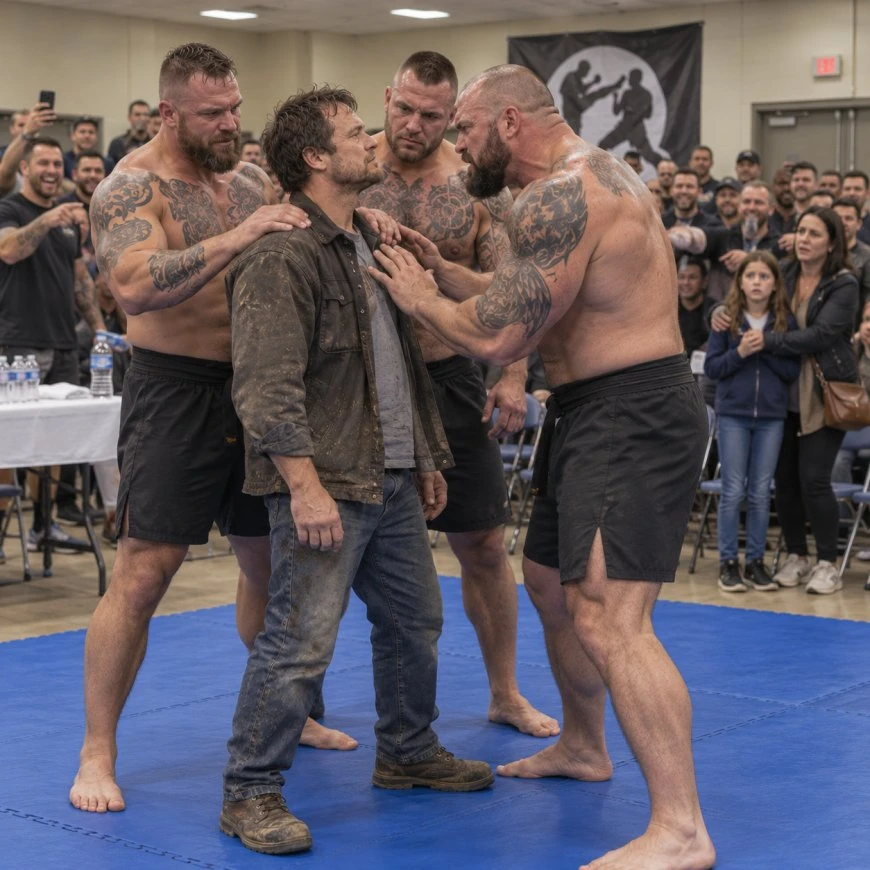
Down on the mat, Grant scrambled to his feet. His face was pale.
He was breathing heavily, his chest heaving under his martial arts uniform.
He looked at the torn fabric hanging off my shoulder, clearly confused by the violent damage to the jacket.
Then he followed Calvin’s gaze into the crowd.
Grant had absolutely no idea what was happening. He didn’t know who the older man was, or why the entire room had stopped breathing.
For the first time in his career, he stood in front of a microphone with nothing to say.
I reached across my chest and pulled my torn jacket up as best as I could.
I didn’t try to hide the scars completely. It was too late for that.
I walked down the stage steps.
I used the same uneven, limping gait I had used to walk up them.
The crowd parted for me in absolute silence. No one murmured, no one pointed, and no one tried to block my path.
I reached the second-to-last row.
Mara was waiting for me.
The fear was completely gone from her eyes.
She wasn’t embarrassed, and she wasn’t terrified anymore. She looked at me with a quiet, profound realization.
It was an expression caught somewhere between the child she had been and the young woman she was becoming.
“Let’s go,” I said quietly.
She nodded once. We turned and walked out of the convention center together.
The ride home was quiet.
It was the kind of heavy, settling quiet that usually follows a car crash or a near miss.
Mara sat in the passenger seat with her hands folded in her lap.
She stared out the passenger window into the passing streetlights. She was processing what she had seen on that stage, turning the pieces over in her mind.
I kept my eyes on the road.
In the six years we had been on our own, I had learned how she operated. She handled new information at her own pace.
Pushing her to talk always yielded worse results than simply giving her space.
By the time we pulled into our driveway, she still hadn’t said a word about the convention center.
I unlocked the front door and turned on the kitchen lights.
I put the kettle on and made her a cup of chamomile tea.
She sat at the kitchen table, wrapping both hands around the warm mug, but she didn’t drink much of it.
“Go get some sleep,” I told her softly.
She didn’t argue. She pushed the mug away, stood up, and walked down the hallway to her bedroom.
I heard her door click shut.
I sat alone at the kitchen table for a long time after her lights went out.
The adrenaline was finally draining from my system, leaving a dull, familiar ache in my bad leg.
My right shoulder throbbed where the violent torque of the takedown had strained the old scar tissue.
I wasn’t particularly worried about Grant Maddox trying to physically retaliate.
But from the moment I had walked down those stage steps, I knew the evening wasn’t over.
Men like Grant do not take public losses lightly.
They especially do not accept being humiliated in front of the exact audience they are trying to impress.
Whatever happened next would be an attempt to rewrite the narrative.
In a public contest of egos, the person who strikes first almost always gains the advantage.
I wasn’t wrong about any of that.
I just severely underestimated the specific, calculated form his retaliation would take.
Three days later, I was sitting on the concrete steps near the maintenance bay on my lunch break.
I worked at the Red Haven Veterans Recovery Center. It was a rehabilitation facility for former service members dealing with physical injuries and invisible trauma.
I was a maintenance technician. I repaired boilers, swapped out ceiling tiles, and fixed wobbly exercise equipment.
It was a quiet, necessary job that let me be present for my daughter.
I unwrapped a turkey sandwich and pulled out my phone to check the local news.
A video was sitting at the top of my local social media feed.
It was only nineteen seconds long.
It was neatly and professionally edited, clearly cut by someone who knew how to manipulate a timeline.
The footage completely removed Grant calling me out, insulting my limp, and tossing my hat.
It cut out my verbal request to be left alone. It cut out his two students grabbing my arms.
The video started at the exact fraction of a second I moved.
It showed a man with terrifying physical speed violently snapping out of a hold.
It showed me dropping a respected martial arts instructor flat onto his face in front of a screaming crowd.
Then, the video abruptly cut to black just as the room fell silent.
It ended before the camera could capture the torn jacket, the scars, or Major Rohr standing up in the crowd.
The caption below the video was heavily dramatized.
It framed me as a dangerous, unstable lunatic who had stormed a community event.
It claimed I had violently attacked an instructor and his students without any provocation whatsoever.





