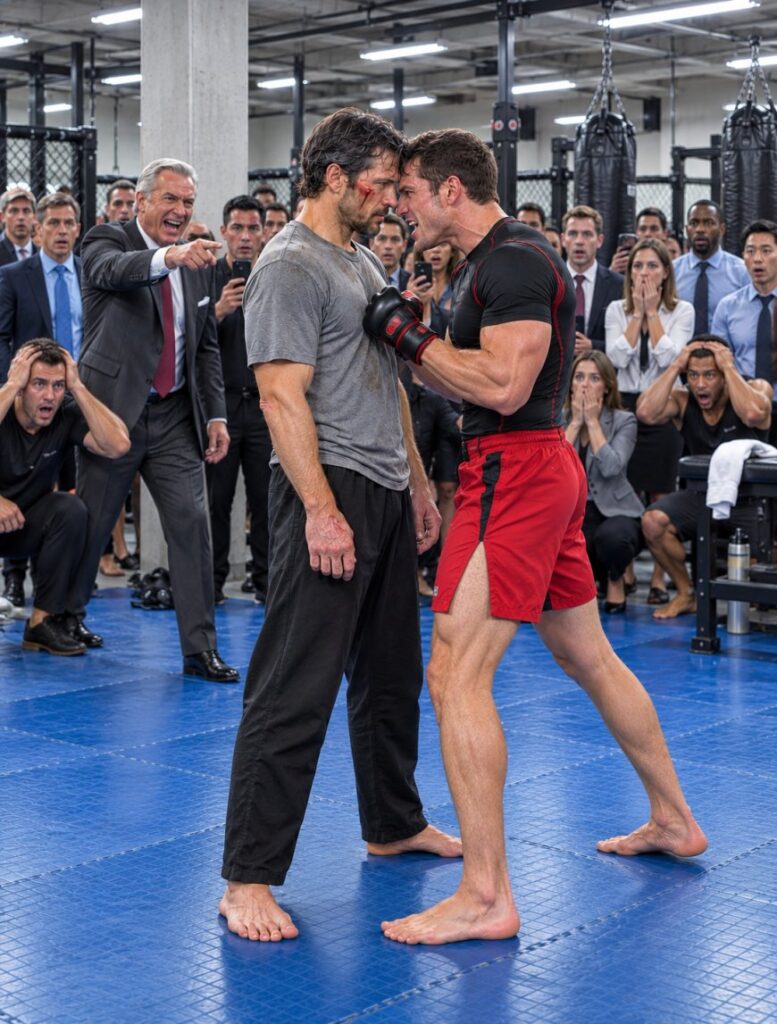
“You took that kick today. You got back up. That’s endurance. You show up every day to a job you hate to pay for a life you love. That’s endurance. Don’t let a rich kid in spandex make you think you’re weak because you don’t want to throw a punch.”
Toby stared at me for a long time. The tension in his shoulders slowly uncoiled.
He reached into his pocket and pulled out a small, folded piece of paper. He slid it across the counter.
“I pulled this from the server before they locked your credentials out completely,” Toby whispered.
I opened the paper. It was a printed list of names and phone numbers — the private contacts of the major shipping vendors that Prescott Logistics used.
“I don’t know what you’re going to do next,” Toby said, standing up. “But I figure a guy who knows how supply chains work might need some contacts. Real ones. Not the corporate gatekeepers.”
I looked at the list. It was a massive breach of company protocol. It was a firing offense for Toby. He had risked his own job, his own security, to give a departing ghost a fighting chance in the real world.
“You’re a brave kid, Toby,” I said quietly.
Toby offered a small, hesitant smile. “I’ll see you around, John. Thank you.”
He turned and walked out into the rain. I watched him go through the smeared glass of the diner window. He walked with a limp, but his head was up.
I looked down at the box on the counter. I picked up the framed photo of my platoon — nine men in tactical gear, smiling through exhaustion and dust. Four of them were dead. Three were scattered across the country fighting their own silent wars. And I was here, eating cold eggs in a diner, holding a stolen list of shipping contacts.
For the first time in three years, I felt like I was back on mission.
Two weeks passed.
The bruise on my cheek faded from angry purple to a dull, sickly yellow. My bank account drained with terrifying speed. Seattle is not a city that forgives the unemployed.
I spent my days in a small public library, firing off resumes into the digital void, getting back nothing but automated rejection emails.
“We are looking for candidates with a more linear career trajectory,” one recruiter told me over the phone. “Your gap in traditional employment is concerning.”
“I was in the military,” I told him.
“Yes, but we need someone who understands agile corporate frameworks. Thank you for your service, Mr. Cole.”
Click.
The civilian world wanted my service as a bumper sticker, not as a skill set. They wanted the idea of a veteran, not the reality of one.
I didn’t panic. Panic is a luxury you can’t afford when the walls are closing in. You just assess the variables and keep moving.
It was a Tuesday afternoon — the exact time I would normally be formatting pivot tables for Connor’s father. I was sitting at my kitchen table, drinking cheap instant coffee, staring at Toby’s list of vendor contacts.
I’d called three of them. They all hung up the moment they realized I wasn’t officially representing Prescott Logistics.
My phone rang. It was an unknown number.
I let it ring three times before picking it up.
“Cole,” I answered.
“John Cole?” The voice on the other end was deep, gravelly, and carried the distinct clipped cadence of a man used to giving orders over radio static.
“Who’s asking?”
“My name is David Miller. I run an independent supply chain operation down in Tacoma. Miller Global Logistics. We specialize in rapid response freight.”
There was a pause. The sound of a lighter flicking, a deep inhale of smoke.
“I got a phone call from a mutual acquaintance. A guy named Stan. Used to be a cop in Seattle.”
Stan — the security guard from the Prescott lobby.
“I know Stan,” I said carefully.
“Stan handles some freelance security consulting for my warehouses on the weekends,” Miller said. “He told me a very interesting story. Said he watched a data analyst fold a 24-year-old black belt like a cheap lawn chair in front of half the corporate executive board.”
I leaned back in my chair. “News travels fast.”
“In this industry? Fast doesn’t even cover it. But that’s not why I’m calling. Stan told me your background. Naval Special Warfare. Seven years. Honorable discharge.”
“That’s on my resume, yes.”
“I don’t give a damn about resumes, Cole. I care about what happens when the plan goes to hell. Right now, my company has a massive contract with FEMA. We’re moving emergency medical supplies and water filtration units into hurricane disaster zones in the Gulf. It’s a logistical nightmare. The ports are backed up. The local infrastructure is wiped out. And the corporate freight guys I have working the spreadsheets are having panic attacks because the numbers aren’t lining up.”
I stared at the peeling paint on my kitchen wall.
“And you need a new data guy.”
“I need a data guy who doesn’t panic when the building’s on fire,” Miller corrected. “I need a guy who understands that supply chains aren’t just lines on a graph. They’re physical things in a physical world. And sometimes you have to break the rules to get the cargo where it needs to go. I need someone who knows how to operate in chaos.”
He paused again.
“Stan said you looked like a man who was done hiding. Are you done hiding, John?”
I looked down at my hands. The knuckles were scarred, permanently thick. I thought about the basement gym. I thought about the cold, terrifying clarity that had washed over me when I put Connor on the mat.





