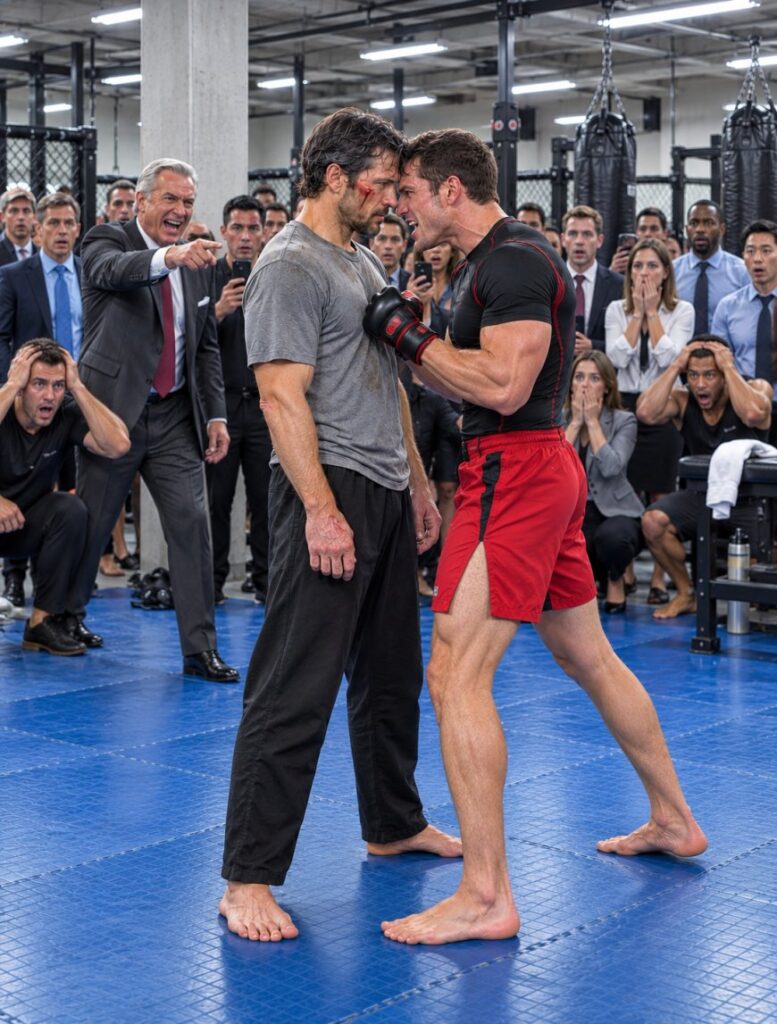
The basement gym was dead silent. The humming of the fluorescent lights suddenly seemed deafening. Forty people stood frozen, their mouths slightly open, staring at the mat. Nobody looked at their phones. Nobody whispered. They just stared at the 24-year-old executive vice president crying on the synthetic rubber.
And then they slowly turned their eyes to me.
I walked over to the wooden bench at the edge of the mat. I picked up a clean white towel and pressed it against my cheekbone. The bleeding had already started to slow, the blood coagulating in the cold basement air. I wiped the crimson smear from my skin, folded the towel neatly, and dropped it into the laundry bin.
I picked up my socks. I sat on the bench and pulled them on.
In my peripheral vision, I saw William Prescott moving. The CEO pushed off the steel pillar he had been leaning against. His face was pale, his jaw locked tight. He didn’t look at his son. He looked directly at me.
He marched across the gym, his heavy leather shoes squeaking loudly on the bare floor, and stopped at the edge of the mat.
“What the hell was that, Cole?” William demanded. His voice was a low rumble, laced with years of boardroom authority. It was the voice of a man who was used to making people shrink.
I laced up my left boot. I pulled the knot tight. I didn’t look up.
“That was mandatory department alignment training, Mr. Prescott,” I said mildly.
“You assaulted an executive.”
“I participated in a sparring session under the rules established by your son,” I replied, lacing my right boot. “Light contact until he threw an illegal elbow. Then the rules changed.”
William pointed a thick finger at me. “You’re fired, Cole. You’re done in this city. You understand me? I’ll make sure you never touch a keyboard in a logistics firm from here to Chicago.”
I finally stood up. I looked William Prescott in the eyes. He was a big man, but up close, I could see the soft, pampered edges of a life lived indoors. He was a man who ordered violence — economic or otherwise — from a safe distance.
“You talk a lot about killer instinct, William,” I said. My voice carried across the silent room. Every employee was hanging on every word. “You tell these people they need it to succeed. You encourage your son to beat it into junior accountants.”
I gestured vaguely toward Connor, who was finally sitting up, holding his ribs, looking at the floor in absolute shame.
“That isn’t killer instinct,” I continued. “That’s bullying. It’s a cheap imitation of strength by people who have never had to survive anything real.”
William’s face flushed red. “Who do you think you are, lecturing me in my own building?”
“I’m John Cole,” I said. “And for seven years before I came to work here, I commanded a naval special warfare extraction unit. I spent my 20s pulling mutilated hostages out of basements in Fallujah and Helmand Province. I know what killer instinct looks like, Mr. Prescott. I’ve watched it bleed out on a dirt floor.”
The silence in the room deepened. It felt like the air pressure had dropped. A few of the mid-level managers physically took a step back, suddenly looking at my beige slacks and graying hair with an entirely different context.
I saw Toby Fisher near the heavy bags. He was staring at me, his eyes wide behind his wire-rimmed glasses.
“I came to your company because I wanted a quiet life,” I said, my voice dropping back to a tired conversational tone. “I wanted to look at spreadsheets. I wanted to drink bad coffee. I didn’t want to hurt anyone ever again. I tried very hard not to.”
I reached into the pocket of my sweatpants and pulled out my plastic blue key card. The little company lanyard dangled from it.
“But you couldn’t leave well enough alone,” I said.
I tossed the key card. It landed softly on the blue mat, right next to where Connor was sitting.
“You don’t need to fire me, William. I quit.”
I turned my back on the CEO. I didn’t wait for a response. I walked toward the locker room doors.
As I approached the crowd of employees clustered near the exit, a strange thing happened. They didn’t just step aside. They parted completely. They flattened themselves against the mirrors and the heavy bags, giving me a wide berth, looking at me with a mixture of awe and deep instinctual fear.
I didn’t acknowledge them. I just pushed through the heavy wooden double doors of the locker room.
The air in the locker room was cool and smelled of cedar. I walked to my locker, grabbed my duffel bag, and shoved my button-down shirt and slacks inside. I didn’t bother changing. I just wanted to be out of this building.
I zipped the bag shut and threw the strap over my shoulder.
When I pushed back out into the hallway leading to the elevator bank, the basement gym was still quiet. I could hear William Prescott’s voice, sharp and angry, finally berating his son. Connor wasn’t arguing back.
I pressed the button for the ground floor. The metal doors slid open. I stepped inside and pressed the lobby button.
As the doors closed, cutting off the fluorescent light of the basement, I caught my reflection in the polished steel panel of the elevator. My cheek was swollen, a dark purple bruise blooming around the thin red cut. My eyes looked older than 36. They looked tired.
I let out a long, slow breath. The cold stillness was fading, retreating back into the dark corners of my mind. The ghost was gone. I had made myself visible again.
I knew it meant uncertainty. It meant looking for another job. It meant explaining why I left Prescott Logistics so suddenly. It meant dealing with HR background checks and awkward interview questions.





