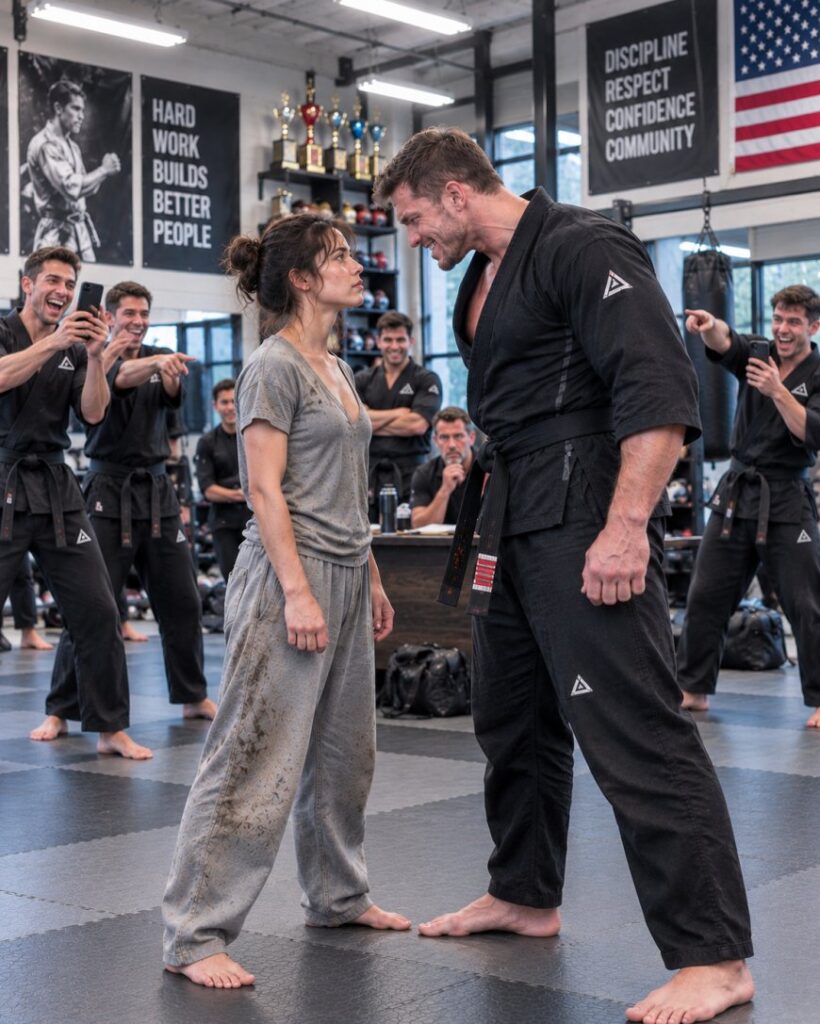
The people who stayed—the Tobys of the world, the quiet ones who had been bullied into silence—started to come out of their shells.
Toby was the first.
He showed up on a Tuesday night, three weeks after the knockout, and asked if he could train with Harper. She looked at him for a long moment, her eyes assessing, and then nodded.
“Warm up. Ten minutes on the bike. Then we’ll work on your jab.”
Toby’s jab was terrible. He threw it like he was afraid of hurting someone. Harper watched him for five minutes without saying a word, then stepped in and adjusted his elbow.
“Your power doesn’t come from your arm,” she said. “It comes from your hips. Watch.”
She demonstrated the motion in slow motion—foot, hip, shoulder, arm. Toby watched, his eyes wide, and then tried again. This time, his jab snapped out with real force.
“Better,” Harper said. It was the first compliment I’d ever heard her give.
Toby grinned. It was the first time I’d ever seen him smile.
Over the next few weeks, more people came. A middle-aged woman who had been training for years but never felt like she belonged. A retired cop with a bad back and a chip on his shoulder. A teenage girl who wanted to learn how to defend herself. Harper trained them all with the same quiet, methodical patience.
She didn’t yell. She didn’t bark orders. She just watched, corrected, and waited. She had the patience of a mechanic—the kind of patience that comes from spending hours hunched over an engine, slowly diagnosing a problem that no one else could see.
And slowly, the gym began to change.
The ego-driven sparring sessions disappeared. The bullies stopped coming. The people who stayed were the ones who actually wanted to learn—who wanted to put in the work, to sweat, to bleed, to grow.
I watched it all from behind the reception desk, my coffee growing cold, my spreadsheets still bleeding red, and I felt something I hadn’t felt in years.
Pride.
One night, about a month after Harper’s first session, I stayed late to close up. The gym was empty, the mats freshly mopped, the heavy bags swinging gently in the dim light.
I found Harper in the back corner, working the 90-pound bag she had claimed as her own.
She was throwing combinations—jab, cross, hook, uppercut—with a fluidity that made my old fighter’s heart ache. Her feet moved in perfect rhythm, her hips rotating with every punch, her hands snapping back to her guard like they were on rails.
I watched her for a long time before I spoke.
“You still miss it,” I said quietly.
Harper didn’t stop. She threw a final combination—one, two, three—and then stepped back, breathing hard.
“Every day,” she said.
“But you’re training again. You’re teaching. Isn’t that enough?”
She looked at me, her eyes dark and unreadable. “It’s not the same.”
“I know.”
She turned back to the bag and placed her hand against it, feeling its weight. “I spent six years fighting amateur. Six years of waking up at four in the morning to run, of lifting until my arms shook, of getting punched in the face until I couldn’t see straight. And I loved every second of it.”
She paused.
“When I got hurt, I thought it was over. I thought I’d never feel that way again. And for a long time, I didn’t. I just… existed. Wake up. Go to work. Turn wrenches. Go home. Sleep. Repeat.”
She turned to face me, her expression raw.
“But then I walked into your gym. And I saw that kid—Toby—getting bullied. And I felt something I hadn’t felt in years.”
“What?”
“Anger.” She smiled, but it wasn’t a happy smile. It was the smile of a fighter who had finally found something worth fighting for. “Real anger. Not the tired, numb kind. The kind that makes you want to hit something.”
I nodded slowly. “That’s why you came in that night.”
“That’s why I came in that night.”
She picked up her water bottle and took a long drink.
“You know, I never told you why I really left the sport.”
“You said you got hurt.”
“I did get hurt. But that wasn’t the whole story.” She set the bottle down and leaned against the wall. “After my injury, I spent two years in physical therapy. Two years of learning how to stand up, how to walk, how to lift my arms above my head. And the whole time, I kept telling myself that I’d come back. That I’d fight again. That I’d prove everyone wrong.”
She paused.
“But when I finally got cleared to train, I realized something. I wasn’t the same fighter anymore. I was slower. My reflexes were shot. My body didn’t move the way it used to. And the worst part was, I didn’t care.”
“Why not?”
“Because I was tired. Tired of the politics, the sponsors, the managers who only cared about their cut. Tired of the constant pressure to be perfect. Tired of waking up every day with the knowledge that one wrong move could end everything.”
She looked at me, her eyes hard.
“So I quit. I walked away. I got a job at a garage and I tried to forget that I ever knew how to fight.”
“But you didn’t forget.”
“No.” She laughed, a short, bitter sound. “You can’t forget something like that. It’s in your bones. It’s in your blood. It’s the only thing that ever made sense to me.”
She pushed off the wall and walked back to the bag.
“That’s why I came to your gym. Not because I wanted to fight. Because I wanted to remember what it felt like to be… whole.”
I stood there for a long moment, not knowing what to say.





