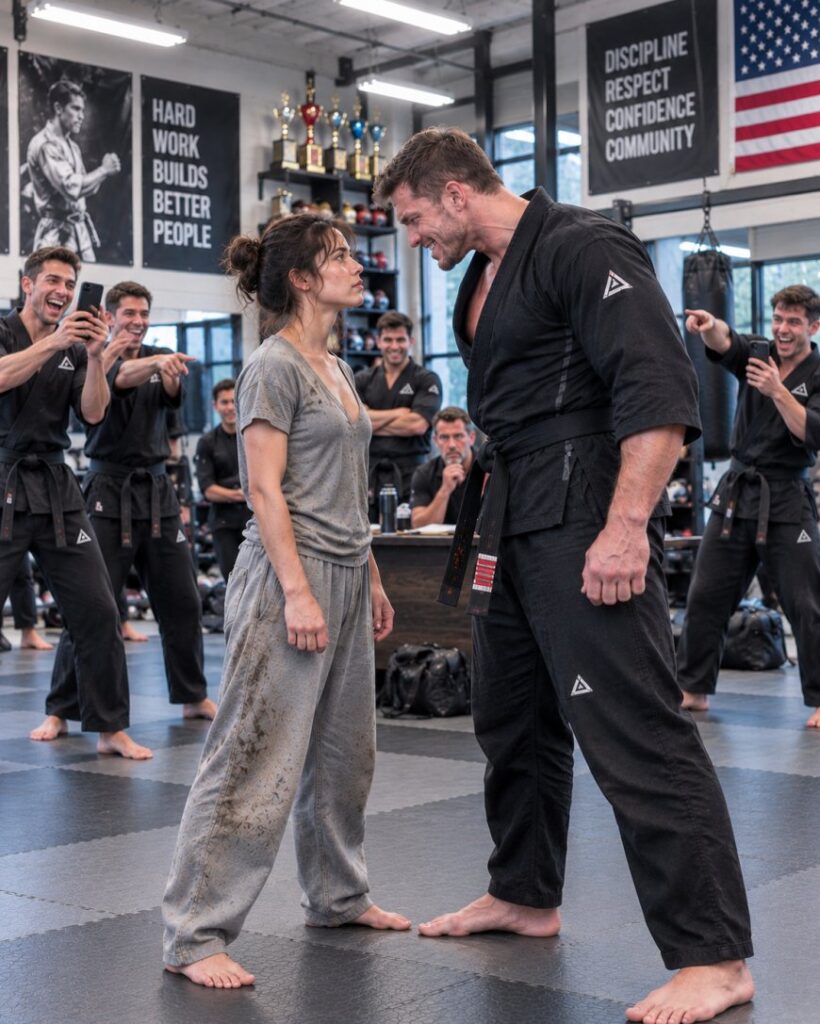
Harper looked down at her hands. The knuckles were perpetually scarred, calloused from both heavy machinery and heavy leather.
“I fought amateur for six years. Went pro when I was twenty-two.” Her voice was devoid of nostalgia. A sterile recitation of facts. “Had a good run. Seven and zero. Then I blew out my L5 vertebrae in a grappling tournament. Spent two years in physical therapy just learning how to stand up without crying. By the time I could throw a kick again, my sponsors were gone, my management dropped me, and I had fifty grand in medical debt.”
She gestured lazily to the rusted truck, her grease-stained clothes.
“Turns out fixing transmission blocks pays better than low-tier combat sports. Sucks the soul out of you just the same. But at least the cars don’t actively try to give you brain damage.”
I nodded slowly. I knew the story. It was the oldest, saddest story in the fight game. The sport chewed up the dedicated and spat them out broken, leaving them to navigate a world that had moved on without them.
“Why did you come in tonight?” I asked. “If you’re done with it, why buy the pass?”
Harper looked away, staring out into the dark, empty street. She rotated her right shoulder, the muscle memory of the punch still lingering in her joints.
“Because sometimes I miss the quiet,” she whispered.
I understood perfectly. The world was loud. Full of bills, demanding bosses, broken engines, constant grinding stress. But inside the cage, between the bells, the world shrank to a three-foot radius. There was no past, no future. Only the immediate truth of distance, timing, and survival. It was a violent, brutal monastery.
“I’m firing Carter,” I said suddenly.
Harper looked back at me, frowning. “You just said he pays your bills.”
“I’ll figure it out.” My voice found a firm, solid rhythm I hadn’t heard in myself for a long time. “I’ll sell the excess bags. Downsize the cardio equipment. But I’m done catering to bullies. I’m taking the gym back to the roots. Real fundamentals, real discipline, no egos.”
I pushed off the truck and stood directly in front of her.
“I need a striking coach,” I said. “Someone who understands leverage. Someone who knows how to break down the mechanics. Someone who won’t take any crap from the guys who think paying a premium membership makes them a killer.”
Harper let out a sharp, cynical bark of laughter. “You can’t afford me, Drew. I work fifty hours a week at the shop just to make rent. I don’t have time to play sensei for a bunch of accountants.”
“I can’t pay you a salary. Not yet,” I admitted. “But I can give you a key. Free membership. Twenty percent cut of the door for any seminars you run. And a place to train where no one will bother you unless you want them to.”
I held out my hand.
“You don’t just miss the quiet, Harper,” I said softly. “You miss the work. I saw your eyes when you threw that right hand. You’re starving for it. Come back to the mats. Help me fix this place. Help me build real fighters again.”
Harper looked at my extended hand. It was scarred, knuckles swollen with arthritis, bearing the same history as her own. She looked past me through the glass doors of the gym to the heavy bags hanging in the dim light. She thought about the heavy, suffocating smell of the garage. The endless, numb repetition of turning wrenches.
Then she thought about the crisp, definitive crack of her glove meeting Carter’s jaw. The absolute terrifying peace of a perfectly timed counter.
Harper reached out and gripped my hand. Her grip was like a vice forged in steel and canvas.
“No egos,” Harper said, her voice dropping to a low, serious register. “If I catch anyone throwing heat at a beginner, I’m putting them to sleep. And you’re not going to stop me.”
“I’ll hold their coats while you do it,” I promised, a faint smile breaking through the exhaustion on my face.
Harper released my hand. She reached into her pocket, pulled out the keys to her truck, and unlocked the heavy door. It groaned loudly on rusted hinges.
“I work until six on Tuesdays and Thursdays,” she said, climbing into the driver’s seat. “I’ll be here by six-thirty. Have the heavy bags taped and the mats mopped.”
“They’ll be spotless,” I said.
Harper shut the door. The engine roared to life with a mechanical cough that settled into a steady, reliable idle. She put the truck in gear and pulled out of the parking lot, the red tail lights disappearing into the humid night.
I stood alone in the dark for a long time. I listened to the rumble of the engine fade away, replaced by the low hum of the city.
I turned back toward the gym. The neon Apex sign flickered above the door, its red light bleeding into the damp air.
I walked back inside. The air still smelled like sweat and old vinyl. But underneath it, there was something else. The stifling weight of entitlement had been violently cleared away, leaving room to breathe.
I locked the front door behind me, grabbed a mop from the janitor’s closet, and walked out onto the empty black mats.
I had work to do.
The foundation had just been poured, and it was time to rebuild.
The next morning, I woke up before my alarm for the first time in years.
The sun was barely cresting over the industrial park when I pulled into the Apex parking lot. I had a cup of gas station coffee in one hand and a roll of fresh duct tape in the other. My knee was still aching from vaulting the desk the night before, but I ignored it. There was too much to do.
I started with the heavy bags.





