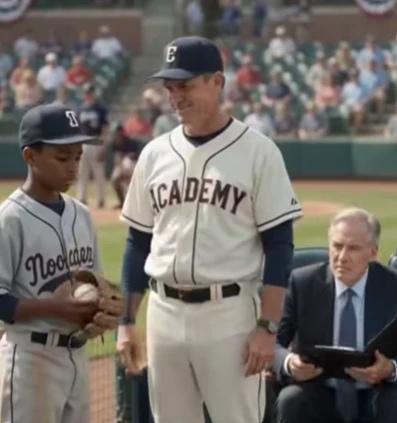
Two former players said Coach Blake used them in brochures but never gave them promised training access.
A former office manager brought the file that made the whole case undeniable.
Two folders.
One labeled DONOR-FACING ATHLETES.
One labeled SUPPORT SCHOLARSHIPS.
Noah’s name was in the second folder.
Tyler’s was in the first.
Under Noah’s file was a note:
Elite ability. Limit public exposure until development narrative can be controlled. Do not allow third-party scouts direct access without staff present.
Do not allow scouts direct access.
Noah read the sentence in Daniel’s office with his mother beside him.
It felt worse than being benched.
Benching was visible.
This had been invisible.
A wall built around his future that he could not even see to climb.
Daniel said softly,
“I’m sorry.”
Noah asked,
“Did scouts ask about me?”
Daniel nodded.
“How many?”
“More than Blake told you.”
Noah looked at the floor.
“He told me nobody serious was watching.”
Alana closed her eyes.
Daniel pushed a folder across the desk.
“Someone serious was.”
Inside were letters.
Not full scholarship offers.
He was fourteen.
But invitations.
Evaluations.
Training camp interest.
Notes from college assistants.
One from a national youth development program.
One from a professional scouting consultant.
And one handwritten card from Elliot Mercer.
Noah,
The best thing I saw at Ridgefield was not the hush pitch.
It was that you threw the next two pitches after everyone started watching.
Talent got you on the mound.
Composure kept you there.
— E.M.
Noah read it twice.
Then folded it carefully.
“What happens now?”
Daniel sat back.
“That depends partly on you.”
“I just want to play.”
Alana smiled sadly.
“That should have been the easiest part.”
Mercer returned to Ridgefield one month after the championship.
Not for a signing ceremony.
For a public meeting.
The academy gym was packed.
Parents.
Players.
Board members.
Reporters.
Former staff.
Families who had never been allowed near donor meetings before.
Coach Blake did not attend.
His attorney sent a letter saying he denied all wrongdoing and had acted in the academy’s best interest.
No one read it aloud.
Preston Knox did attend, sitting near the back with Tyler beside him.
He looked smaller without the luxury box rail in front of him.
Mercer stood at center court with no stage, no banner, no glass case.
“I came here originally prepared to invest one hundred million dollars,” he said. “I will not invest that money in the structure that existed here.”
Whispers moved through the room.
He continued.
“But I still believe youth sports in this region deserve better facilities. So the proposal is being rebuilt.”
The screen behind him changed.
RIDGEFIELD COMMUNITY BASEBALL TRUST.
Mercer explained the new structure.
No private control by one coach.
No pay-to-feature arrangements.
Independent scholarship oversight.
Public equipment audits.
Media access guidelines ensuring no athlete’s footage could be hidden by a single coach.
A parent and athlete advisory board.
A direct reporting channel for players.
And a rule named without naming Noah:
No coach or academy employee may restrict an athlete from communication with verified scouts, recruiters, or evaluators without documented safety or eligibility reason reviewed by independent staff.
Daniel Ortiz would become interim baseball director.
A retired college coach named Marisol Grant would supervise athlete development.
The $100 million would still come.
But not as Coach Blake’s empire.
As a trust.
Open fields.
Transparent records.
Scholarship protections.
Community access.
Mercer paused.
“Ridgefield can still build champions. But it will not build them by hiding children.”
The room stood.
Not all at once.
First scholarship families.
Then some academy parents.
Then players.
Then, slowly, Tyler Knox.
His father looked at him.
Tyler did not sit back down.
Noah watched from the second row.
He did not stand immediately.
Alana looked at him.
“You okay?”
He nodded.
Then stood.
Not for Mercer’s money.
For the sentence.
It will not build them by hiding children.
After the meeting, Preston Knox approached Noah and Alana.
Daniel moved closer, but Alana gave a small shake of her head.
She could handle herself.
Preston cleared his throat.
“Mrs. Carter. Noah.”
Alana looked at him.
“Yes?”
“I want you to know my son did not ask for what Warren did.”
Noah looked toward Tyler, who stood several feet away with his hands in his pockets.
Alana said,
“Did you?”
Preston’s mouth tightened.
“I advocated for my child.”
“At the expense of mine.”
He looked away.
“I did not know the equipment issue.”
“That was not my question.”
Preston looked back.
Alana’s voice stayed calm.
“Did you advocate for your child at the expense of mine?”
He swallowed.
“Yes.”
Tyler’s face reddened.
“I’m sorry,” Tyler said.
Noah looked at him.
This time, the apology sounded heavier.
Noah nodded.
“Don’t let people make you need the spotlight that bad.”
Tyler blinked.
Then nodded back.
It was not friendship.
Not yet.
Maybe never.
But it was a cleaner ending than silence.
Coach Warren Blake’s fall was not instant.
Men like him rarely vanish the first time truth appears.
He gave interviews about being misunderstood.
He said youth sports had become too political.
He said he had tried to protect a young player from pressure.
He said Noah was talented but “emotionally influenced by adults around him.”
That last phrase made Alana so angry she nearly called the reporter herself.
Daniel told her not to.
Mercer’s team released one document instead.
The email where Blake wrote:
Keep Carter in support role unless emergency.
Then another.
Do not use Carter hush pitch clips in donor reel. Too much attention.
Then the equipment audit.
Then the scholarship folder.
Blake stopped giving interviews.
Eventually, his coaching license was suspended by the private academy association.
Several families filed civil claims.
The academy board removed his name from the training center wall.
Someone asked Noah if that made him happy.
He said,
“No.”
The reporter seemed disappointed.
Noah added,
“I just want the wall to have the right names.”
The first name added under the new trust was Samuel Carter.





