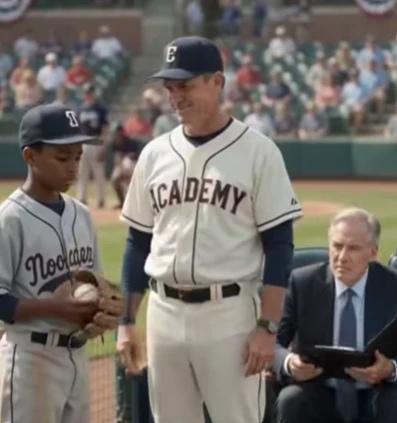
“Yes.”
“And your best pitcher sat until public pressure forced you to use him.”
Blake stiffened.
“You are not a baseball coach.”
“No,” Mercer said. “I am the man whose check you kept mentioning in private emails.”
Blake’s mouth opened.
Closed.
Mercer’s attorney handed him a folder.
Mercer removed the first page.
“This agreement includes a community access requirement. Scholarship protections. Public reporting on athlete development. Equal media representation for funded athletes. No pay-to-feature arrangements.”
Preston Knox’s face went pale.
Mercer continued.
“Yet I have been given evidence that you planned to market Tyler Knox as the academy face in exchange for local development support while hiding the best scholarship athlete on your roster.”
“That is not true,” Blake said.
Daniel held up the tablet.
“It is.”
Blake turned on him.
“You’re fired.”
Mercer said,
“No. He’s protected.”
Blake blinked.
“What?”
Mercer looked toward the academy board members gathering near the stage.
“My due diligence team has been reviewing Ridgefield for three weeks. Coach Ortiz has been cooperating since last month.”
Noah stared at Daniel.
Daniel gave him a small nod.
“I wanted to tell you,” Daniel said softly. “But I needed you protected first.”
Blake looked around.
Suddenly the field felt less like a championship celebration and more like a courtroom with chalk lines.
Mercer lifted another paper.
“Pitching logs show Noah Carter carried this team in high-pressure games but was removed from promotional materials. Internal messages show deliberate efforts to feature Tyler Knox for investor optics. Scholarship supply records show equipment marked as issued to Carter but never received by him.”
Alana stepped onto the field.
“What?”
Noah looked at his cleats.
His borrowed cleats.
His glove with marker on it.
Mercer’s voice stayed calm.
“The academy billed scholarship funds for custom cleats, two gloves, travel gear, and private training sessions in Noah’s name.”
Alana’s face hardened.
“He never got those.”
Noah whispered,
“Mom.”
She looked at him.
“No.”
That one word carried fourteen years of making do.
No more.
Preston Knox backed away half a step.
Mercer looked at him.
“Your company’s donation account reimbursed several of those charges. Would you like to explain why scholarship gear was redirected to promotional accounts?”
Preston’s mouth tightened.
“My office handles many payments.”
“I’m sure investigators will enjoy the variety.”
Coach Blake stepped forward.
“You are destroying this program over a misunderstanding.”
Mercer looked at the stage.
At the glass case holding the contract.
At the cameras.
At the boys standing in stunned silence.
“No, Coach. You almost built a program on one.”
Then he turned to the crowd.
“The signing ceremony is canceled.”
Noise erupted.
Blake went white.
Preston shouted,
“Elliot, don’t be foolish.”
Mercer did not look at him.
“My money will not fund a facility where children are sorted into stars and scenery by the size of their parents’ checks.”
That sentence traveled through every phone recording on the field.
By morning, it would be everywhere.
But that night, it landed first on Noah.
Stars and scenery.
That was exactly how he had felt.
A player when they needed outs.
Scenery when they needed photos.
The aftermath began before the sun went down.
The academy board suspended Coach Blake pending review.
Preston Knox’s development company was removed from the proposal.
Tyler Knox left the field with his father, eyes red, jaw tight.
Before he left, he looked at Noah.
For a moment, Noah expected another insult.
Instead, Tyler muttered,
“I didn’t know about the gear.”
Noah said nothing.
Tyler swallowed.
“I knew about the camera stuff.”
Noah looked at him then.
Tyler’s face flushed.
“I’m sorry.”
It was not enough.
But it was more than silence.
Noah nodded once.
Tyler walked away.
The championship trophy sat near home plate, forgotten for almost twenty minutes.
Finally, Jace carried it to the dugout.
“Do we still get this?” he asked Daniel.
Daniel looked at the boys.
“You earned it.”
Noah touched the trophy with two fingers.
It felt strange.
Winning and hurt standing in the same place.
Alana drove him home that night without turning on the radio.
The city lights passed across the windshield.
Noah held his glove in his lap.
For a long time, neither spoke.
Then Alana said,
“How long did you know?”
Noah looked at the glove.
“Know what?”
“That he was hiding you.”
He shrugged.
“I didn’t know. I just felt it.”
“That is knowing.”
He leaned his head against the window.
“I didn’t want to make it harder for you.”
Alana’s hands tightened on the steering wheel.
“You are my child. Not a bill.”
“I know.”
“No. I need you to hear me. If someone is hurting you, you tell me. Even if I’m tired. Even if money is tight. Even if you think I can’t fix it.”
Noah’s eyes burned.
“I didn’t want you to feel bad.”
Alana pulled into their apartment lot and parked.
Then she turned to him.
“I already felt bad watching you wear cleats I knew were too old.”
He looked down.
She continued.
“I felt bad every time that man called you a scholarship kid like he was doing charity instead of receiving your work. I felt bad because I could not buy our way into respect.”
Noah whispered,
“You shouldn’t have to.”
“No,” she said. “I shouldn’t. And you shouldn’t have to pitch perfect to receive it.”
That broke him.
He cried then.
Not loudly.
Not like a movie.
Just bent over his glove in the front seat while his mother held the back of his neck and let him be fourteen.
The investigation took six weeks.
Long enough for rumors to grow.
Short enough that Coach Blake never regained control of the story.
Ridgefield’s board hired an outside law firm.
Mercer’s team conducted its own review.
Parents demanded records.
Scholarship families began speaking.
A catcher from the twelve-under team said his son was charged for travel meals he never received.
A girl from the softball program said her recruiting video disappeared after her family could not afford extra showcase fees.





