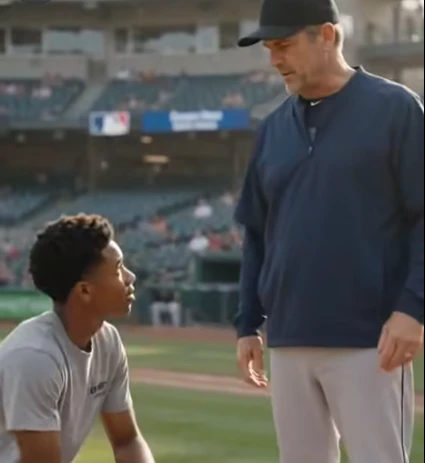
Television crews were already broadcasting from outside.
Nobody had announced anything publicly.
But players noticed.
Staff noticed.
Reporters began sending messages.
Something was wrong with the mound.
League president Charles Whitcomb arrived wearing a suit without a tie.
He looked at Daniel.
“Can the mound be repaired safely?”
Isaiah answered.
“Yes.”
“How long?”
“Twenty minutes.”
“Then why are we still stopped?”
Daniel pointed toward the evidence markers.
“Because the mound is not the problem anymore.”
Charles looked irritated.
“Explain.”
Daniel did.
Unauthorized access.
Moved rubber.
Fresh repair.
Pitching cleat prints.
Badge log.
Team employee refusing to explain.
Charles rubbed his forehead.
“Do we know intent?”
“No.”
“Then repair it.”
Daniel did not move.
“If someone intentionally altered the mound, I need to know whether anything else was touched.”
That landed.
Home plate.
Bullpens.
Base anchors.
Rosin.
Game balls.
Player areas.
A championship did not stop because dirt was uneven.
It stopped because trust in the field had been broken.
Charles nodded.
“Full inspection.”
Every grounds crew member spread across the field.
Base measurements.
Plate dimensions.
Bullpen mounds.
Warning track.
Foul territory.
Dugout equipment.
Game baseball storage.
Nothing else seemed wrong.
Then Zion noticed something else.
Everett Sloan had walked away from the mound three times.
Each time, he moved toward his club’s tunnel.
Each time, security redirected him.
Zion whispered to his father:
“He knew.”
Isaiah looked at him.
“Don’t guess.”
Zion nodded.
His father’s rule.
Observe first.
Assume later.
The security team searched Mason Kell’s locker with club authorization.
No tools.
No dirt.
No cleats.
Then Teresa asked a simple question.
“What shoe size?”
Mason answered.
“Ten.”
The footprint looked larger.
Daniel asked the equipment manager for a list of team-issued cleats.
Pitchers received several models.
Coaches sometimes wore turf shoes.
Everett Sloan wore size twelve-and-a-half pitching cleats during bullpen sessions.
Everyone knew because he still demonstrated mechanics himself.
Everett laughed when Daniel asked.
“You’re accusing me because of shoe size?”
Daniel said:
“I’m asking where your cleats are.”
“In my locker.”
They checked.
The locker contained two pairs.
One clean.
One missing.
Everett stared.
“Somebody took them.”
The equipment manager looked confused.
“I saw your black pair yesterday.”
Everett turned sharply.
“Then find them.”
Security did.
Inside a laundry bag in a service closet.
Black pitching cleats.
Size twelve-and-a-half.
Fresh clay packed between the metal spikes.
Nobody spoke for several seconds.
Everett looked at Mason.
“You idiot.”
Daniel’s head turned.
Charles Whitcomb heard it too.
Mason closed his eyes.
Everett realized what he had said.
Too late.
Daniel asked quietly:
“Why is he an idiot?”
Everett said nothing.
Mason’s shoulders dropped.
The whole thing cracked open from there.
Not instantly.
Not dramatically.
Lawyers arrived.
Interviews moved into separate rooms.
Phones were secured.
Access logs copied.
Surveillance video collected.
The league delayed gate opening.
Then delayed first pitch.
Publicly, they announced:
Field integrity inspection.
That phrase spread online within minutes.
Nobody knew what it meant.
Inside the stadium, investigators found the first video.
A service-camera angle showed a person leaving the opposing dugout tunnel at 1:46 a.m.
Face obscured by a cap.
Body broad.
Wearing team warm-up pants.
Pitching cleats.
Carrying a small hand tool.
The next camera showed the same figure near the equipment room.
Then entering a blind spot.
At 1:50, Mason Kell’s credential exited the tunnel.
Another camera finally captured the person removing the cap.
Everett Sloan.
The championship pitching coach.
The man who had mocked Zion for touching the mound had been the one touching it after midnight.
Isaiah sat down when he saw the image.
Zion stared.
Daniel said nothing.
Everett’s attorney asked for privacy.
The league refused to let Everett rejoin the team while the investigation continued.
He was escorted from the stadium.
But the question remained.
Why?
Why risk a career over a pitching rubber?
The answer involved the starting pitcher.
Everett’s club planned to start twenty-four-year-old ace Nolan Pierce.
Nolan had electric velocity.
A devastating slider.
And one known mechanical weakness.
When his back foot slipped or lost resistance against the rubber, he shortened his stride.
When the stride shortened, his fastball tended to rise arm-side.
His slider backed up.
Every pitching coach in the organization knew it.
So did Everett.
But Nolan was on Everett’s own team.
That made no sense.
Until league investigators checked who would actually pitch first.
The opposing club’s starter was left-hander Adrian Vale.
Adrian pushed from the first-base side of the rubber.
Exactly where the rubber had been raised.
The altered edge could subtly affect his drive foot.
Not enough to injure him.
Not enough that anyone would immediately accuse the mound.
Enough to make him uncomfortable.
Enough to possibly alter command during the first inning.
The championship format made first innings especially valuable.
Everett’s club was known for aggressive early offense.
If Adrian struggled before adapting, Everett’s hitters might gain an advantage.
Still, Charles Whitcomb asked the obvious question.
“You moved a pitching rubber for that?”
Everett denied everything.
Mason did not.
After hours with attorneys, Mason cooperated.
He explained the plan.
Everett had been obsessed with Adrian Vale for weeks.
Video analysis showed Adrian repeatedly adjusting his footing on unfamiliar mounds.
At certain road stadiums, his first-inning walk rate was noticeably worse when the clay felt loose beneath his push foot.
Everett became convinced that a slightly unstable rubber could make Adrian uncomfortable.
He did not ask Mason to move the rubber himself.
He asked for access.
Mason objected.
Everett said it was “gamesmanship.”
A harmless adjustment.
Nothing dangerous.
They would loosen one anchor.
Raise one side slightly.
Adrian would feel it.
The home grounds crew would probably blame settling.
If anyone noticed before the game, they would fix it.
No harm.
That was the justification.
Mason provided his credential.
Everett used his own cleats because he wanted to test the altered mound himself.
That detail explained the footprint.
He had stepped behind the rubber.
Tested it.
Then walked toward the dugout.
The two patched holes were from the original anchor position.





