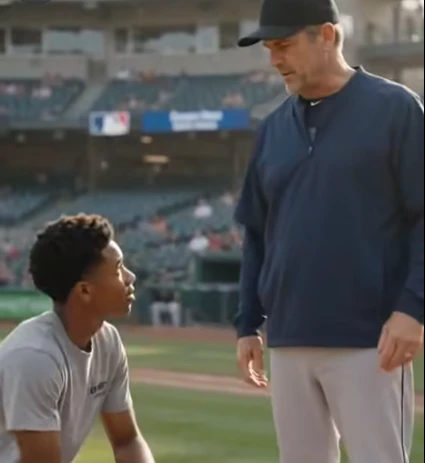
Daniel was sixty-one.
He had worked professional baseball for more than three decades.
His job that morning was simple.
Inspect game conditions.
Confirm rules compliance.
Then disappear until first pitch.
He had heard enough of the argument to stop.
Everett looked irritated.
“Daniel, the kid’s messing with the mound.”
Daniel looked at Zion.
“Were you?”
“No, sir.”
“What were you doing?”
Zion pointed.
“There’s a pitching cleat print behind the rubber.”
Daniel crouched.
Everett sighed loudly.
“This is ridiculous.”
Daniel ignored him.
The print was clear once you looked.
Three metal-spike marks.
A heel edge.
Then another partial footprint leading toward the back slope.
Daniel pressed his thumb into the darker patch.
Fresh clay.
He looked at Zion.
“You said two holes?”
“Yes, sir.”
“Show me.”
Zion pointed to both.
Daniel gently scraped the surface with a plastic field gauge from his pocket.
Under the first patch was a narrow cavity.
Filled recently.
Under the second, the same.
Daniel’s face changed.
He placed both hands against the rubber.
Pressed forward.
Nothing.
Then backward.
The pitching rubber shifted.
Less than half an inch.
Enough.
Daniel froze.
Isaiah’s face went pale.
Everett stopped talking.
Daniel tested again.
The rubber moved.
He stood immediately and raised both arms.
“No pitcher takes this mound.”
The words carried across the stadium.
A bullpen coach turned.
Several players stopped stretching.
League officials near home plate looked up.
Everett stepped toward Daniel.
“You’re not serious.”
Daniel shouted toward the tunnel.
“Bring me the measurement kit.”
Then toward another official.
“Security stays on the mound.”
He pointed.
“Nobody touches anything.”
The stadium was still mostly empty, but suddenly it felt silent.
Daniel looked at Isaiah.
“When was this rubber last confirmed?”
“Eleven last night.”
“By you?”
“Yes.”
“And?”
“It was solid.”
“You measured?”
Isaiah nodded.
“Photographed too.”
Daniel looked at Zion.
“How did you know the print mattered?”
Zion pointed toward his father’s grounds crew near the dugout.
“Our crew wears flat-soled work boots.”
Everyone looked.
Black work boots.
Wide tread.
No spikes.
Zion turned back toward the footprint.
“That came from a pitching cleat.”
Daniel followed the mark with his eyes.
One print.
Another.
Then a faint clay transfer leading down the back of the mound toward the grass.
He crouched.
There was another print near the edge.
Then another.
A trail.
Not toward the home dugout.
Toward the opposing dugout.
Daniel stood.
“Markers.”
A league operations official handed him small numbered evidence tabs.
Everett’s face changed.
“Evidence?”
Daniel looked at him.
“That is what it is until we know otherwise.”
Everett laughed nervously.
“It’s dirt.”
Daniel pointed at the shifting rubber.
“That is a game surface that was secure eight hours ago.”
Then he pointed at the footprints.
“And somebody wearing pitching spikes was here after the field crew left.”
Everett’s jaw tightened.
Daniel looked toward stadium security.
“Lock both clubhouses.”
Everett stepped forward.
“You can’t do that.”
Daniel turned.
“I can stop this game.”
Now everyone went silent.
The measuring crew arrived.
Isaiah joined them.
He looked sick.
A mound was personal to him.
If something was wrong, he felt responsible even when he knew he had left it perfect.
They measured the rubber.
First position.
Then anchor depth.
Then centerline.
The result confused everyone.
The rubber itself had been repositioned only slightly.
Not enough to create some dramatic crooked mound.
But the front edge had been raised unevenly.
One side sat slightly higher.
The two patched holes marked where anchors had originally been.
Someone had loosened the plate.
Shifted it.
Then repacked clay around it.
Daniel asked:
“What effect?”
Isaiah answered first.
“Depends on the pitcher.”
Everett immediately said:
“None.”
Isaiah looked at him.
“I didn’t say none.”
Everett glared.
“It’s fractions.”
Isaiah nodded.
“Fractions matter to pitchers.”
Daniel asked:
“How?”
Zion answered before he could stop himself.
“If one side sits higher, a pitcher who lands or drives from that angle could feel like his back foot is slipping.”
Everyone looked at him.
Zion continued carefully.
“And if he changes his push because it feels wrong, his release changes.”
Everett snapped:
“He’s fifteen.”
Daniel said:
“He’s also correct.”
Isaiah looked at his son.
Not proud yet.
Worried.
This was becoming bigger.
Daniel had security follow the footprint trail.
Zion stayed where he was.
The cleat marks reached foul territory beside the opposing dugout.
Then disappeared on concrete.
A stadium security supervisor named Teresa Vaughn checked access logs.
The tunnel required credentials after midnight.
Only grounds staff, security, league officials, and designated team personnel had clearance.
The grounds crew had exited before midnight.
League officials had not returned until morning.
Security patrols had passed through but wore flat tactical shoes.
That left team personnel.
Teresa opened electronic records.
At 1:42 a.m., one temporary championship credential had entered the restricted tunnel.
At 1:49, it exited.
Seven minutes.
Credential owner:
MASON KELL — PITCHING OPERATIONS ASSISTANT
Everett Sloan stopped moving.
Daniel noticed.
“You know him?”
Everett answered too quickly.
“He works with us.”
“Your club?”
“Yes.”
“What does pitching operations mean?”
“Video.”
“Data.”
“Bullpen support.”
Daniel looked toward the opposing dugout.
“Is he here?”
Everett said:
“I don’t know.”
Teresa already had a radio to her mouth.
Within minutes, security found Mason Kell near the team equipment room.
He was twenty-nine.
Nervous.
Wearing running shoes.
No cleats.
Daniel asked:
“Were you on the field at 1:42 this morning?”
“No.”
Teresa held up the access report.
“Your credential was.”
Mason swallowed.
“I lent it to somebody.”
“Who?”
“No one.”
“You just said somebody.”
“I mean, maybe someone used it.”
Teresa asked:
“Without permission?”
Mason looked toward Everett.
That glance lasted less than a second.
Zion saw it.
Daniel did too.
Everett said:
“Don’t look at me.”
Mason immediately looked down.
Daniel’s voice became colder.
“Who used your badge?”
Mason said:
“I want to talk to team counsel.”
That was the moment the championship moved from delay to crisis.
League executives arrived.
Then club executives.
Then legal counsel.
The stadium gates were supposed to open in ninety minutes.





