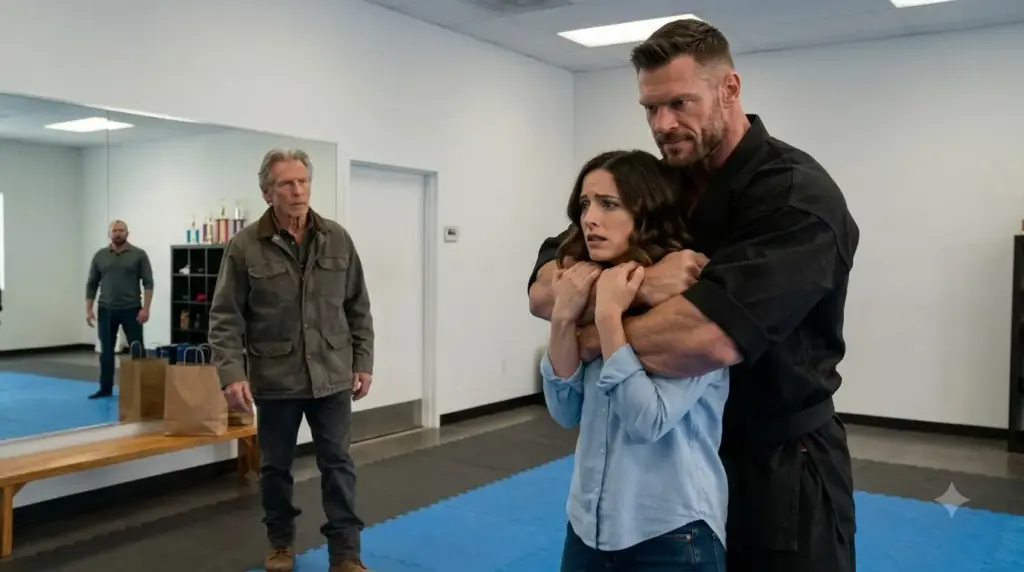
And now she was sitting in a hospital room, wondering whether her scholarship opportunity had disappeared.
When Elias visited, she was staring at her application papers.
“How are you feeling?” he asked.
“Embarrassed.”
He pulled up a chair.
“Why?”
“Because I couldn’t get out.”
Elias studied her.
“You tapped.”
“I know.”
“That was the correct decision.”
Wren looked away.
“He made it look like I was weak.”
Elias leaned forward.
“Can I tell you something?”
She nodded.
“The most dangerous person in a training room isn’t always the strongest fighter.”
Wren looked at him.
“Then who is it?”
“The person who believes the rules don’t apply to them.”
She was silent.
Elias continued.
“You were responsible for your own safety. You recognized the danger and signaled surrender. He was responsible for releasing you.”
Wren stared at her hands.
Then whispered, “I thought champions were supposed to know that.”
Elias nodded.
“They are.”
The next morning, Wren received an email from Breakwater Combat Academy.
Her scholarship application had been rejected.
The message stated that she had failed to demonstrate sufficient composure during the final assessment.
Wren read it three times.
Then called the academy.
Victor Sloane answered.
“Mr. Sloane, I received the email.”
“Yes.”
“It says I failed because I lost composure.”
Victor hesitated.
“That’s the assessment committee’s decision.”
“But I tapped because Nolan wouldn’t release.”
“Wren, I understand you’re upset.”
“I’m not asking you to understand that I’m upset. I’m asking why following the safety rules counts as failure.”
Victor was silent.
Then said, “The committee has already finalized its decisions.”
Wren looked toward her hospital discharge papers.
“Can I appeal?”
A pause.
“There’s no formal appeal process.”
The call ended.
Wren sat motionless.
Then she opened her phone and called Elias.
Elias listened without interrupting.
When she finished, he asked one question.
“Do you still have the assessment instructions?”
“Yes.”
“Read the section about safety.”
Wren opened the document.
Her eyes moved down the page.
Then she stopped.
“Participants must demonstrate sound judgment, respect for boundaries, and immediate compliance with surrender signals.”
Elias waited.
Wren read the sentence again.
Her voice changed.
“That’s exactly what I did.”
“Yes.”
She took a breath.
“What should I do?”
“Ask them to explain their decision in writing.”
“Will that help?”
“It will establish what they’re willing to stand behind.”
Wren looked at the email.
Then nodded.
“Okay.”
Three days later, Breakwater’s board of directors received a formal complaint.
It included Wren’s account.
The referee’s statement.
Copies of the assessment rules.
And recordings from three spectators.
The complaint also questioned why an applicant had been penalized for signaling surrender during an unsafe demonstration.
Victor initially attempted to resolve the matter quietly.
He offered Wren a refund of her application fee.
She declined.
Then he offered her a private reassessment.
She declined that too.
“Why?” he asked during a telephone call.
“Because I didn’t fail the first assessment.”
Victor sighed.
“Wren, we’re trying to find a solution.”
“So am I.”
“What do you want?”
She paused.
Then answered.
“I want the rules to mean something.”
The board opened an independent review.
Nolan was temporarily removed from instructional duties.
Several students were interviewed.
What emerged was troubling.
Other applicants described being mocked for tapping.
Some said Nolan deliberately increased pressure during demonstrations to test their toughness.
One former student reported leaving the academy after being injured during a session where instructors discouraged participants from stopping.
The board also discovered that Nolan had considerable influence over scholarship decisions.
Applicants he personally favored received strong recommendations.
Those who challenged his methods were often rated poorly.
The scholarship program had been advertised as an opportunity for people committed to youth instruction.
But in practice, Nolan had been treating it as a competition for his approval.
When the board confronted Victor, he admitted that concerns about Nolan had been raised before.
He had dismissed them because Nolan attracted sponsors and publicity.
That admission changed everything.
The issue was no longer simply one champion’s conduct.
It was the academy’s failure to protect the people who trusted it.
Two weeks later, the board announced its findings.
Nolan had violated the academy’s safety rules.
His continued restraint after Wren’s surrender was unacceptable.
His role in scholarship selection had created serious concerns about fairness.
And the academy’s response to Wren’s complaint had been inadequate.
Nolan’s contract was suspended pending disciplinary proceedings.
Victor was removed from direct oversight of the scholarship program.
The board introduced independent assessments, written appeal procedures, and stronger requirements for instructor conduct.
Wren’s rejection was withdrawn.
She was invited to complete a new assessment under independent supervision.
This time, the board offered to cover her travel expenses.
Wren considered the invitation.
Then accepted.
Not because she wanted revenge.
Because she still wanted to teach.
A month later, Wren returned to Breakwater.
The winter rain had turned to cold sunshine.
She stepped off the bus carrying the same duffel bag.
Her finances were still tight.
Her nursing coursework was still demanding.
And she still felt nervous walking into the academy.
But this time, Elias was waiting near the entrance.
He held a cardboard box.
Wren smiled.
“More coats?”
He laughed.
“Actually, yes.”
She shook her head.
“Do you ever stop helping people?”
“Occasionally. When I sleep.”
They walked inside together.
The training hall looked different.
A new sign hung beside the mat.
SAFETY IS A SKILL. RESPECT IS A REQUIREMENT.
Wren read it.
Then looked at Elias.
“Do you think they’ll actually follow it?”
He considered the question.
“That depends on what they do when following it becomes inconvenient.”
She nodded.
“Fair answer.”
The reassessment began with technical demonstrations.
Wren performed controlled movements.
Explained how she would teach beginners.
And responded to scenarios involving frightened or injured students.
One assessor asked her what she would do if a young athlete refused to continue an exercise.
Wren answered immediately.
“I’d stop.”
“Even if you believed the exercise was safe?”
“Yes.”
“Why?”





