The Quiet Man at Breakwater
Wren Calder had never wanted to become a professional fighter.
She wanted to become the kind of instructor who could help frightened children feel safe.
Her younger brother, Eli, was the reason.
At thirteen, Eli had developed a habit of walking three extra blocks home from school to avoid a group of older boys. He never complained. He simply arrived home late, his shoulders tense, pretending he had stopped to look at the fishing boats.
Wren discovered the truth when she found his torn backpack hidden beneath his bed.
She couldn’t afford private lessons for him.
So she began teaching him what she knew from her own years of recreational martial arts: awareness, confidence, boundaries, and when to ask for help.
Over time, Eli stopped hiding.
That small change meant more to Wren than any medal she had ever won.
When she learned that Breakwater Combat Academy offered scholarships for aspiring youth instructors, she applied immediately.
The monthly stipend could help her pay for nursing textbooks.
The training could help her build a free after-school program in Port Mercer.
And the academy’s reputation suggested that she would be learning from some of the best instructors in the region.
She had no idea what was waiting for her.
The assessment began at nine that morning.
Twenty-four applicants gathered inside the academy.
Some wore expensive uniforms.
Others carried professional equipment bags.
Wren arrived with a borrowed training jacket and shoes she had repaired herself.
Nolan Pryce noticed her almost immediately.
“You’re the girl from Port Mercer?”
“Yes, sir.”
He examined her application.
“Community college?”
“Yes.”
“Part-time nursing student?”
“Full-time student. I also work part-time.”
Nolan smirked.
“Busy girl.”
Wren said nothing.
He glanced at her equipment.
“Do you actually train, or did you just watch some videos online?”
A few applicants laughed.
Wren felt her cheeks warm.
“I’ve trained for six years.”
“At what academy?”
“Harbor Community Athletics.”
Nolan raised his eyebrows.
“Never heard of it.”
“It’s a small program.”
“Obviously.”
He handed back her paperwork.
“Well, we’ll see what you can do.”
Throughout the morning, Wren performed well.
She demonstrated controlled movements, followed instructions, and helped another applicant who became confused during a partner exercise.
Her technical skills weren’t perfect.
But she listened carefully.
And she never used more force than necessary.
That seemed to irritate Nolan.
During the final assessment, he announced that each applicant would participate in a short demonstration with a senior instructor.
When Wren’s name was called, he stepped onto the mat himself.
“I’ll take this one.”
The referee looked surprised.
“You’re sure?”
Nolan smiled.
“Absolutely.”
He turned toward Wren.
“Let’s see what they teach in Port Mercer.”
The demonstration began normally.
Wren followed the agreed sequence.
She defended an attempted takedown, recovered her position, and maintained control without unnecessary aggression.
Then Nolan changed the pace.
He began applying more pressure.
Wren tried to adjust.
He forced her toward the mat.
She landed awkwardly but recovered enough to protect herself.
The referee stepped closer.
“Nolan, keep it controlled.”
Nolan ignored him.
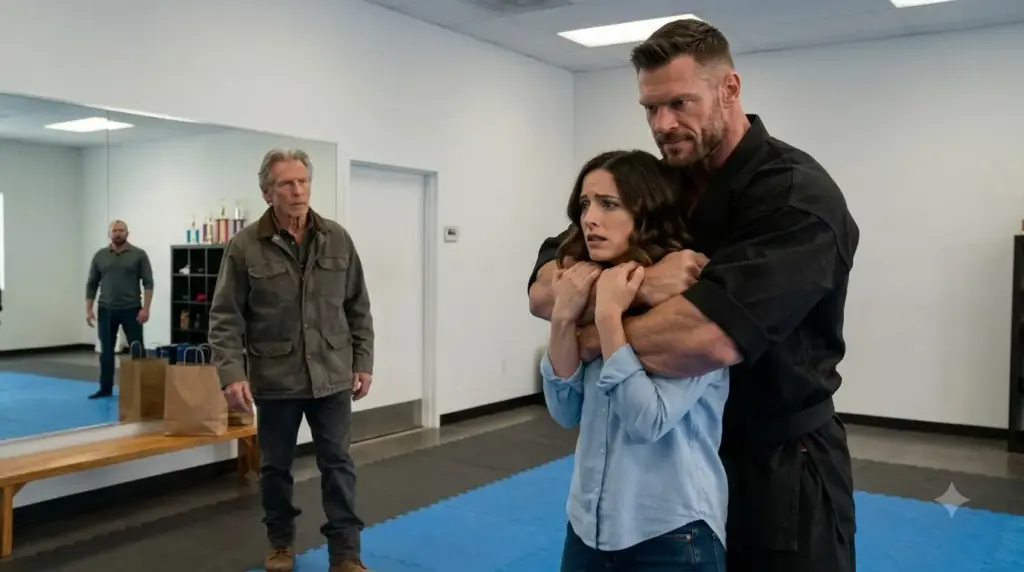
A moment later, he secured the hold around her neck.
Wren recognized the danger immediately.
She tapped.
Once.
Twice.
Three times.
Nolan tightened his arm.
And whispered:
“You should’ve stayed down.”
Now, six hours after leaving home, Wren lay on a training mat while a stranger in a faded jacket helped keep the crowd away.
Her breathing was returning, but she felt dizzy.
The academy medic examined her while emergency services were contacted.
Nolan stood several feet away, furious.
“Who the hell are you?” he demanded.
The stranger looked toward him.
“Someone who saw her tap.”
“That doesn’t answer my question.”
“It answers the important one.”
Nolan stepped closer.
“You think you can walk into my academy and tell me what to do?”
The man remained still.
“I told you to release someone who had surrendered.”
Nolan laughed.
“You have no idea who you’re talking to.”
The stranger looked at Wren.
Then back at Nolan.
“I know enough.”
The academy director, Victor Sloane, hurried toward them.
“What happened?”
Nolan immediately pointed toward the stranger.
“This guy interrupted my demonstration.”
Victor looked at Wren.
She was sitting upright now, supported by the medic.
Her face was pale.
“Is she all right?”
The stranger answered.
“She needs medical assessment. The hold continued after she tapped and after the referee ordered a release.”
Victor turned toward Nolan.
“Is that true?”
Nolan shrugged.
“She panicked.”
The stranger’s expression hardened.
“She surrendered.”
Nolan opened his mouth.
But the referee spoke first.
“He’s right.”
Everyone turned.
The referee swallowed.
“I told Nolan to stop. He didn’t.”
For the first time, Nolan looked uncertain.
The stranger’s name was Elias Ward.
He was forty-eight years old.
He lived two streets away from the academy and worked as a rehabilitation specialist at a local medical center.
That was the explanation he gave when Victor asked who he was.
It was true.
But incomplete.
Years earlier, Elias had served as a senior instructor in a national combat-sports training program.
He had coached athletes, developed safety procedures, and worked with medical professionals to improve injury prevention.
He had left competitive coaching after witnessing a young athlete suffer a serious injury during a demonstration that should have been stopped.
The incident changed his priorities.
He returned to school.
Studied rehabilitation.
And dedicated his career to helping injured people recover.
He still practiced martial arts occasionally.
But he no longer cared about tournaments.
Or championships.
Or applause.
That afternoon, he had come to Breakwater carrying donated winter coats.
Nothing more.
Until he saw Wren tapping.
At the hospital, Wren was evaluated for injuries associated with the neck restraint.
Doctors monitored her condition and provided instructions for follow-up care.
She was frightened.
But she was also angry.
Not only at Nolan.
At herself.
She had spent nearly all her remaining money traveling to Breakwater.
She had taken time away from work.
She had prepared for weeks.





