Frank Bower attended quietly near the back.
Mara looked around the room.
Then began.
“When I was younger, I thought courage meant staying in a difficult situation until I could overcome it.”
She paused.
“I don’t believe that anymore.”
The audience listened.
“Sometimes courage means recognizing that a situation has become unsafe.”
She looked toward Isabel.
“Sometimes it means refusing to sign something you know is false.”
Then toward Sophie.
“And sometimes it means asking for help, even when someone has told you that doing so makes you weak.”
Mara rested her hands on the podium.
“The purpose of training is not to teach people to ignore danger. It’s to help them understand it.”
For several seconds, the room remained quiet.
Then the applause began.
Not the confused applause that had filled the pavilion during Nolan’s demonstration.
This time, people understood exactly what they were applauding.
After the workshop, Isabel approached Mara.
“I have something for you.”
She handed her a small envelope.
Inside was a photograph.
It showed Isabel and Sophie standing together outside a new training center.
Both were smiling.
On the back, Isabel had written:
We found somewhere that listens.
Mara stared at the picture.
“How is Sophie doing?”
“Better. She’s taking things slowly.”
“And you?”
Isabel smiled.
“I’m training again.”
Mara nodded.
“Good.”
Isabel hesitated.
“Can I ask you something?”
“Of course.”
“Do you ever regret stepping onto that mat?”
Mara looked toward the blue competition area, now empty.
She thought about the fear.
The hospital.
The investigation.
The sleepless nights.
Then she answered.
“I regret trusting Nolan.”
Isabel waited.
“But I don’t regret telling the truth afterward.”
The young woman smiled.
“Neither do I.”
That evening, Mara walked home along the harbor.
The sun was setting behind the warehouses.
Fishing boats rocked gently against their moorings.
Her phone vibrated.
A message from the community center director.
The funding committee had approved the renewal of her youth program’s lease.
The center would remain open.
Mara stopped walking.
She read the message twice.
Then she laughed quietly.
For weeks, she had worried that Nolan’s threats might become reality.
But the committee had reviewed the program independently and decided that its work deserved continued support.
She slipped the phone into her pocket.
Ahead of her, a father was teaching his daughter to ride a bicycle.
The girl wobbled.
Her father steadied the handlebars.
“Again?” he asked.
The girl shook her head.
“Not yet.”
He nodded.
“Okay. We’ll wait.”
Mara watched them for a moment.
Then continued walking.
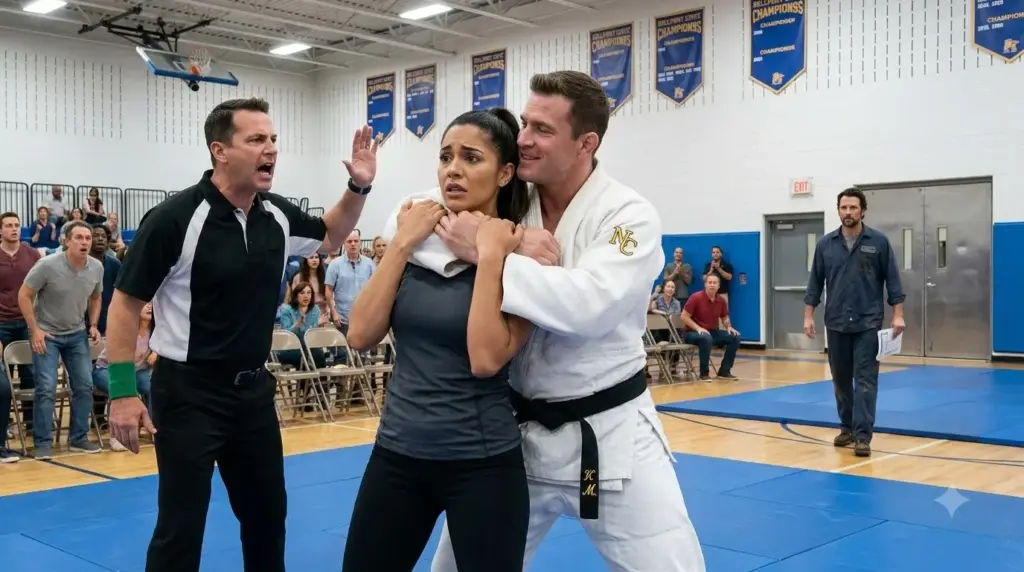
She thought about the words Nolan had whispered into her ear.
Too late to tap now.
He had meant them as a warning.
A reminder that he believed he controlled what happened next.
But the truth had outlasted his threats.
And somewhere in Bellport, young athletes were beginning to learn something more important than how to win.
They were learning that a boundary mattered the moment it was expressed.
That authority did not excuse cruelty.
And that real discipline began when someone had the power to continue but chose to stop.
The End.





