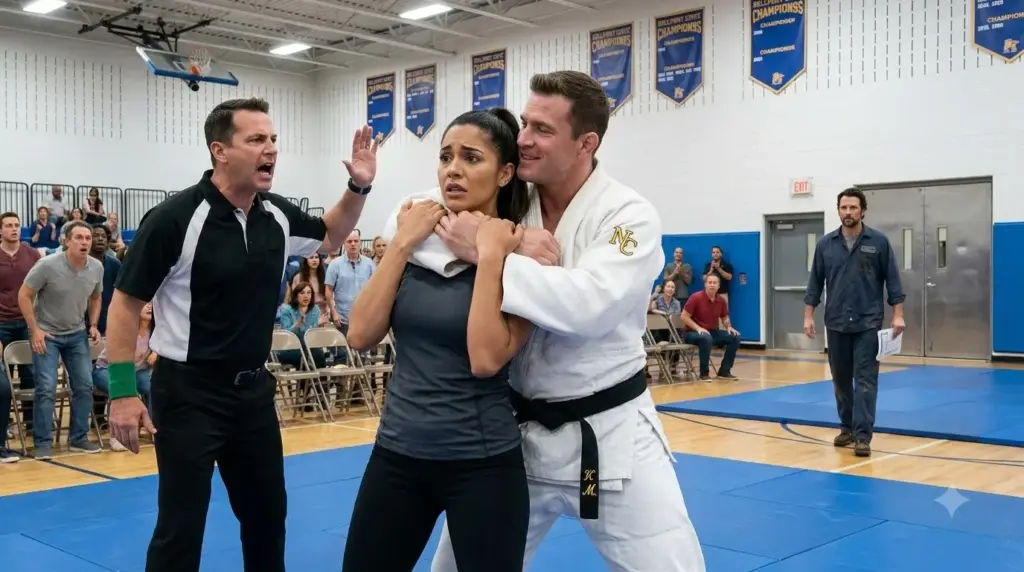
She also believed the presence of a referee and hundreds of spectators would keep the demonstration safe.
She had been wrong.
At the hospital, doctors evaluated her for possible injury related to the neck restraint.
She remained under observation until the medical team was satisfied she could safely leave with follow-up instructions.
Celeste visited her later that evening.
Mara was sitting upright, holding a paper cup of water.
“How are you feeling?”
“Like I made a terrible decision.”
Celeste pulled up a chair.
“You trusted the rules of the demonstration.”
Mara looked down.
“I knew what kind of man he was.”
“Knowing someone is dangerous doesn’t mean you agreed to be harmed.”
Mara remained silent.
Celeste leaned forward.
“There’s something else you should know.”
“What?”
“Several people recorded what happened.”
Mara nodded.
“I assumed they did.”
“One of them recorded what Nolan said after you collapsed.”
Mara looked up.
Celeste continued.
“He told the organizer you deserved it.”
Mara closed her eyes.
For a moment, she could hear Nolan’s voice again.
Too late to tap now.
Celeste waited.
Then asked, “Would you be willing to give a statement?”
Mara opened her eyes.
“Yes.”
The video spread through Bellport overnight.
By morning, thousands of people had watched Nolan Creed continue a hold after Mara signaled surrender.
Some viewers were furious.
Others argued that combat sports were inherently dangerous.
A few defended Nolan, claiming that experienced fighters should expect aggressive demonstrations.
But the clearest footage showed something difficult to dispute.
Mara had tapped.
The referee had ordered a release.
Nolan had continued.
The event organizers suspended future demonstrations pending review.
The regional athletic association requested statements from those involved.
And the local authorities began examining whether Nolan’s conduct warranted further investigation.
Nolan responded with a public statement.
He called the incident an unfortunate misunderstanding.
He claimed Mara had exaggerated her distress.
And he insisted that the demonstration had remained within accepted training standards.
Mara watched the statement once.
Then turned off her phone.
She didn’t respond publicly.
Instead, she met with Isabel.
The young woman arrived at Mara’s apartment carrying a folder.
Inside were copies of messages, training schedules, and a written account of Sophie’s injury.
Isabel placed the folder on the table.
“I kept everything.”
Mara looked at her.
“Why?”
“Because I thought he might try to blame me.”
Mara opened the folder.
The first page was a message from Nolan.
It instructed Isabel to confirm that Sophie had not clearly signaled surrender.
Another warned that her competition opportunities depended on her cooperation.
Mara looked up.
“Have you shown these to anyone?”
“Not yet.”
“Would you be willing to?”
Isabel hesitated.
Then nodded.
“I’m tired of being scared.”
Mara reached across the table.
“You don’t have to handle this alone.”
The investigation expanded.
Sophie’s parents provided medical documentation and their earlier correspondence with Nolan’s academy.
Other athletes came forward.
Some described being pressured to continue training while injured.
Others said they had been threatened with losing opportunities if they complained.
The investigators also reviewed the pavilion footage and interviewed Frank Bower, the referee.
Frank admitted that he had recognized Mara’s surrender.
He explained that Nolan had ignored his instructions.
When asked why he had not stopped the demonstration sooner, Frank lowered his eyes.
“I hesitated.”
“Why?”
“Because Nolan had threatened to stop hiring me for his events.”
The investigator studied him.
“Did that affect your decision?”
Frank nodded.
“Yes.”
He swallowed.
“And Mara paid for it.”
The most important evidence arrived unexpectedly.
A volunteer from the fundraiser contacted the athletic association.
Her name was Rebecca Lin.
She had been responsible for managing the event’s audio equipment.
During the demonstration, she had worn a headset connected to the production system.
She had heard Nolan speaking through a microphone clipped near his collar.
The microphone had been intended for commentary during the demonstration.
But it remained active while he restrained Mara.
Rebecca had saved the raw audio recording.
When investigators listened, they heard Mara tapping against Nolan’s jacket.
They heard Frank ordering a release.
Then they heard Nolan whisper:
“Too late to tap now.”
The room fell silent.
Rebecca explained that she had not understood the significance of the words until she saw the video afterward.
But once she did, she knew the recording needed to be preserved.
The investigators compared the audio with the available footage.
The timing aligned.
Nolan’s public explanation became much harder to sustain.
Six weeks later, the athletic association held a disciplinary hearing.
Mara attended with an adviser.
Isabel and Sophie’s parents were also present.
Nolan arrived with an attorney.
He no longer wore the confident smile from the fundraiser.
The hearing panel reviewed the footage, witness statements, and medical records.
It also considered the evidence of alleged retaliation against Isabel and the pressure placed on officials.
Nolan’s attorney argued that the demonstration had been poorly coordinated and that Nolan had not intended to cause serious injury.
The panel acknowledged that intent and the severity of injury were separate questions.
But the central issue remained clear.
A participant had surrendered.
The referee had ordered the action stopped.
Nolan had knowingly continued.
The association suspended Nolan’s eligibility to participate in sanctioned events pending further disciplinary requirements and referred relevant evidence to the appropriate authorities.
His academy’s governing body opened a separate investigation into its training practices.
Sponsors began reviewing their agreements.
And the youth athletics committee removed Nolan from its fundraising partnerships.
No single decision resolved everything.
But the people who had once been afraid to challenge him were finally being heard.
Three months later, Mara returned to the Bellport Civic Pavilion.
The building was hosting a community safety workshop.
There were no championship belts.
No celebrity fighters.
No cameras waiting for someone to be humiliated.
Instead, families gathered around tables where volunteers explained basic injury prevention, safe training practices, and how to report concerns.
Mara had been invited to speak.
She stood before a small audience.
Isabel sat in the front row.
Sophie was beside her parents.





