But he was ill, and the organization’s leadership had changed.
One evening, he asked Imani to bring him a pen.
He wrote a letter.
Then folded it carefully.
“If they forget why we started,” he told her, “give them this.”
Imani promised.
For almost a year, the letter remained in her desk drawer.
She hadn’t wanted to interfere.
Then she learned that Breakwater had canceled its last free beginner class.
And she knew it was time.
Celia invited Imani into the office.
Imani shook her head.
“I’d rather read it here.”
Dean scoffed.
“This is ridiculous.”
Celia turned toward him.
“You’re finished training for today.”
He stared.
“You can’t be serious.”
“Go home, Dean.”
His eyes moved toward the teenagers.
Toward the phones.
Toward the people who had watched him humiliate a visitor only minutes earlier.
For the first time, he seemed to understand that the audience he had enjoyed might now become witnesses.
He walked toward the locker room.
Kirk followed.
Jace remained behind.
Imani unfolded the letter.
The paper was yellowed at the edges.
Her father’s handwriting leaned slightly to the right.
She began reading.
“To whoever is responsible for Breakwater when this letter is opened.”
Her voice trembled.
She paused.
Then continued.
“When we opened this place, we didn’t have much. We had old mats, borrowed gloves, and a building that smelled like chlorine no matter how often we cleaned it.”
A few older instructors smiled faintly.
“We had children who came hungry. Children who were frightened. Children who had been told so often that they were weak that they had begun to believe it.”
Imani swallowed.
“We promised them something simple. That nobody would have to earn the right to be treated with respect.”
The room remained still.
“Some of those children became fighters. Most didn’t. That was never the point.”
Mara lowered her eyes.
“The point was to give them somewhere they could enter without being ashamed of what they couldn’t afford.”
Imani reached the final paragraph.
“If Breakwater ever becomes a place where the strongest person gets to decide who belongs, then we will have lost the only championship that mattered.”
Her voice broke.
She stopped reading.
Celia stepped forward.
“Imani—”
But Imani shook her head.
“There’s one more line.”
She looked down.
“Please don’t put my name on another wall. Just keep the door open.”
She folded the letter.
Nobody applauded.
The silence was too heavy for that.
The following morning, Celia called an emergency meeting of Breakwater’s board.
The incident had been recorded by several students.
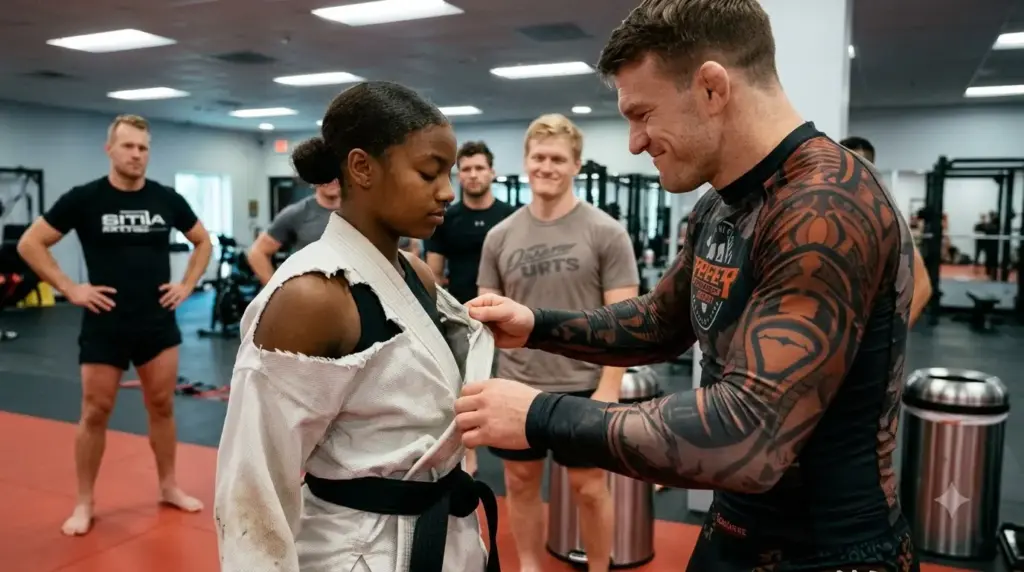
The videos showed Dean and Kirk surrounding Imani, grabbing her clothing, and ignoring repeated requests to stop.
The board suspended both men from the facility while an independent investigation was conducted.
Jace provided a statement.
Mara did too.
Several parents came forward with complaints they had previously been afraid to raise.
The investigation revealed that Breakwater’s problems extended beyond one confrontation.
Some families had been charged fees they hadn’t agreed to.
Scholarship applications had gone unanswered.
And several young athletes reported being pressured to participate in training sessions despite injuries.
Celia realized that the organization had gradually become something Samuel Wells would barely recognize.
She also understood that she had allowed it to happen.
For years, she had focused on fundraising, sponsorships, and keeping the building open.
She had convinced herself that compromises were necessary.
But somewhere along the way, she had stopped asking whom those compromises were hurting.
The board announced an independent review of the youth program, financial policies, and athlete-safety procedures.
It also suspended the Harbor Cup promotional campaign until the review was complete.
The decision angered some sponsors.
But others offered support.
A local construction company volunteered to repair the aging facilities.
A neighborhood foundation offered funding for youth scholarships.
Several former students returned to volunteer.
And parents who had once felt unwelcome began attending community meetings.
For the first time in years, Breakwater’s future was being discussed by the people it was supposed to serve.
Three weeks later, Imani received a phone call.
It was from Mara.
“There’s someone who wants to speak with you.”
Imani was sitting at her kitchen table, repairing the torn jacket.
She had found a matching piece of blue cotton at a fabric shop.
But she couldn’t bring herself to replace the damaged sleeve entirely.
The old fabric carried too much history.
“Who?” she asked.
“Ellie.”
Imani smiled.
“The girl with the green sneakers?”
“That’s her.”
A small voice came onto the phone.
“Ms. Wells?”
“Hello, Ellie.”
“I wanted to ask you something.”
“Of course.”
Ellie hesitated.
“Was your dad really the person who started Breakwater?”
“He helped start it.”
“Did he teach you to fight?”
Imani looked down at the jacket.
“He taught me a few things.”
“Like what?”
Imani considered the question.
“How to stand up after falling.”
Ellie was quiet.
Then she asked, “Was he strong?”
Imani smiled sadly.
“Very.”
“Could he beat up Dean?”
Imani laughed softly.
“I don’t know.”
Ellie sounded disappointed.
“Oh.”
“But I know he wouldn’t have wanted to.”
There was a long pause.
Then Ellie whispered, “I was scared when they grabbed you.”
“I know.”
“I wanted to help, but I didn’t know what to do.”
Imani’s expression softened.
“You spoke up.”
“That didn’t stop them.”
“No,” Imani said. “But it helped other people realize they needed to act.”
Ellie thought about that.
Then asked, “Does that count as being brave?”
Imani looked toward the window.
“Yes, Ellie. It does.”
Two months later, Breakwater reopened its free beginner program.
The first class filled within three days.
Celia had asked Imani to attend the opening ceremony.
Imani initially refused.
She didn’t want speeches.
She didn’t want photographs.
And she certainly didn’t want the incident with Dean turned into a promotional story.
But Mara called again.
“There’s something you should see.”
So Imani returned.
The old bathhouse looked different.
The walls had been repainted.
The benches repaired.
The broken ceiling panels replaced.
But the biggest change was near the entrance.





