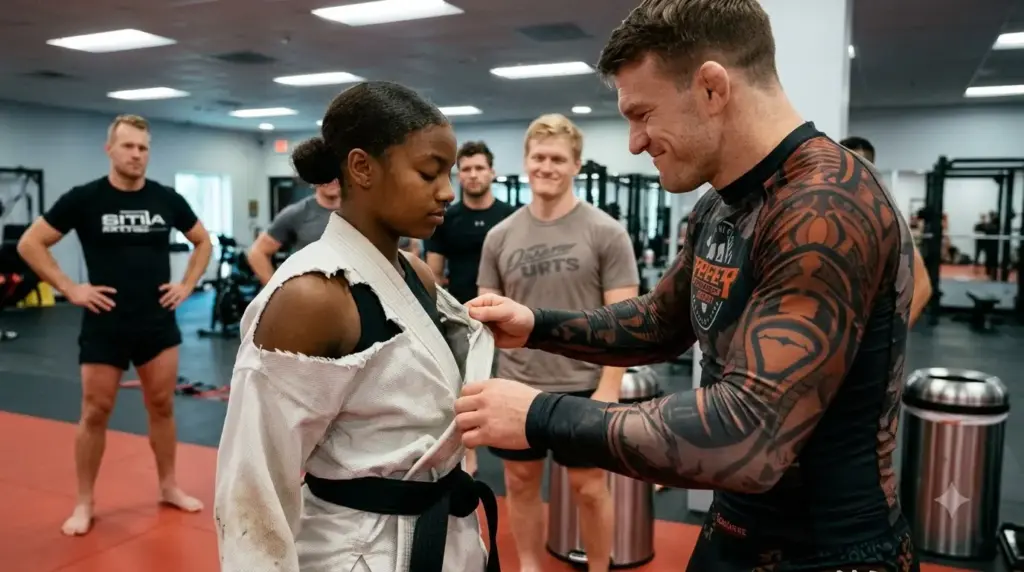
The Jacket They Should Never Have Torn
ever ignored.
Her father had died eleven months earlier.
And now Dean Maddox was holding the last jacket he had ever worn.
“Let it go,” Imani repeated.
Dean grinned.
“Or what?”
She looked at his hand.
“Or you’ll have to explain why three grown men are threatening a woman who came here to deliver a letter.”
Kirk laughed.
“Nobody’s threatening anybody.”
He still had his fist twisted in her jacket.
Imani looked directly at him.
“Then take your hand off me.”
Something about the simplicity of the request made Jace stop smiling.
“Come on, guys,” he muttered. “That’s enough.”
Dean ignored him.
Instead, he pulled the torn sleeve farther away from Imani’s shoulder.
“What’s so special about this ugly old thing?”
Imani looked at the fabric.
“My father made it.”
For the first time, her voice changed.
Not louder.
Just thinner.
Dean glanced at the jacket, then back at her.
“Well, maybe your father should’ve bought better clothes.”
A few teenagers laughed nervously.
The girl in green sneakers didn’t.
She stood.
“That’s not funny.”
Every head turned.
Mara Larkin immediately stepped toward her.
“Ellie, sit down.”
But Ellie remained standing.
“She didn’t do anything.”
Dean’s expression hardened.
“Mind your business, kid.”
Imani looked at the girl.
“He’s right about one thing,” she said gently. “You don’t need to get involved.”
Then she turned back toward Kirk.
“Last time. Release my jacket.”
Kirk tightened his grip.
“Make me.”
Imani moved.
Not dramatically.
Not with a wild punch or a shouted threat.
She turned just enough to free the remaining fabric from Kirk’s fist, stepped out of his reach, and placed the length of the training bench between them.
Kirk stumbled forward, surprised by the sudden absence of resistance.
Dean lunged after her.
“Hey!”
Imani raised one hand.
“Stop.”
The word cut through the room.
It wasn’t a challenge.
It was a boundary.
Dean hesitated.
And in that hesitation, Mara finally moved.
She stepped between them.
“That’s enough, Dean.”
He stared at her.
“Get out of my way.”
“No.”
The gym fell silent.
Mara had worked at Breakwater for eight years.
She had watched Dean become the gym’s most popular fighter, watched his face appear on promotional banners, and watched the director excuse behavior that would have gotten any ordinary member suspended.
She had told herself that keeping quiet allowed her to protect the younger students.
But now Ellie was watching.
And Mara realized that silence was teaching its own lesson.
“Three adults just surrounded a visitor and tore her clothes,” Mara said. “I’m not pretending that didn’t happen.”
Dean’s face reddened.
“You want to lose your job?”
Mara looked toward the office.
“Maybe.”
Then she turned back.
“But I’m not letting you threaten her again.”
The office door opened.
A woman in a charcoal cardigan stepped into the gym.
Her name was Celia Voss.
She was the executive director of Breakwater Combat Collective, a community organization that had once provided free martial arts lessons to children from the surrounding neighborhoods.
“What’s going on?” she demanded.
Dean immediately pointed at Imani.
“She came in here causing trouble.”
Imani said nothing.
Celia noticed the torn jacket.
Then the loose sleeve in Dean’s hand.
Her expression changed.
“Where did you get that?”
Imani looked at her.
“It belonged to my father.”
Celia stepped closer.
“What was his name?”
“Samuel Wells.”
The director stopped.
For several seconds, she seemed unable to speak.
Then she whispered, “Sam?”
Imani nodded.
Celia stared at the jacket.
At the darker patches along the elbows.
At the small yellow rectangle inside the collar.
She knew that jacket.
She had seen Samuel Wells wearing it hundreds of times.
Long before Breakwater had corporate sponsors.
Before the Harbor Cup.
Before the expensive equipment and the promotional posters.
Samuel had taught children in the old municipal bathhouse when the building still had broken windows and a leaking roof.
He had organized the first classes.
Repaired the mats.
Built the benches.
And spent his weekends helping families who couldn’t afford membership fees.
Celia had been one of his first students.
She looked at Dean.
“Give her the sleeve.”
Dean frowned.
“What?”
“Now.”
He dropped it.
The fabric landed on the mat.
Imani bent to retrieve it.
But Celia reached it first.
She picked it up carefully.
Then handed it back with both hands.
“I’m sorry,” she said.
Imani accepted the fabric.
“Thank you.”
Celia looked at the folded letter still clutched in Imani’s hand.
“Is that from your father?”
Imani nodded.
“He asked me to bring it here if the youth program ever stopped being free.”
Celia’s face went pale.
Eleven months earlier, Samuel Wells had died in a small hospital overlooking the harbor.
He was seventy-two.
His hands were permanently rough from decades of carpentry, and his knees had long since stopped cooperating with the demands of martial arts.
But until his final illness, he continued visiting Breakwater twice a week.
He never asked for money.
He never wanted his photograph on the wall.
He simply liked seeing children discover that they were capable of more than they believed.
When Imani was little, she had spent her afternoons in the old bathhouse watching him teach.
Her father didn’t begin with punches.
He began with falling.
He taught children how to land safely, how to stand again, and how to recognize when a situation was becoming dangerous.
“Anybody can learn to hit,” he used to say. “Knowing when not to is harder.”
Imani had eventually become a physical therapist.
She worked with patients recovering from injuries, including people learning to walk again after serious accidents.
Her father’s lessons had followed her into that work.
Patience.
Dignity.
And the belief that physical strength meant very little without compassion.
During his final weeks, Samuel had become concerned about changes at Breakwater.
Membership fees were increasing.
Free classes were disappearing.
Children whose parents couldn’t pay were being turned away.
Samuel had tried speaking with the board.





