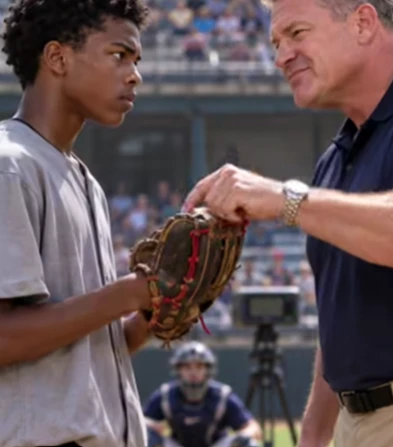
“Ladies and gentlemen,” he announced, “this is the arm you’ve been waiting to see.”
Mason glanced toward his father.
His expression was difficult to read.
“Ready, son?”
Mason nodded.
Tyler Knox crouched behind home plate.
A radar gun sat on a tripod behind the mound, while a separate digital presentation screen displayed the recorded pitch speeds to the observers.
Mason threw his first fastball.
The catcher received it cleanly.
The display showed 93 MPH.
Applause rose from the bleachers.
Brent pointed toward the number.
“That’s what elite development looks like.”
Mason threw again.
94 MPH.
Then 95.
The spectators became louder.
Several parents raised their phones.
Isaiah watched from beside the equipment buckets.
He knew those were remarkable speeds for a sixteen-year-old.
But something troubled him.
Mason’s mechanics looked strained.
His stride was inconsistent, and his throwing shoulder appeared to open too early.
Isaiah had made those same mistakes before Earl corrected them.
Yet the radar readings kept climbing.
Then came the pitch that Isaiah couldn’t forget.
Mason released the baseball with his arm dragging behind his body.
The pitch dropped sharply and struck the dirt several feet before home plate.
Tyler blocked it with his chest protector.
The presentation screen displayed 94 MPH.
Brent immediately clapped.
“Beautiful velocity!”
Isaiah narrowed his eyes.
A fastball could certainly strike the ground and still register its release speed.
Earl had explained that to him.
But the number had appeared almost before Tyler completed the block.
And the small radar unit on the tripod seemed to be displaying something different from the presentation screen.
Isaiah couldn’t read the smaller digits from where he stood.
He glanced at Mason.
The older boy wasn’t smiling.
He was studying the same equipment.
Then Brent stepped toward the presentation screen and adjusted something behind its casing.
The next pitch registered 96 MPH.
The bleachers erupted.
Isaiah felt a cold uncertainty settle in his stomach.
Maybe he was imagining things.
Maybe jealousy was making him suspicious.
He hated that possibility.
He wanted to earn an opportunity, not resent somebody else’s.
But he couldn’t forget the timing.
The numbers seemed to be appearing according to Brent’s expectations rather than Mason’s actual pitches.
At the back of the scouting section, a woman named Rebecca Sloan watched Mason’s demonstration without applauding.
Rebecca was a college recruiting coordinator in her early forties, with short dark hair, a navy jacket, and an old-fashioned leather notebook.
She had spent nearly two decades evaluating young baseball players.
Numbers interested her.
Mechanics interested her more.
She lowered her binoculars.
Beside her, another recruiter checked the reading on his independent handheld radar gun.
“That’s odd,” he murmured.
Rebecca looked toward him.
“What did you get?”
He turned the display slightly.
She read it.
Then she glanced toward the large presentation screen beside the mound.
The readings didn’t match.
Not by one or two miles per hour.
By considerably more.
Rebecca made a note.
She didn’t accuse anyone.
Radar equipment sometimes produced bad readings because of alignment, interference, or setup errors.
But she had learned that when equipment behaved strangely, the correct response was to collect more evidence.
She watched Brent approach the presentation unit again.
His hand briefly disappeared behind its metal frame.
Rebecca wrote another line.
Then her attention shifted toward a boy carrying two buckets across the infield.
A skinny teenager in a faded gray jersey.
A repaired glove hung from his equipment bag.
She watched him pause beside a younger pitcher.
Something about the boy’s movements seemed familiar.
Rebecca opened a folder on her tablet.
She searched through several saved video clips.
Then she froze.
The boy on the field looked remarkably like the teenager in one of those videos.
But according to the showcase roster, that teenager wasn’t supposed to be present.
Rebecca looked up.
“Who is that kid?”
The recruiter beside her followed her gaze.
“The ball boy?”
“Yes.”
“Don’t know.”
Rebecca studied the field.
Then she began searching through her email.
Shortly before noon, twelve-year-old Owen Parker approached Isaiah near the bullpen.
Owen wore a bright red practice jersey and carried an expensive black glove.
He was talented but nervous.
His first pitching session had gone badly, and Brent had already shouted at him twice.
“Hey,” Owen whispered. “Can I ask you something?”
Isaiah looked around.
“What?”
“How do you keep your fingers on a fastball?”
Isaiah hesitated.
He remembered Brent’s warning.
But Owen looked miserable.
“Show me your grip.”
Owen placed a baseball between his fingers.
Isaiah gently adjusted his hand.
“Don’t squeeze it like you’re trying to crush it. Keep your fingers across the seams.”
“Like this?”
“Yeah. And don’t twist your wrist trying to make it faster.”
Owen tried again.
Isaiah smiled.
“That’s better.”
Then a voice cracked across the bullpen.
“WHAT DO YOU THINK YOU’RE DOING?”
Both boys turned.
Brent Harlan was marching toward them.
His face had gone red.
“Did somebody hire you to teach pitching?”
Isaiah immediately stepped back.
“No, sir.”
Brent stopped inches away.
“Then explain why you’re giving instructions to my players.”
“He just asked about the grip.”
Owen opened his mouth.
“Coach, I—”
“Go warm up, Parker.”
The younger boy flinched.
“But—”
“Now.”
Owen hurried away.
Brent turned back toward Isaiah.
“You think carrying buckets makes you qualified to coach my athletes?”
Several nearby parents turned to watch.
Isaiah lowered his eyes.
“No, sir.”
“You think because you hang around a baseball field, you’re suddenly an expert?”
“I didn’t say that.”
Brent laughed.
“Oh, listen to him. He’s got answers.”
The parents chuckled.
One teenage player leaned against the dugout railing, grinning.
Isaiah felt his face burning.
He could hear Rochelle’s voice in his memory.
You can work for a man without belonging to him.
He tightened his grip on the bucket handle.
“I was only helping.”
“Helping?” Brent repeated. “You’re here to carry equipment. That’s your job.”
Isaiah glanced toward the mound.
He saw the radar gun.
The scouts.
The boys wearing numbers.
And suddenly, the humiliation became unbearable.





