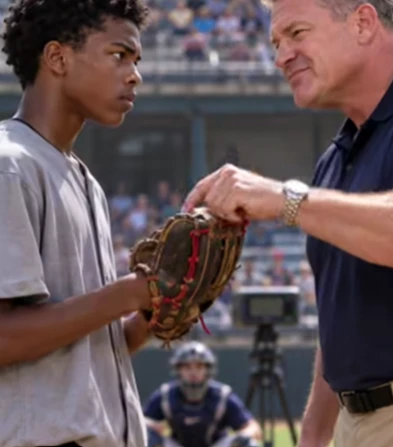
At 5:18, Isaiah reached the bullpen carrying his repaired glove.
Earl Moses was already waiting.
At sixty-eight, Earl moved with the careful economy of a man whose joints remembered every game he had ever played.
His back was slightly bent, his hands were scarred from decades of catching baseballs, and his graying hair showed beneath an old cap.
He had spent nine seasons catching in the minor leagues before injuries ended his career.
Now he maintained Dawson Field.
He repaired fences, cut grass, dragged the infield, and cleaned up after boys whose families sometimes spent more on one baseball glove than Earl earned in a week.
But before sunrise, when the stadium belonged to nobody important, he became something else.
Isaiah’s coach.
“You’re late,” Earl said.
Isaiah checked the battered clock above the bullpen.
“Two minutes.”
“That’s still late.”
“Mom was fixing my glove.”
Earl noticed the red stitching.
His stern expression softened.
“She has better hands than half the equipment managers I worked with.”
Isaiah grinned.
Earl pointed toward the foul line.
“Warm up. Slowly.”
They began with shoulder mobility exercises, easy movements, and short throws.
Earl insisted on proper preparation every morning.
He had seen too many promising young pitchers damage their arms because an impatient adult wanted an impressive number.
“Your arm isn’t a machine,” he reminded Isaiah. “It doesn’t owe anybody a hundred miles an hour.”
Isaiah stretched his shoulders.
“Not even ninety?”
“Especially not ninety.”
After twenty minutes, they moved to the bullpen.
Earl lowered himself onto an overturned bucket and raised his catcher’s mitt.
“Show me what we worked on.”
Isaiah took his stance.
He inhaled.
Lifted his left knee.
Balanced over his right leg.
Then drove forward.
The baseball cracked into Earl’s mitt.
The old man winced almost imperceptibly.
“Again.”
Isaiah threw.
Another sharp impact echoed through the empty stadium.
Earl stared at his glove.
For months, he had suspected the boy possessed something extraordinary.
Isaiah wasn’t simply strong.
He had unusual timing, natural coordination, and an explosive combination of leg drive and arm speed that Earl rarely saw in athletes his age.
But talent alone wasn’t enough.
Earl had spent nearly a year correcting Isaiah’s mechanics, teaching him how to generate velocity without sacrificing control.
The boy listened.
He never argued.
He never skipped the difficult exercises.
And every morning, he improved.
Isaiah retrieved another baseball.
“How fast do you think that was?”
Earl rubbed his aching palm.
“Fast enough.”
“Come on.”
“Upper eighties, maybe.”
“Ninety?”
“Could be.”
“Ninety-five?”
Earl gave him a sharp look.
“Don’t start chasing numbers.”
Isaiah sighed.
“I just want to know.”
“I know.”
“Every other kid gets measured.”
Earl said nothing.
Isaiah looked toward the stadium’s main entrance, where a huge banner had been installed for the Southern Plains Youth Showcase.
The registration fee was twelve hundred dollars.
For his family, that might as well have been twelve thousand.
Last month, Isaiah had asked Brent whether he could throw just three pitches into the radar gun.
The coach had laughed.
“Twelve hundred dollars buys a registration number, Reed. Carrying buckets doesn’t.”
Earl remembered how quietly Isaiah had walked away afterward.
Now the old man lowered his mitt.
“There’s something I need to tell you.”
Isaiah turned.
“What?”
Earl looked toward the equipment shed.
For several seconds, he seemed to be searching for words.
Then the sound of an approaching truck broke the silence.
Headlights swept across the outfield fence.
Brent Harlan’s pickup rolled into the parking lot.
Earl immediately stood.
“Practice is over.”
Isaiah frowned.
“But we still have—”
“Put the balls away.”
Something in Earl’s voice stopped him.
It wasn’t irritation.
It sounded like fear.
As Isaiah gathered the baseballs, he noticed Earl slipping a folded paper from his back pocket.
The old groundskeeper stared at it.
Then he quickly tucked it away again.
Isaiah didn’t ask what it was.
Later, he would remember that moment more clearly than almost anything else about the morning.
By nine o’clock, Dawson Field had become a different world.
Cars filled the parking lot.
Families carried folding chairs, cameras, coolers, and expensive equipment bags toward the entrance.
Teenage athletes moved across the diamond in matching uniforms.
Parents gathered beneath promotional tents.
College recruiters took their seats behind home plate.
And everywhere Isaiah looked, he saw registration numbers.
Numbers stitched onto jerseys.
Numbers printed on scouting sheets.
Numbers displayed beside names on electronic tablets.
Each one represented an opportunity.
Isaiah had none.
He wore his faded gray shirt and carried two heavy equipment buckets toward the bullpen.
Brent intercepted him near the dugout.
“Those go to the third-base station.”
“Yes, sir.”
“And make sure the water coolers are full.”
“Yes, sir.”
Brent looked at the repaired glove hanging from Isaiah’s equipment bag.
His mouth curled.
“You still carrying that piece of garbage around?”
Isaiah kept his expression neutral.
“It works.”
“For what? Collecting trash?”
Brent laughed at his own joke.
Two nearby fathers smiled awkwardly.
Isaiah picked up the buckets.
“Anything else, Coach?”
“Yeah. Stay away from my pitchers.”
Isaiah nodded.
As he walked away, he heard Brent speaking to one of the fathers.
“Some kids can’t understand the difference between working around baseball and actually belonging in baseball.”
The words followed Isaiah all the way to third base.
He set down the buckets and stared at the field.
For one brief moment, he considered leaving.
Sixty dollars wasn’t enough to buy back the dignity Brent seemed determined to take from him.
But then he pictured Naomi opening the kitchen cabinets and asking whether there was anything besides crackers.
He stayed.
Mason Harlan took the mound shortly after ten.
At sixteen, Mason possessed the confident posture of an athlete who had spent his entire childhood surrounded by professional coaches.
He was broad-shouldered and handsome, with neatly styled brown hair and expensive cleats that looked almost new.
His uniform carried the showcase’s most prominent sponsor logo.
When he approached the mound, Brent practically glowed.





