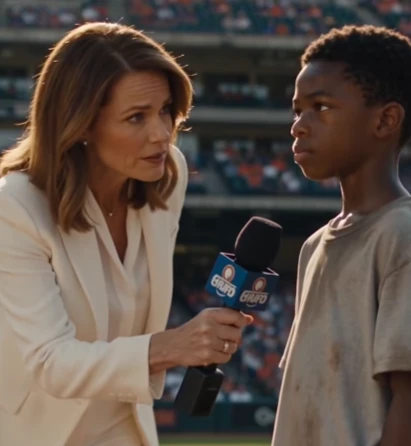
“Throw the one you know.”
The words reached me through the noise.
And suddenly, I remembered my old practice field.
The uneven dirt.
The broken backstop.
The painted square on the wooden board.
I remembered spending entire afternoons trying to hit the lower outside corner.
Not with power.
Not with speed.
With control.
I looked at Daniel.
He understood.
His glove moved toward the outside edge of the plate.
I nodded.
Then I began my windup.
The third pitch left my fingers cleanly.
For a moment, I knew exactly where it was going.
Then the wind caught the ball.
Just a little.
Not enough for the crowd to notice.
But enough for me to feel something was wrong.
Marcus watched it approach.
His bat moved.
I held my breath.
The ball reached the plate.
Marcus swung.
The sound was sharp.
Crack.
My heart dropped.
The baseball shot upward.
For one terrible second, I thought he’d hit it into the stands.
Then I saw its path.
Straight back.
Above the protective netting.
Into the upper seats behind home plate.
Foul ball.
The count remained two strikes.
I stood on the mound, staring.
The crowd roared.
Tom raised both hands.
“Still alive!”
Marcus laughed.
“That was close.”
I nodded.
It had been.
Closer than I wanted to admit.
I looked toward Daniel.
He tossed me another baseball.
I caught it.
The seams felt unfamiliar.
I turned it slowly in my hand until I found the grip I wanted.
Then I stepped onto the rubber again.
The crowd began chanting.
“EL-I-JAH! EL-I-JAH!”
I wished they would stop.
Not because I disliked them.
Because I needed to hear myself think.
I took one breath.
Then another.
And threw.
The ball traveled toward the outside corner.
Marcus held his bat high.
He watched the pitch.
For an instant, I thought he would swing.
But he didn’t.
Daniel caught the baseball.
The umpire remained still.
One second passed.
Then another.
I stared toward home plate.
The entire stadium seemed to be waiting for a single word.
The umpire raised his hand.
“STRIKE THREE!”
For a moment, I couldn’t move.
Then the stadium erupted.
People jumped from their seats.
The announcer shouted my name.
Daniel threw off his mask and ran toward the mound.
Marcus lowered his bat.
Then smiled.
He walked toward me.
I expected him to laugh.
Instead, he held out his hand.
“That was a beautiful pitch.”
I shook it.
“Thank you, sir.”
Marcus looked toward Tom.
“You owe this kid a million dollars.”
The crowd roared even louder.
Tom stood near the dugout with both hands on his head.
He was laughing.
But this time, nobody was laughing at me.
The ceremony happened twenty minutes later.
I stood beside Tom and Marcus while cameras flashed.
A giant ceremonial check was carried onto the field.
$1,000,000 — YOUTH BASEBALL DEVELOPMENT
Tom handed me the microphone.
“Elijah, you’ve earned the right to choose where this money goes.”
I looked toward the crowd.
Then toward the camera.
“I want it to go to the Eastwood Community Baseball Program.”
Tom nodded.
“Tell us why.”
I swallowed.
“Because there are kids there who love baseball, but they don’t have enough equipment.”
The stadium grew quiet.
“Our field floods when it rains. Some of the benches are broken. And sometimes we can’t practice because the lights don’t work.”
I looked down at my glove.
“Coach Harris fixes things himself, but he can’t fix everything.”
Tom listened.
I continued.
“I don’t want the money for me. I want the kids who come after me to have somewhere good to play.”
For several seconds, nobody spoke.
Then Marcus began clapping.
Arthur stood.
Soon, the entire stadium followed.
I had never heard applause like that.
But the part I remembered most wasn’t the noise.
It was seeing my old glove on the giant stadium screen.
The fishing-line stitches were visible.
So were the worn edges.
And for the first time, I didn’t wonder whether people thought it looked embarrassing.
I wondered how many children would soon have gloves of their own.
Three months later, construction began at Eastwood Field.
The old backstop came down.
New drainage pipes were installed.
The damaged benches were replaced.
The community center received new equipment, and the program established a fund to cover registration fees for families who couldn’t afford them.
The money was placed under independent financial oversight, with spending reports available to the community.
Coach Harris insisted on that.
“This belongs to the children,” he told everyone.
One Saturday morning, I arrived at the field and found him standing beside the new pitching mound.
He held my old glove.
“Elijah.”
“Yes, Coach?”
“Come here.”
I walked toward him.
He handed me the glove.
The fishing-line stitches were still holding.
“Thought you might want this back.”
I smiled.
“I never wanted a different one.”
Coach Harris laughed.
“I know.”
Then he looked toward the field.
Dozens of children were warming up.
Some were wearing brand-new cleats.
Others still had old shoes.
But everyone had a glove.
Everyone had a baseball.
And everyone had somewhere to practice.
Coach Harris placed a hand on my shoulder.
“You did something special, son.”
I looked toward the mound.
“I just threw three strikes.”
He shook his head.
“No. You remembered where you came from.”
A year later, I returned to the same stadium.
This time, I wasn’t there to prove anything.
Tom had invited me to help welcome another group of young baseball players.
I wore matching cleats.
My uniform was clean.
But I carried the same old glove.
As I walked past the dugout, a little boy approached me.
He couldn’t have been older than eight.
His shoes were scuffed.
His cap was too big.
He looked at my glove.
“Is that really the one you used?”
I nodded.
“Yes.”
He stared at the fishing-line stitches.
“Why didn’t you buy a new one?”
I smiled.
“Because this one still works.”
The boy laughed.
Then hesitated.





