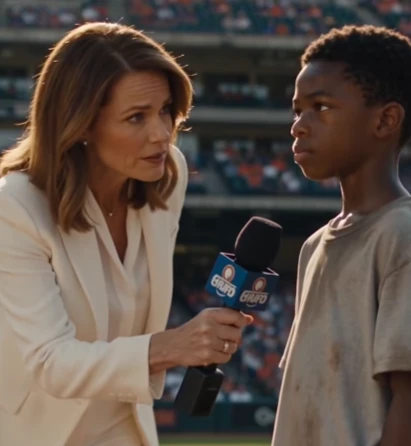
Three Strikes, One Million Dollars
For the first time that afternoon, I forgot about the baseball in my glove.
One million dollars.
I had never seen that much money. I couldn’t even imagine what it would look like stacked on a table.
Tom stood near home plate, smiling as the crowd erupted.
“Well, Elijah? Do we have a deal?”
I looked at the microphone.
“Can I choose any youth baseball program?”
Tom laughed.
“Any legitimate program in America.”
I thought about the little field behind the abandoned grocery store in my neighborhood. The backstop had holes in it, the benches were rotten, and half the children shared equipment because their families couldn’t afford gloves.
Our coach, Mr. Harris, had been asking the city to repair the field for three years.
“Then I know where I’d send it,” I said.
The crowd cheered.
Tom held out his hand.
I shook it.
And just like that, three baseballs had become the most important pitches of my life.
But before I could walk toward the mound, the elderly man in dark sunglasses rose from his seat behind home plate.
“Tom,” he called.
His voice wasn’t loud, but several professional players turned immediately.
Tom stopped smiling.
“Arthur?”
The old man removed his sunglasses.
“Who’s catching for the boy?”
Tom gestured toward the professional catcher warming up nearby.
“Daniel.”
Arthur nodded.
“And who’s calling the pitches?”
Tom frowned.
“Does it matter?”
“It does if you’re offering a million dollars.”
A ripple of laughter moved through the stands.
Arthur stepped closer to the railing.
“Let the boy call his own pitches.”
Tom looked toward me.
“Can you do that, Elijah?”
I nodded.
“Yes, sir.”
Arthur studied my face.
Then said something I didn’t understand until much later.
“Good. Then nobody can say the catcher gave you the answer.”
The walk to the mound felt longer than the drive from my neighborhood to the stadium.
Every step brought me closer to the enormous white plate waiting sixty feet and six inches away.
I had practiced from that distance before.
But never with a professional hitter standing in the batter’s box.
His name was Marcus Reed.
He was tall, powerful, and famous for hitting fastballs into the upper deck.
When I reached the mound, Marcus tapped his bat against his shoes.
“Ready, little man?”
“Yes, sir.”
He smiled.
“Don’t worry. I’ll take it easy.”
I shook my head.
“You don’t have to.”
The stadium laughed again.
Marcus raised his eyebrows.
“All right, then.”
Behind home plate, Daniel crouched.
I looked toward his glove.
He held it at the outside corner.
I shook my head.
Daniel moved it toward the middle.
I shook my head again.
Finally, he lowered it slightly.
I nodded.
The crowd grew quiet.
I took a breath.
Then I threw.
The baseball traveled toward the plate, moving more slowly than anything Marcus normally faced.
He watched it.
At the last moment, it curved downward.
Daniel caught it just above the dirt.
The umpire raised his right hand.
“Strike one!”
The stadium erupted.
Marcus stepped out of the batter’s box.
He looked at the catcher.
Then toward me.
“Not bad, kid.”
I didn’t answer.
I was already thinking about the second pitch.
Tom stood near the dugout, grinning.
“One down!”
Melissa spoke excitedly into her microphone.
“Elijah Brooks has just thrown his first strike against Marcus Reed!”
I heard the announcement, but I didn’t look toward the cameras.
I looked at Daniel.
He held his glove near the inside corner.
This time, I agreed.
I adjusted my grip.
The seams pressed against my fingers.
My front foot settled into the dirt.
Then I threw.
The ball traveled toward Marcus’s chest before moving across the inside edge of the strike zone.
Marcus started to swing.
Then stopped.
Daniel caught it.
The umpire hesitated for a fraction of a second.
“Strike two!”
The crowd exploded.
Marcus turned toward the umpire.
“Seriously?”
The umpire nodded.
“Inside corner.”
Marcus laughed in disbelief.
Then looked at me.
“Okay, Elijah. Now you’ve got my attention.”
I swallowed.
My mouth had gone dry.
For the first time, I felt nervous.
Not because of the crowd.
Because I was one pitch away.
One pitch from a million dollars.
One pitch from giving the children in my neighborhood something we’d never had.
I looked toward the stands.
Somewhere among those thousands of faces, I imagined Mr. Harris watching the broadcast on the small television inside our community center.
I imagined the boys who shared gloves.
The girls who practiced with tennis balls because the baseballs had disappeared over the fence.
The younger children who watched us play because they didn’t own equipment.
Then I looked down at my mismatched cleats.
I pressed my feet into the dirt.
And prepared to throw the third pitch.
Marcus stepped out of the batter’s box.
He removed his helmet and wiped his forehead.
Then he approached the umpire.
“Can I say something to the kid?”
The umpire looked toward the organizers.
Tom nodded.
Marcus walked halfway toward the mound.
The crowd quieted.
“Elijah,” he said, “you know what happens if I hit this next pitch?”
I nodded.
“The count stays at two strikes if it’s a foul.”
Marcus smiled.
“And if I hit it into the stands?”
“Then I don’t get the third strike.”
He studied me.
“Are you scared?”
I considered lying.
But I remembered something Mr. Harris always told us.
A pitcher who pretended he wasn’t nervous usually forgot to pay attention to what his body was doing.
“A little,” I admitted.
Marcus nodded.
“Good.”
I frowned.
“Why?”
“Because now you know it’s important.”
He returned to the batter’s box.
Then lifted his bat.
“Give me your best pitch.”
I looked toward Daniel.
He held out his glove.
But before I began my motion, something unexpected happened.
The elderly man behind home plate stood again.
“Elijah!”
I turned.
Arthur had removed his cap.
“Don’t throw the pitch they want to see.”
I stared at him.
He continued.





