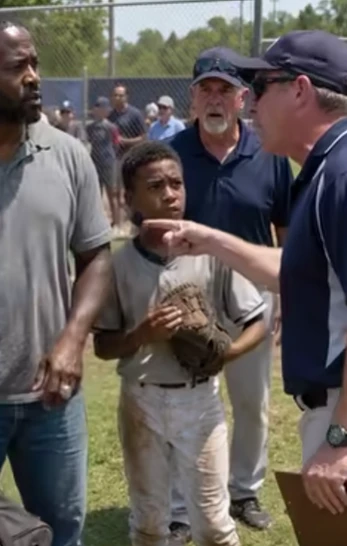
“Yes.”
Malik looked at the ring.
“Why didn’t you tell me?”
Darius crouched so they were eye level.
“I told you I played.”
“You said you played baseball. You didn’t say that baseball.”
Darius exhaled.
“You’re right.”
Malik’s eyes were wet, but he looked angry too.
That was fair.
Darius could handle anger better than disappointment.
“I didn’t want my career to become pressure on your shoulders,” Darius said.
Malik looked toward the field.
“They already put pressure on me.”
“I know.”
“And I didn’t even know why everybody was staring.”
“I know.”
“Did Mom know?”
Darius’s face softened.
“Yes. Your mom knew all of it.”
“Did she want you to tell me?”
Darius closed his eyes briefly.
Trust children to find the deepest door.
“She used to say I should tell you before somebody else did.”
Malik wiped his cheek quickly.
“Why didn’t you?”
Darius looked at the dirt.
“Because after she got sick, baseball felt different. I left the game to take care of her and you. I never regretted that. Not once. But people had opinions. They said I quit. They said I wasted my talent. They said I couldn’t handle being the man anymore.”
He looked back at Malik.
“I didn’t want you hearing that noise before you understood the truth.”
Malik was quiet.
Darius continued.
“The truth is, the best thing I ever did wasn’t hitting a double. It wasn’t winning that ring. It was coming home.”
Malik looked down at the glove.
“Then why wear it?”
“The ring?”
Malik nodded.
Darius looked at his hand.
“I almost didn’t today. But your mom made me promise not to hide every part of myself. She said one day, you might need to know your father didn’t bow his head because he had nothing behind him.”
Malik swallowed.
“And today?”
Darius looked toward Coach Benton.
“Today I think she was right.”
Malik took that in.
Then he said quietly,
“I don’t want them to pick me because of you.”
Darius smiled sadly.
“That makes two of us.”
“So what do I do?”
Darius placed both hands on Malik’s shoulders.
“You play so honest they have to make their own decision.”
Malik nodded slowly.
Then he looked toward the mound.
“They said I could pitch some.”
Darius raised one eyebrow.
“You want to?”
Malik’s jaw tightened.
“Yes.”
“Then pitch.”
The next evaluation was bullpen work.
Only five kids had signed up as pitchers.
Malik was not on the list.
Coach Benton made that very clear.
“He didn’t register as a pitcher,” Benton said.
Harlan looked at him.
“He didn’t register at all, according to you.”
A few parents laughed.
Benton did not.
Malik stood near the mound holding the old glove.
Darius remained behind the fence.
He did not give signals.
He did not coach.
He let Malik stand alone.
The first pitcher threw hard but wild.
The second had a good curveball.
The third had a clean delivery and parents with a camera set up behind the backstop.
Then Malik stepped up.
Benton looked at the radar gun in an assistant’s hand.
“All right,” he said. “Let’s make it quick.”
Malik climbed the mound.
For one moment, he looked small.
The lights were brighter there.
The eyes heavier.
His cleats dug into the dirt.
He took the sign from the catcher.
Then he glanced once toward Darius.
Darius touched two fingers to his chest.
Breathe.
Malik breathed.
First pitch.
Fastball.
Not overpowering.
But it had life.
It popped the catcher’s mitt at the outside corner.
“Strike,” Harlan said softly, though no umpire was there.
Second pitch.
Fastball inside.
The catcher caught it awkwardly.
Third pitch.
Changeup.
The ball came out with the same arm speed, then faded down.
The catcher dropped to block it.
Several coaches looked up.
Benton lowered the radar gun sheet.
“Again.”
Malik threw another changeup.
Better.
Then a fastball.
Then a two-seam that ran in on a right-handed imaginary hitter.
Then, after the catcher called for one more, Malik threw a breaking ball.
Not big.
Not dangerous for his arm.
Just a small, late slider Darius had resisted teaching him until Malik’s mechanics were clean enough.
The ball moved at the end.
The catcher missed it entirely.
It hit the backstop padding.
A few players made impressed sounds.
Harlan looked at Darius.
Darius looked at the ground, fighting the fatherly urge to grin.
Benton walked halfway to the mound.
“Who taught you that?”
Malik looked at his father.
Then back at Benton.
“My dad.”
Benton’s mouth tightened.
“Of course.”
Darius heard the tone.
So did Harlan.
Malik heard it too.
But this time, he did not shrink.
He stood on the mound and said,
“He taught me not to throw it until I could repeat my fastball.”
Harlan smiled.
“That’s good teaching.”
Benton turned away.
The tryout continued for another hour, but the mood had changed.
Malik was no longer invisible.
Some parents were kind now in a way that made Darius uneasy.
A few came over to tell him they had always respected his career.
One asked for a photo.
Darius politely declined.
One father said,
“Man, you should’ve said who you were from the jump.”
Darius looked at him.
“My son shouldn’t need my résumé to get a tryout.”
The father had no answer.
Near the end, Coach Harlan gathered the players at home plate.
He spoke about effort, development, and roster decisions.
Then he asked the coaches to meet by the dugout.
Benton came last, arms crossed.
Darius stood with Malik near the fence.
He could see the debate.
Not hear every word.
But enough.
Benton gesturing.
Harlan shaking his head.
Another coach pointing toward Malik’s evaluation sheet.
The teenage assistant showing video of Malik’s swing.
Finally, Harlan walked over.
Benton followed reluctantly.
Malik stood straighter.
Harlan looked at him.
“Malik, you’ve got talent.”
Malik’s eyes flicked toward Darius, then back.
“Thank you, sir.”
“You’ve also got work to do. Footwork. Strength. Game reps. You’re not polished like some of these boys.”





