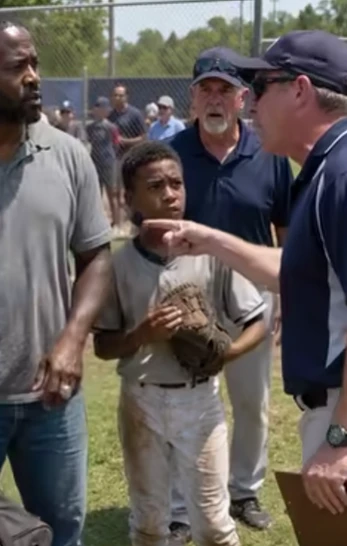
Embarrassment does that to a kid.
It makes his body feel borrowed.
Darius watched him from behind the fence.
He wanted to go to him.
To fix the hurt.
To tell him none of this mattered.
But it did matter.
And some things fathers cannot fix by stepping closer.
Some things a boy must answer with his own feet in the dirt.
Coach Harlan came to stand beside Darius.
“I heard about your wife,” he said quietly.
Darius’s jaw tightened.
“She passed four years ago.”
“I’m sorry.”
Darius nodded.
“Thank you.”
“Cancer?”
“Yes.”
Harlan exhaled.
“And you’ve been raising him alone?”
“Yes, sir.”
Harlan watched Malik stretch his throwing arm.
“He know?”
“About what?”
Harlan gave him a look.
Darius looked toward the field.
“Some. Not all.”
“Why not?”
Darius’s thumb brushed the championship ring.
“I didn’t want baseball to feel like inheritance.”
Harlan was quiet.
Darius continued.
“I didn’t want him chasing my shadow. I wanted him to love it or leave it on his own.”
“That’s noble.”
“Maybe.”
Harlan glanced at him.
“You say maybe like you don’t believe it.”
Darius watched Malik catch a warm-up throw cleanly.
“I also didn’t want to explain why I walked away.”
Harlan’s face softened.
“Darius.”
“I know.”
“People understood.”
“No,” Darius said quietly. “People made stories. Injury. Attitude. Contract dispute. Burnout. Some said I couldn’t handle pressure after the postseason.”
Harlan’s eyes hardened.
“People talk because silence gives them room.”
Darius looked at him.
That sounded familiar.
His late wife, Lena, used to say something close.
A closed mouth can protect peace, but it can also protect lies.
On the field, Coach Benton had taken over infield evaluations.
Whether from pride or anger, he hit the first grounder to Malik harder than necessary.
A sharp one-hopper to his backhand.
Some parents noticed.
Darius did not move.
Malik reacted late but got his glove down.
The ball hit leather, popped slightly, and nearly escaped.
He trapped it against his chest.
Not pretty.
But he stayed with it.
“Throw!” Benton barked.
Malik planted and threw to first.
The ball reached the coach’s glove chest-high.
Solid.
Not flashy.
Benton smirked.
“Again.”
The next grounder was easier.
Malik fielded cleanly.
Quick feet.
Smooth transfer.
Strong throw.
A few coaches glanced at each other.
Third ball.
Slow roller.
Malik charged hard, barehanded, and threw on the run.
The throw was low, but catchable.
Harlan smiled.
Darius kept his face still.
Fourth ball.
Benton tried to test him with a high chopper.
Malik waited half a beat, read the bounce, moved through it, and fired across the diamond.
Better.
The fifth was a shot up the middle.
Malik dove.
The ball hit the end of his glove, bounced out, rolled away.
Some boys laughed.
Malik’s face flushed.
Benton clapped once.
“Next.”
Darius stepped toward the fence.
Then stopped himself.
Malik picked up the ball and tossed it back.
He jogged out of line, head down.
Harlan watched him carefully.
“He’s raw.”
Darius nodded.
“Yes.”
“Good hands.”
“Yes.”
“Feet need work.”
“Yes.”
“Arm plays.”
Darius did not answer.
Harlan smiled.
“Still scouting without blinking, huh?”
Darius looked away.
Old habits do not die.
They wait.
Batting was next.
Malik took his old bat from his bag.
Around him, other kids held expensive composite bats that sounded like cannons.
His bat was older, heavier, and taped near the knob.
Benton looked at it and shook his head.
“You want to use that?”
Malik glanced at Darius.
Darius only nodded.
Use what you know.
Malik stepped into the cage.
First pitch.
Fastball down the middle.
He swung late.
Foul tip.
Second pitch.
He rolled over to short.
Third pitch.
He missed entirely.
Darius heard a parent whisper,
“He’s nervous.”
Another said,
“Wouldn’t you be?”
Malik stepped out.
He took a breath.
Then he looked at his glove on the ground.
Old leather.
Home.
He stepped back in.
Fourth pitch.
He stayed back and lined it over second base.
Clean.
Fifth pitch.
Hard grounder through the left side.
Sixth pitch.
He drove it to the gap.
Not a home run.
Not a show swing.
But a real swing.
Balanced.
Short.
Quick through the zone.
Harlan’s eyebrows rose.
Benton stopped writing.
Seventh pitch.
Malik fouled it straight back.
Eighth pitch.
Line drive.
Ninth pitch.
Line drive again.
Tenth pitch.
The pitcher threw a breaking ball.
Most twelve-year-olds at tryouts either froze or waved.
Malik’s front foot started early.
Then he held.
His hands stayed back.
He sent the ball hard into right center.
The field went quiet for a second.
Harlan looked at Darius.
Darius looked at Malik.
Malik was trying not to smile.
That was when a man near the fence spoke loudly enough for everyone to hear.
“Wonder who taught him that swing.”
The man was wearing a Braves cap.
He had been quiet until now.
Darius looked over.
The man’s eyes were fixed on him with growing recognition.
“Darius Cole,” the man said. “Man, I watched your pinch-hit double in Game Six about fifty times.”
More heads turned.
Someone else said,
“Wait, that Darius Cole?”
A teenage assistant coach pulled out his phone.
Coach Benton’s face tightened further.
The old world was rushing in now.
Darius could not stop it.
The whispers moved along the fence.
Former Braves utility man.
Postseason hero.
Best defensive infield instructor in the minors.
Worked with half the league before he disappeared.
Didn’t he coach prospects?
Didn’t he have a foundation?
I thought he left baseball.
Malik stepped out of the cage and looked at his father.
“Dad?” he asked again.
This time, the question was not shock.
It was hurt.
Darius felt it in his chest.
Coach Harlan saw it too.
“Take five,” Harlan called to the field.
The players scattered toward water bottles.
Malik walked slowly to the fence.
Darius opened the gate and met him near the dugout.
For a few seconds, neither spoke.
Then Malik said,
“You played for the Braves?”
Darius nodded.
“For real?”
“Yes.”
“You won a ring?”





