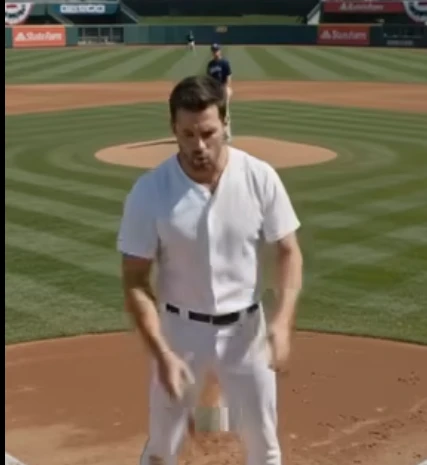
People groaned.
Damian laughed.
“Thank God.”
Leonard pointed toward him.
“You’re not done.”
Damian stopped.
Leonard looked at Malachi.
“Neither are you.”
“What happens now?”
“A real evaluation.”
Malachi glanced toward his field-crew shirt.
“I have to finish volunteering.”
Leonard almost laughed.
“Finish your shift.”
“I’m serious.”
“So am I.”
The fan-day video reached social media before Malachi’s shift ended.
By the time he walked out of the stadium, millions of people had seen Damian place the ring on home plate.
They had seen Leonard shout:
“Clear the batter’s box.”
They had seen the huge arc.
The violent bounce.
The ring flying.
They had seen Damian hesitate.
And they had seen Malachi say:
“I expect you to keep your word.”
What the videos did not show was Rochelle Reed waiting beside a dented silver sedan in the parking lot.
She had gotten off work early.
Someone had sent her the clip.
Malachi saw her from fifty feet away.
He stopped walking.
“Oh, no.”
Rochelle folded her arms.
Damian had decided to accompany Malachi outside.
He immediately slowed.
“Is that your mother?”
“Yes.”
“She looks upset.”
“She’s a mother.”
Leonard came behind them.
Rochelle looked at all three.
“Malachi Aaron Reed.”
Malachi walked closer.
“Hi, Mom.”
“Do not ‘hi, Mom’ me.”
He held out Damian’s championship ring.
Her eyes widened.
“I know what that is.”
“Okay.”
“Why is it in your hand?”
“I won it.”
“You won what?”
Damian stepped forward.
“Ms. Reed, this may partially be my fault.”
Rochelle turned toward him.
“Partially?”
Damian stopped.
Leonard looked down to hide a smile.
Rochelle had watched the entire video.
She understood exactly what happened.
She did not care how famous Damian was.
“You told my son if he missed one throw, he had to leave the field forever?”
Damian rubbed the back of his neck.
“In hindsight—”
“No.”
“Yes, ma’am.”
“You put a championship ring on home plate?”
“Yes.”
“And challenged a child?”
“He challenged me first.”
Malachi said, “I didn’t really.”
Rochelle pointed at him.
“You are not helping.”
He stopped.
Then she looked at Leonard.
“And you?”
“I told everyone to move away from home plate.”
“That’s your contribution?”
“I also told Damian to give him the ring.”
Rochelle stared at them.
Three grown men looked suddenly much younger.
Finally she looked at Malachi.
“Are you hurt?”
“No.”
“Shoulder?”
“Fine.”
“Elbow?”
“Fine.”
“Did you warm up?”
Malachi hesitated.
Her eyes narrowed.
“Malachi.”
“Not really.”
She closed her eyes.
“That is the part I’m most angry about.”
Damian looked surprised.
“The warm-up?”
Rochelle turned toward him.
“You’re a professional athlete.”
“Would you make a one-throw challenge without warming up?”
“No.”
“Then why ask a fifteen-year-old to?”
Damian had no answer.
Leonard nodded.
“She’s right.”
Rochelle looked at Malachi again.
“Give him his ring.”
Damian blinked.
Malachi did too.
“But I won.”
“I know.”
Damian said, “He did.”
Rochelle looked at the ring.
“You want it?”
Malachi stared at it.
For a few seconds, yes.
Of course he did.
It was worth more than anything he owned.
It represented a championship.
A story nobody would believe without video.
But eventually he shook his head.
“No.”
Rochelle nodded.
“Then give it back.”
Malachi turned toward Damian.
He placed the ring into Damian’s palm.
Damian did not close his hand.
“You sure?”
Malachi nodded.
“I wanted the throw.”
“Not the ring?”
“I wanted you to stop laughing.”
Damian’s face changed.
That answer stayed with him.
He finally closed his hand around the ring.
“I did.”
Malachi looked at him.
“What?”
“Stopped laughing.”
The next morning, Leonard met Rochelle and Malachi at a training complex away from the main stadium.
No fans.
No cameras.
No championship ring.
Leonard insisted Malachi begin with twenty minutes of mobility and throwing progression.
Fifteen feet.
Thirty.
Sixty.
Ninety.
Then farther.
A physical therapist watched his shoulder.
A pitching coordinator examined his arm path.
A defensive coach tested his footwork.
Nobody asked him to throw from four hundred feet.
That was important to Leonard.
Viral moments made people stupid.
They made adults want repetition.
Do it again.
Throw farther.
Throw harder.
Prove the clip was real.
Leonard wanted the opposite.
He wanted to know whether Malachi could make ordinary baseball plays.
He could.
From shortstop, his throws carried easily.
From deep in the hole, he had enough arm to finish plays most fifteen-year-olds could not.
From right field, his throws stayed low and accurate.
Then Leonard tested speed.
Good.
Not elite.
Hitting.
Raw.
Malachi’s hands were quick, but his lower body drifted.
Against fastballs, he competed.
Against breaking balls, he chased.
He was not a finished player.
Not even close.
Leonard loved that.
It meant there was something to teach.
After two hours, Malachi sat on a bench drinking water.
Leonard joined him.
“You want the truth?”
“Yes.”
“Your arm is exceptional.”
Malachi smiled.
“That sounded good.”
“Your hitting needs work.”
Smile disappeared.
“Your first-step quickness is average.”
“Okay.”
“You rush backhand plays.”
“Okay.”
“You rely on your arm after your feet get lazy.”
Malachi looked offended.
“My feet aren’t lazy.”
“They are when you know your arm can rescue you.”
Malachi considered that.
“Maybe.”
“Your long-throw mechanics are clever.”
“But?”
“You should not do that often.”
“Why?”
“Because trying to launch at maximum distance puts stress on a young arm.”
“I’ve done it for years.”
“That doesn’t make it smart.”
Malachi looked down.
Leonard continued.
“The thing I liked most yesterday had nothing to do with the distance.”
“What then?”
“You had a plan.”
“You knew you couldn’t reach the ring on a line.”
“You used spin.”
“Wind.”
“Angle.”
“Dirt.”
“You solved the problem instead of pretending it was a different problem.”
Malachi looked at him.
“That sounds like scouting talk.”
“It is.”
Then Leonard handed him the old report from when he was thirteen.
Malachi read every line.
When he reached ARCHIVE — LOW EXPOSURE PRIORITY, he stopped.
“Who wrote this?”
“One of our coordinators.”
“Was he wrong?”
Leonard thought before answering.





