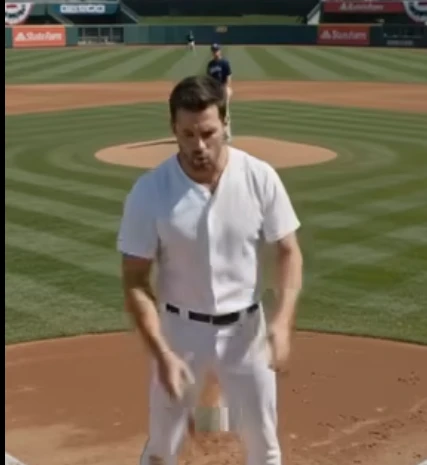
The crowd cheered.
Someone began chanting his name.
“Mal-a-chi!”
“Mal-a-chi!”
Others joined.
Malachi looked embarrassed.
Then his field-crew supervisor pushed through the group.
“Malachi Reed!”
Malachi closed his eyes.
“Here we go.”
The supervisor looked at the ring.
Then Damian.
Then Leonard.
“What happened?”
Damian answered.
“He won.”
The supervisor stared.
“Won what?”
“My ring.”
“You gave a fifteen-year-old your championship ring?”
“It was a bet.”
The man slowly turned toward Malachi.
“Your mother is going to kill both of us.”
Malachi nodded.
“Probably.”
Leonard smiled for the first time.
Then he asked the question that mattered more than the ring.
“Malachi, who taught you that throw?”
Malachi looked at him.
“Nobody.”
Leonard frowned.
“That grip came from somewhere.”
“I figured it out.”
“At fifteen?”
“I’ve been working on it since I was eleven.”
“Where?”
Malachi hesitated.
“Behind our apartment building.”
The laughter and cheering around them faded for Leonard.
“What do you throw at?”
“There’s a concrete flood channel behind the parking lot.”
“You throw across it?”
“Across and back.”
“How far?”
“Depends where I stand.”
“Anybody coach you?”
“My middle-school coach helped with regular mechanics.”
“But that?”
Leonard pointed toward center field.
“No.”
Malachi looked at the baseball still lying near the plate.
“I wanted the ball to come down steep.”
“Why?”
“Because I knew I couldn’t throw four hundred feet on a line.”
Leonard nodded.
“So you planned the bounce.”
“Yes.”
Damian looked at him.
“You planned to bounce it into the ring?”
Malachi shrugged.
“Home plate dirt is packed hard.”
“That doesn’t mean the bounce goes straight.”
“It does if the spin is right.”
Leonard stared at him.
Not because the explanation was perfect.
It wasn’t.
Baseballs were unpredictable.
Dirt changed.
Wind changed.
A tiny difference at release became several feet at landing.
But Malachi understood what he had attempted.
That mattered.
“Do you play outfield?”
Leonard asked.
“Shortstop.”
“High school?”
“Not right now.”
“Why not?”
Malachi looked down.
The field-crew supervisor answered for him.
“He transferred schools.”
Leonard waited.
Malachi sighed.
“My mom moved us in November.”
“So?”
“The new school varsity coach already had his roster.”
“You’re a freshman?”
“Sophomore.”
“Try junior varsity.”
“They said I needed offseason evaluation.”
“When is it?”
“It was last fall.”
“You weren’t there.”
“No.”
“Club ball?”
Malachi shook his head.
“Travel?”
“No.”
“Showcases?”
“No.”
“Why?”
Malachi looked toward the dugout.
Damian was still listening.
“Money.”
One word.
That was enough.
Leonard had spent his career watching talented families spend thousands chasing exposure.
Travel tournaments.
Hotels.
Flights.
Private lessons.
Showcase registrations.
Video packages.
Memberships.
Equipment.
Baseball called itself a simple game.
For many families, access to being seen was not simple at all.
Leonard asked, “How did you get here today?”
“Volunteer program.”
“You signed up to chase baseballs?”
“It gets me on the field.”
“And you’ve done this before?”
“Three fan events.”
Leonard looked toward the ring.
Something bothered him now for a different reason.
“Spell your full name.”
Malachi frowned.
“Malachi Aaron Reed.”
Leonard’s eyes narrowed.
“Reed.”
“Yes.”
“Phoenix area?”
“South Phoenix.”
Leonard reached for his notebook.
Then stopped.
A memory had surfaced.
Eighteen months earlier, one of the organization’s area scouts forwarded a short video.
No radar readings.
No certified showcase data.
No travel-team profile.
Just a clip filmed from behind a backstop at a public recreation field.
A skinny thirteen-year-old had fielded a ball near deep shortstop.
Then thrown across his body.
The throw carried strangely.
The scout wrote:
Arm is unusual. Need verified follow-up. Family difficult to schedule. No club affiliation.
The file eventually disappeared into hundreds of other names.
Leonard hated that he remembered the throw but not the boy.
“Have you ever been evaluated by someone named Pete Callahan?”
Malachi’s expression changed.
“A long time ago.”
“How long?”
“I was thirteen.”
“At a city field?”
“Yes.”
“Blue fence?”
“I think so.”
Leonard closed his eyes briefly.
“I’ve seen you before.”
Malachi looked confused.
“We never met.”
“No.”
“I saw a video.”
Leonard pulled out his phone and called someone.
“Pete.”
He turned away slightly.
“Do you remember a kid named Malachi Reed?”
Pause.
“South Phoenix.”
Another pause.
“Deep shortstop throw.”
Leonard listened.
Then his face hardened.
“What happened?”
Longer pause.
“Send me the old report.”
He ended the call.
Damian asked, “What?”
Leonard ignored him.
He looked at Malachi.
“You were in our system.”
Malachi laughed softly.
“I don’t know what that means.”
“It means one of our scouts saw you.”
“When I was thirteen?”
“Yes.”
“Then what?”
Leonard had no good answer yet.
His phone buzzed.
A file arrived.
He opened it.
There was Malachi.
Thirteen years old.
Smaller.
Same eyes.
Same worn glove.
The report had several notes.
Above-average arm strength for age.
Advanced body awareness.
Raw hitter.
Needs follow-up.
Then near the bottom:
No verified travel schedule. Parent unable to commit to fall events. Follow-up incomplete.
And finally:
ARCHIVE — LOW EXPOSURE PRIORITY
Leonard read the last line twice.
Malachi watched him.
“What does it say?”
Leonard turned the phone off.
“It says we did a bad job.”
That surprised everyone.
Scouts did not often say that in public.
“What do you mean?” Malachi asked.
“We saw enough to be interested.”
“Then we decided the easiest way to see you again was for your family to bring you to us.”
“My mom worked weekends.”
Leonard nodded.
“I know that now.”
“She still does.”
“I believe you.”
Malachi looked toward the field.
“So I got archived?”
“Yes.”
“What does that mean?”
“It means nobody followed properly.”
“Because I wasn’t on a travel team?”
“That was part of it.”
“Because we couldn’t afford showcases?”
“Probably part.”
Malachi gave a small laugh.
“So you did see me.”
Leonard nodded.
“You just didn’t come back.”
The sentence landed harder than any accusation.
Leonard had no defense.
“You’re right.”
Damian looked uncomfortable.
For once, he had nothing clever to say.
Then Leonard noticed the championship ring again.
“Give me the baseball.”
Malachi picked it up.
Leonard turned to the crowd.
“This part is over.”





