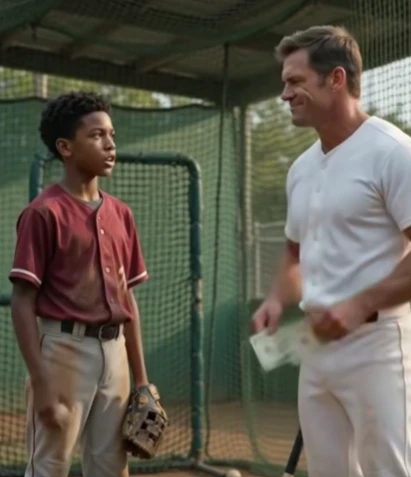
Most of the money funded promotional events, celebrity appearances, and administrative costs.
The white uniforms, cameras, and sponsor tents had cost more than the grants given to three neighborhood leagues combined.
Cole released an apology through a public-relations company.
It said he regretted that his words “may have been misunderstood.”
Tariq read it once.
Then he closed the page.
“Is that an apology?” he asked Raymond.
“No.”
“What is it?”
“A man wishing people had reacted differently.”
The Southside field repairs began two weeks later.
Parents removed the damaged dugout roof.
The hardware store delivered lumber and fencing.
The bank paid a contractor to rebuild the backstop.
The sporting-goods company brought boxes of uniforms.
The boys gathered around them excitedly.
Each jersey was bright navy with white lettering.
Tariq lifted his new number seven shirt.
Then he looked down at his old one.
Coach Carter stood beside him.
“You can keep both.”
Tariq folded the new jersey.
“I want to wear the old one for the first game.”
“Why?”
“So people remember the uniform wasn’t why we won.”
Coach Carter smiled.
“That sounds like something your grandfather would say.”
Raymond began attending Southside practices.
At first, he sat near the dugout and watched.
Then he corrected Darnell’s receiving position.
He showed Luis how to move his feet around second base.
He taught the outfielders to throw through the cutoff man.
With Tariq, he was careful.
A knuckleball could be ruined by too much instruction.
Raymond focused on balance.
Finger pressure.
The quiet wrist.
“Your job isn’t to control where it moves,” he said.
“That sounds dangerous.”
“Your job is to control where it begins.”
“What if it doesn’t move?”
“Then pray.”
Tariq smiled.
Raymond rarely praised a pitch.
When Tariq threw a good one, he simply asked for another.
When Tariq threw a great one, Raymond removed his mask and rubbed his knee while pretending he needed a break.
Tariq noticed.
“Grandpa said catchers hate the pitch more than hitters.”
“Your grandfather was correct.”
Aisha sometimes watched from the bleachers after work.
She had mixed feelings about Tariq’s sudden attention.
College coaches called even though he was only fourteen.
Television shows requested interviews.
A company offered free equipment in exchange for using Tariq’s image.
Aisha rejected every contract until a lawyer reviewed it.
She did not want her son becoming someone else’s promotion.
Raymond agreed.
“Attention comes faster than wisdom,” he said.
“And leaves faster too.”
The city scheduled a reopening ceremony for Southside Field in September.
A council member planned to throw the first pitch.
Local television stations would attend.
The Falcons would play the North County Royals, a team with expensive facilities and three private coaches.
Two days before the game, Cole Barrett called Coach Carter.
He wanted to attend.
Coach Carter nearly refused.
Then he asked to speak to Tariq.
Aisha placed the phone on speaker.
Cole’s voice sounded different without a microphone and a crowd.
“I owe you an apology.”
Tariq looked at his mother.
She said nothing.
Cole continued.
“What I said was wrong.”
Tariq waited.
“I embarrassed your team. I tried to get out of a promise. And I acted like having money made me better than people who didn’t.”
The room remained quiet.
It was the first time Cole had said exactly what he had done.
Tariq asked, “Why did you laugh at us?”
Cole took several seconds to answer.
“When I was your age, I had one glove. My father repaired it with fishing line. I hated when kids from richer teams saw it.”
“So you made us feel the same way?”
“Yes.”
“That doesn’t make sense.”
“No,” Cole said. “It doesn’t.”
Tariq looked toward his taped glove on the table.
“Do you want me to tell people I forgive you?”
“No.”
“Then why are you calling?”
“Because I should have apologized before asking for anything.”
Coach Carter took the phone.
“What are you asking for?”
“To come to the reopening.”
“We don’t need another publicity event.”
“I know.”
“Do you?”
“I’ll come without cameras.”
“There will already be cameras.”
“Then I won’t speak unless you ask me.”
Coach Carter looked at Aisha.
Aisha looked at Tariq.
The decision belonged to him more than anyone.
Tariq thought about the pitch.
He thought about Cole refusing to pay.
He thought about the children who watched famous players and believed fame revealed character.
“Come,” Tariq said.
Cole exhaled.
“Thank you.”
“But don’t wear the white uniform.”
“What?”
“Wear what you wore when you were fourteen.”
Cole did not answer for a moment.
Then he said, “All right.”
On opening day, Southside Field looked new without losing what made it theirs.
The repaired backstop shone in the morning sun.
Fresh dirt covered the infield.
The dugouts had solid roofs.
A hand-painted sign hung beside the concession stand.
GOOD GLOVES REMEMBER GOOD HANDS
Malik had suggested the words when he returned from training for the weekend.
He stood beside Tariq during warm-ups, wearing his service uniform.
“You still using my glove?” he asked.
Tariq held it up.
“Raymond says the pocket is too shallow.”
“Raymond can buy his own glove.”
Raymond shouted from behind the plate, “I heard that.”
The stands filled early.
Families brought folding chairs.
Children crowded along the fence.
Sponsors attended, but there was no private tent.
They sat with everyone else.
Cole arrived twenty minutes before the ceremony.
He wore faded jeans, old black cleats, and a red jersey from his childhood team.
The jersey no longer fit.
He had left it unbuttoned over a plain shirt.
In one hand, he carried a worn glove repaired with pale fishing line.
People recognized him immediately.
Some booed.
Others raised phones.
Cole did not wave.
He walked directly toward the Southside dugout.
Tariq met him near the gate.
Cole handed him the glove.
“This was mine.”
Tariq examined the repair.
“Your dad fixed it?”
“Three times.”
“It looks bad.”
Cole almost smiled.
“It does.”
“Still works?”
“It did.”
Tariq gave it back.





