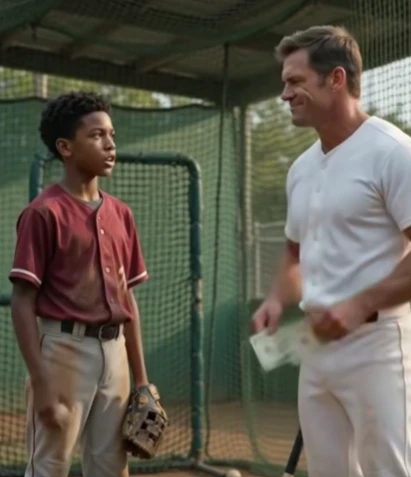
He had been sitting alone in the last row, wearing brown work boots, gray pants, and a faded green cap with no team logo.
His name was Raymond Clark.
Most people at the event did not know him.
Those who did remembered only that he had played minor league baseball decades earlier.
Raymond had spent eleven seasons catching pitchers whose names never appeared on television.
He had broken fingers.
Damaged knees.
A shoulder that no longer lifted above his head.
He had caught in small towns, empty stadiums, and summer leagues where the buses had no air-conditioning.
He had never reached the major leagues.
But he knew pitching.
He knew the difference between a child copying something from the internet and a child whose fingers had been shaped by thousands of secret throws.
Raymond walked slowly toward the fence.
He was not watching Tariq’s face.
He was watching the baseball in Tariq’s hand.
Tariq held it low beside his thigh.
His index and middle fingers rested against the seams.
His thumb pressed underneath, almost hidden.
Raymond stopped.
“Kid,” he said.
Tariq looked over.
“Who taught you to hold the ball like that?”
Cole glanced at him.
“Stay out of this, old man.”
Raymond did not look at Cole.
His eyes remained on Tariq’s hand.
“Who taught you?”
Tariq closed his fingers around the ball.
“My grandfather.”
Raymond’s expression changed.
“What was his name?”
Tariq hesitated.
“Isaiah Mason.”
Raymond’s hand tightened around the fence.
For a second, the noise of the event disappeared for him.
He was no longer standing at Bellhaven Stadium.
He was twenty-two years old again, crouched behind a plate in Jackson, Mississippi, catching a skinny pitcher with a smooth delivery and a ball that refused to fly straight.
Isaiah Mason.
A man with quiet eyes.
A man who threw one of the ugliest pitches Raymond had ever seen.
A pitch that danced sideways, dropped without warning, and made powerful hitters look foolish.
Raymond had not heard that name in forty years.
Cole tapped the bat against his shoe.
“Are we doing this or not?”
Coach Carter placed one hand on Tariq’s shoulder.
“You don’t have to prove anything to him.”
Tariq looked toward his teammates.
Ten boys stood behind the fence.
Darnell wore a catcher’s mask with one missing pad.
Luis had borrowed his cousin’s cleats.
Marcus had walked three miles to practice all spring because his mother worked nights and could not drive him.
None of them had complained.
They dragged the field themselves.
They patched the dugout roof with a plastic tarp.
They practiced ground balls on a church parking lot after Southside Field closed.
They did belong.
But Tariq knew that saying it would not change the laughter he had heard.
He looked at Coach Carter.
“We need the money.”
“We don’t need it like this.”
“If he misses, we get the field back.”
“And if he doesn’t?”
Tariq glanced at Cole.
“Then nothing changes.”
Coach Carter understood.
Without the money, the city would close Southside anyway.
Cole placed his bat on his shoulder.
“I’ll accept.”
The event director hurried toward him.
“Cole, this wasn’t scheduled.”
Cole smiled at the television camera near the first-base line.
“It is now.”
A local reporter raised her microphone.
The audience began moving closer to home plate.
People pulled out their phones.
The challenge spread through the crowd in seconds.
Major league star against poor youth pitcher.
One pitch.
Ten thousand dollars.
Cole walked to the batter’s box.
He removed his warm-up jacket and handed it to an assistant.
Then he rolled his shoulders.
Tariq moved toward the mound.
The stadium used professional distances, so the youth pitching rubber had been placed several feet in front of the regular mound.
Cole pointed to it.
“No.”
Coach Carter frowned.
“What?”
“He challenged me,” Cole said. “He pitches from the real mound.”
“That’s sixty feet, six inches. He’s fourteen.”
Cole looked at Tariq.
“Then he shouldn’t make grown-man bets.”
The crowd murmured.
Raymond Clark stepped through the open gate.
“Let the boy use the youth rubber.”
Cole laughed.
“If you’re scared, old man, say so.”
Raymond looked at him for the first time.
“I spent eleven years watching hitters become brave before the ball was thrown.”
Cole’s smile disappeared.
“And?”
“Most of them got quiet afterward.”
Some of the older men near the dugout recognized the tone.
Two former scouts turned toward Raymond.
One whispered, “Clark?”
The other nodded slowly.
Cole stepped into the box.
“Real mound.”
Tariq looked at Coach Carter.
She shook her head.
He looked at the ceremonial check.
Then he walked past the youth rubber and climbed onto the professional mound.
The distance made home plate look small.
The catcher assigned to the event, a seventeen-year-old from a private academy, crouched behind the plate.
Tariq stared at the target.
His stomach tightened.
He had practiced from sixty feet only a few times.
His grandfather had taught him that distance was not defeated with strength.
It was defeated with rhythm.
“Don’t throw hard,” Coach Carter called.
Tariq nodded.
“I’m not.”
Cole’s smile faded for the first time.
The catcher gave a target near the center of the plate.
Tariq slipped the ball into his taped glove.
The tape pressed against his knuckles.
He heard his grandfather’s voice.
Don’t squeeze it.
Don’t guide it.
Let the air argue with the seams.
Raymond moved closer to the fence.
He watched Tariq set his fingers.
Then he whispered, almost to himself, “That’s not a kid’s grip.”
The old scouts heard him.
Both stood.
Tariq lifted his front leg.
Cole tightened both hands around the bat.
The crowd leaned forward.
Tariq moved toward home plate.
The ball left his fingers without spin.
For the first forty feet, it looked harmless.
Slow.
Straight.
Almost floating.
Cole waited.
He had spent his career punishing slow pitches.
He shifted his weight forward and began his swing.
Then the ball moved.
It jumped toward the inside corner.
Cole adjusted.
The ball dropped.





