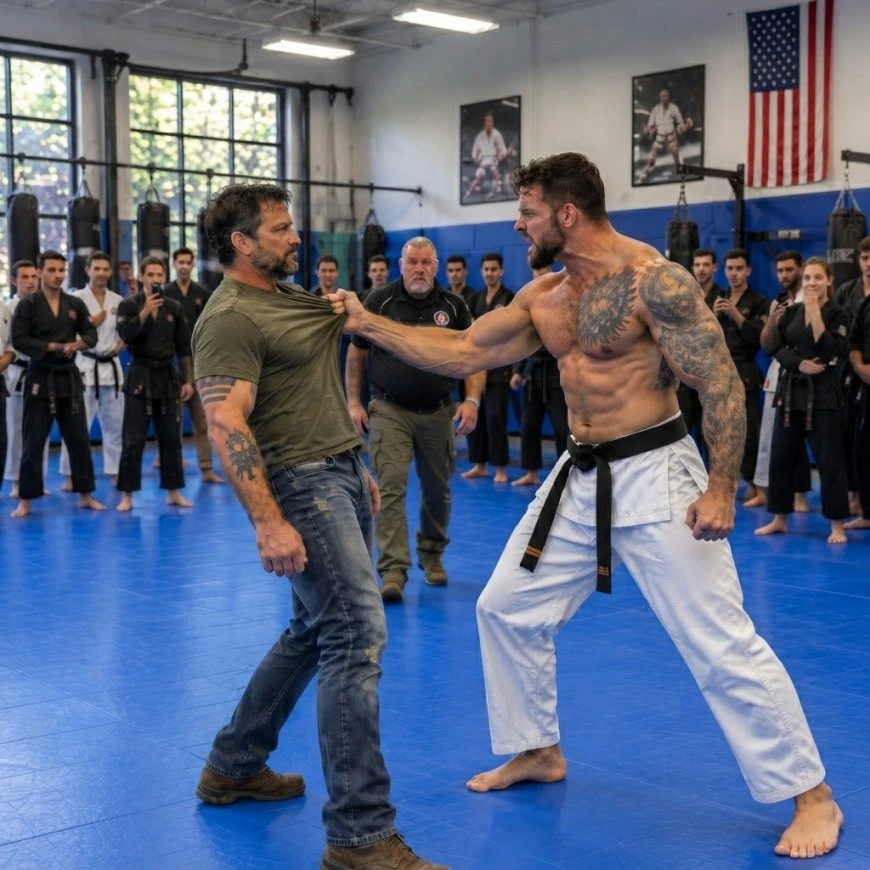
I did not raise my hands in victory. I didn’t pound my chest. I didn’t look at the cameras to gloat.
I calmly dropped to one knee beside Bryce’s unconscious body.
I pressed two fingers directly against his sweaty neck, locating his carotid artery. I watched his chest for the steady rise and fall of respiration. I gently peeled back his eyelid with my thumb to check his pupil dilation.
I ran the rapid medical assessment with the unhurried, emotionless efficiency of a man who had done it on battlefields covered in sand and blood.
His pulse was racing but strong. He was breathing. His pupils were sluggish but reacting. He would have a massive concussion, a bruised jaw, and a headache for a month, but he wasn’t dying.
I stood up and pointed a steady finger at the pale, trembling assistant instructor hovering near the edge of the mat.
“Roll him onto his side so he doesn’t choke on his own tongue,” I commanded, my voice cutting through the dead quiet room.
I pointed to a parent holding a phone. “Call an ambulance. Tell them it’s a concussive knockout, patient is stable and breathing.”
They both moved instantly, obeying the tone of absolute authority without a single second of hesitation.
A teenage boy near the edge of the mat—a kid who had trained under Bryce for over a year and idolized him—stared at me with wide, terrified eyes.
“Why…” the kid stammered, his voice shaking. “Why didn’t you keep hitting him when he was down? He kicked you when your back was turned.”
I looked at the boy. “Because the danger was finished.”
The teenager blinked, processing the profound weight of those words.
In five seconds, standing over his unconscious instructor, I had taught that kid more about true martial arts, honor, and restraint than Bryce Keller had taught him in an entire year of paid classes.
I turned and walked over to the front counter. I picked up the wrinkled liability waiver I had signed thirty minutes ago.
I folded it neatly in half, tore it down the middle, and dropped the torn pieces onto the floor.
Then, I turned to face the wall of parents. The people who had sat in their comfortable folding chairs, drinking their bottled waters, while my twelve-year-old son was thrown to the ground and mocked.
“The next time a child in this room is treated the way my son was treated tonight,” I said, my voice dangerously calm, carrying to the furthest corners of the gym. “The answer is not to sit in your chair with your phone out and wait for someone else to act. You are the adults.”
I didn’t yell. The quiet, suffocating shame that settled over the adults was infinitely heavier than any screaming match could have produced. Several of them looked down at their shoes. The Navy veteran nodded at me once, a gesture of deep, profound respect.
I walked over to Milo.
I picked up his gym bag, slung it over my uninjured shoulder, grabbed my work boots, and put my hand gently on the back of my son’s neck.
“Let’s go home, buddy,” I said softly.
We walked out the front glass doors into the humid, thick Florida night, and we didn’t look back.
The car ride home was quiet at first. The adrenaline was slowly leaching out of my system, leaving behind the familiar, deep ache in my ribs and a profound exhaustion in my bones. The streetlights flickered rhythmically across the dashboard of my old truck.
Milo sat in the passenger seat, staring out the window into the darkness.
“Dad?” he finally asked, his voice small.
“Yeah, Milo.”
“Were you… were you really in the Navy? Like, the secret Navy?”
I sighed, keeping my eyes on the road. “Yes. I was.”
“Why didn’t you ever tell me? Why do you work at the freight warehouse if you know how to do… that?”
I pulled the truck over to the side of the road, putting it in park under a glowing yellow streetlight. I turned to look at my son. His face was a mixture of awe, confusion, and lingering fear.
“Because,” I said slowly, choosing my words with the utmost care, “the things I learned how to do in the military are not things I want you to idolize. When your mother got sick, I promised her I wouldn’t bring that world into our house. I promised her I would raise you to be kind, to be gentle, and to solve problems with your words and your mind, not your fists. I work at the warehouse because it’s a quiet, honest living. And quiet is a very good thing, Milo.”
Milo looked down at his lap. “But being quiet didn’t stop Bryce. Being quiet just made him think we were weak.”
“He was wrong,” I said firmly. “And he knows he was wrong now. But remember what I told that kid in the gym? The fight ended the exact second the danger was over. Restraint is the hardest thing in the world to practice, Milo. Anyone can throw a punch. It takes a real man to know exactly when to stop.”
Milo nodded slowly, absorbing it. “I’m glad you’re my dad,” he whispered.
I reached over and ruffled his hair. “I’m glad I’m your dad, too. Now, let’s go get some ice for your shoulder. And my ribs.”
The fallout from the gym was catastrophic and immediate.
The ambulance cleared Bryce of any serious trauma, just as I predicted. But his physical recovery was the least of his problems.
Before midnight, the unedited footage of the entire encounter hit the internet.
But the internet did not care about the knockout punch. In a world full of street fights and MMA highlights, a clean knockout was common.





