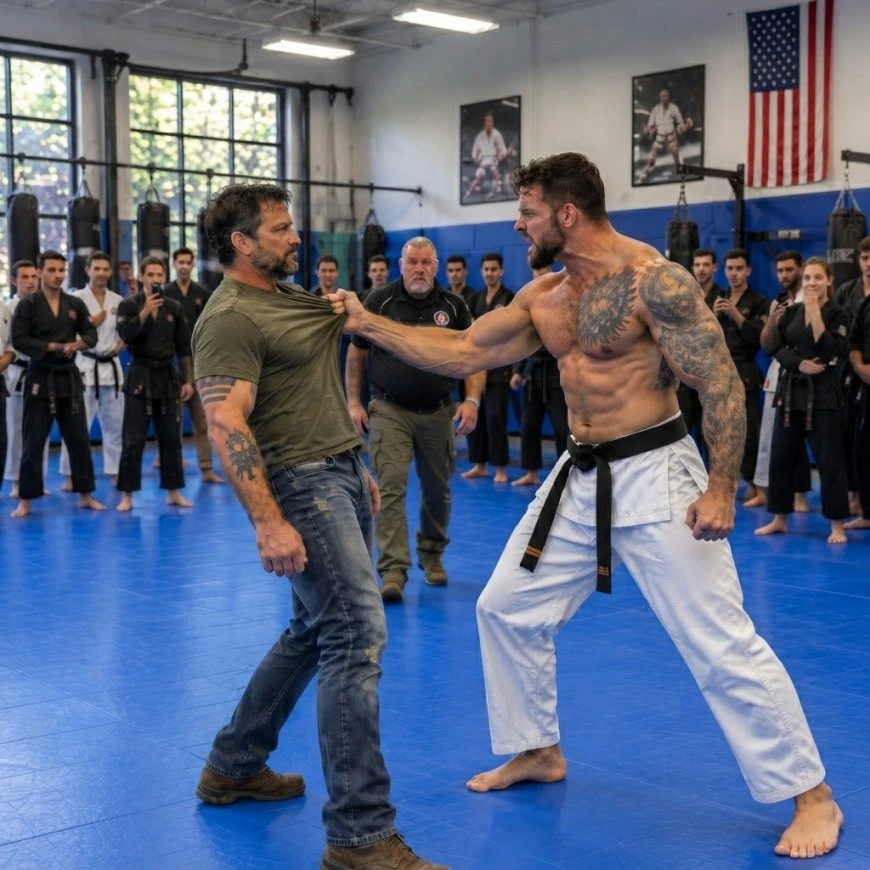
A man who refuses to throw back in a fight is either paralyzed by absolute fear, or he is waiting.
And looking at my eyes, the room could see I was visibly not afraid.
Frustration boiled over into Bryce’s eyes, burning away his discipline. He abandoned his calculated, rehearsed combinations and committed to a massive, knockout-oriented left hook. He put his entire body weight behind the glove, throwing it with a wild grunt of effort.
I didn’t dodge it.
I reached out and caught his wrist directly out of the air.
I didn’t deflect it away. I caught his swinging arm the exact way a father catches a set of keys tossed across a living room. Effortlessly. Firmly.
Bryce yanked his arm, trying to pull free. His shoulder jerked violently, but his wrist did not move a single millimeter.
The grip clamped around his arm belonged to a different category of human structural physics than he had ever encountered in his comfortable, padded life. The absolute immovability of my hand sent a shockwave of cold terror straight into his widened eyes.
I held him there.
I let him struggle. I let the entire room fully absorb his total helplessness.
Then, I spoke.
My voice wasn’t a yell. It wasn’t angry. It was clinical, flat, and echoed in the silent room like a doctor calmly reading out terminal lab results.
“Your right shoulder drops a full half-second before every significant strike,” I said, staring directly into his panicked, sweating face.
Bryce tried to twist his wrist. It was like trying to twist out of a steel vice.
“You hold your breath the exact moment you enter the pocket,” I continued. “Your eyes fixate on your target before you initiate, completely removing any element of deception.”
“Let go of me!” Bryce hissed, his face turning bright, furious red.
“And,” I said, my voice dropping a terrifying register, “you are fighting for the people watching. You are performing. Not fighting the man standing in front of you. That is a losing condition against anyone who actually knows what they are doing.”
I released his wrist and effortlessly shoved him backward.
Bryce stumbled back three steps, his bare feet slapping against the mat, his fragile ego fractured in front of his entire paying student base.
Desperate to regain control, desperate to save face for the cameras he assumed were still rolling, he yelled to the crowd that we were switching to grappling. His supposed domain. His absolute specialty.
He shot a double-leg takedown with genuine, terrifying speed.
Before his hands could even clasp behind my knees, my hips dropped backward in a flawless, heavy sprawl. The precision and crushing weight of the defense collapsed Bryce’s momentum entirely, driving his face directly into the mat with a wet smack.
Before he could scramble or adjust, I flowed over his back like water. I secured deep wrist control, effortlessly rolled his resisting body over, and seamlessly locked his arm into a severe, inescapable joint submission.
I held his limb exactly one quarter-inch away from catastrophic structural failure.
Bryce’s muscles corded and strained against the hold. The veins in his neck bulged. But he was completely, hopelessly trapped. He couldn’t tap, he couldn’t move his hips, and he couldn’t pull air into his lungs.
I leaned down, pressing my mouth mere inches from his sweating ear.
“What you have been telling these children,” I whispered softly, so only he could hear the absolute finality in my voice. “That strength gives a person the right to cause pain to someone smaller… is not martial arts.”
He grunted, trying to thrash. I tightened the angle by a fraction of a millimeter. He froze.
“It is not discipline,” I whispered. “It is child abuse disguised as a belt.”
Before the angle of his arm could snap his shoulder out of its socket, I let go.
I stood up, took two calm steps back, and reset my stance, my arms hanging loose at my sides.
For Bryce Keller, being willingly released in front of his students was infinitely worse than being choked unconscious. I had systematically dismantled him from the inside out. I had exposed every amateur flaw in his system, totally dominated him on his own mat, and then extended a humiliating mercy he had not earned.
Bryce snapped.
His mind broke. He scrambled to his feet, his face twisted in pure, unadulterated, blinding fury. He screamed that I was cheating. He screamed that I needed to put gloves on.
As I turned my head slightly toward the equipment shelf on the wall, Bryce abandoned all rules of combat, all pretense of sport, and launched a cowardly, full-power kick directly at the back of my skull.
I caught the blur of movement in my peripheral vision.
I instantly rotated.
The kick missed my skull but violently clipped my heavily scarred left shoulder, spinning me slightly off balance.
A collective, horrified gasp echoed through the gym. The heavy-set Navy veteran near the door shouted that it was over and they needed to call the cops.
Bryce ignored him. He pressed forward like a rabid animal, completely abandoning technique for sheer, blind destruction. He threw a flurry of wild punches, intentionally maneuvering me backward, pushing me directly toward the corner of the mat where my twelve-year-old son was still standing.
When I realized Bryce was intentionally steering the violence toward Milo, my priorities shifted instantly.
My footwork adjusted, squaring up to keep my body entirely between the black belt and my boy.
Bryce read the protective, fatherly shift. He saw the tiny opening it created in my stance. He stepped in with a cruel smirk and drove a brutal, flying knee directly into the site of my old, well-documented ligament injury on my left ribcage.
The impact sounded like a car door slamming shut on a winter morning.
The breath left my lungs in a violent, uncontrollable rush. Pain flared through my side like a lit match hitting gasoline. I dropped heavily to one knee, clutching my ribcage, my teeth gritted against the agonizing spike of familiar pain.





